
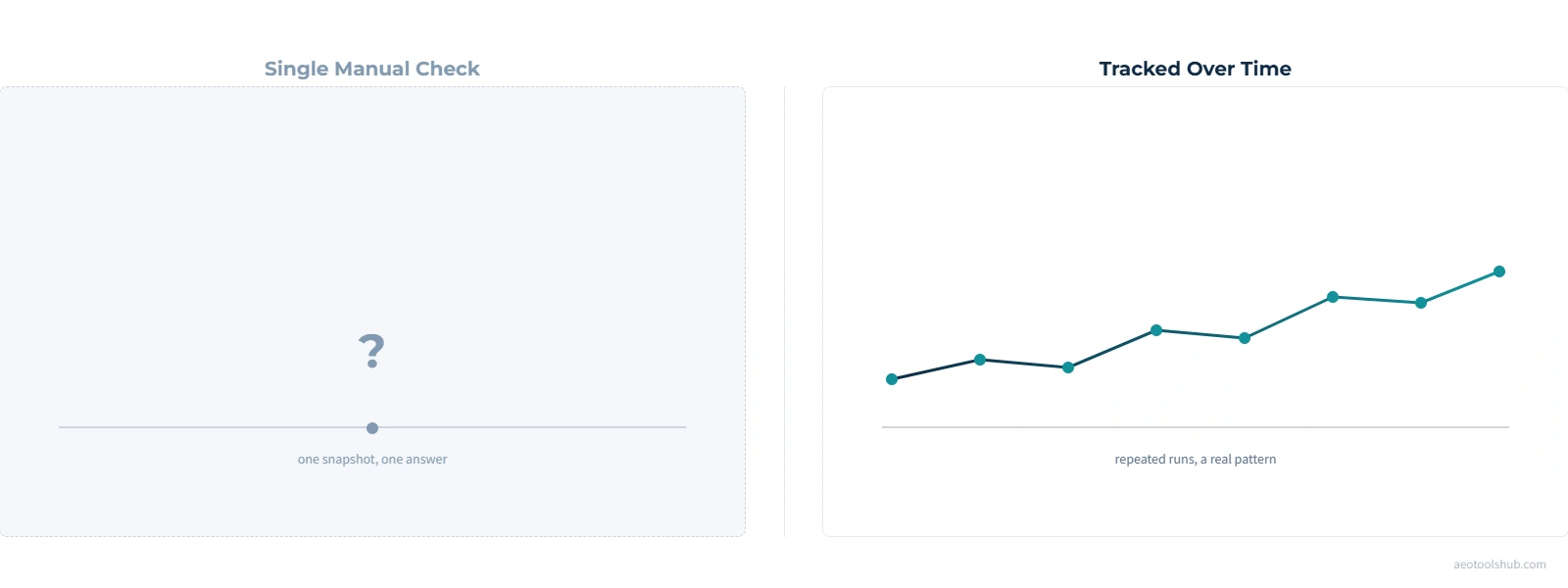
Most brands measuring AI visibility for the first time make the same move: they open ChatGPT, type their own brand name, and see what comes back. That tells you almost nothing. A single prompt run once is a snapshot of one probabilistic answer, not a measurement. Real AI visibility tracking means running a defined set of prompts, repeatedly, across the platforms your customers use, and watching how the pattern moves over time.
It is a new enough space that a lot of clients, and plenty of marketers generally, do not even know tools for this exist yet. Running the same prompts by hand across ChatGPT, Perplexity, and Google AI Overviews, every day, is not something anyone does manually. A tracking tool becomes the default entry point almost immediately, and for good reason: it is the only realistic way to see a pattern instead of one lucky, or unlucky, answer.
How AI visibility tracking works
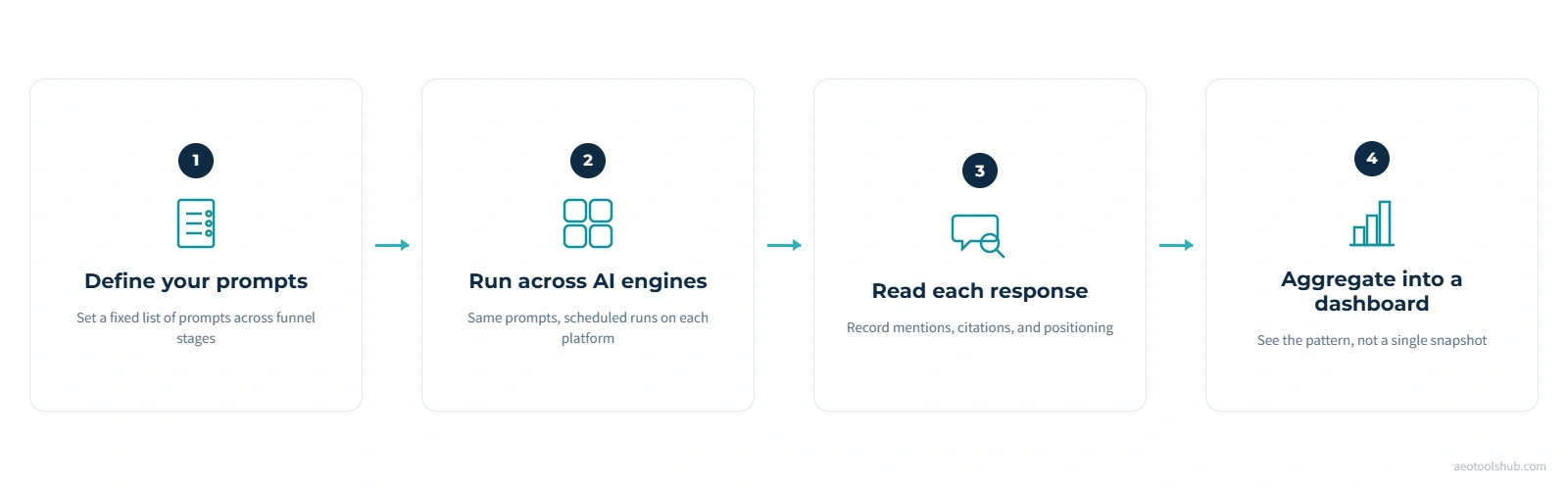
Every AI visibility platform, including Peec.ai, which I use daily for client work, and the others covered in our roundup of AI visibility tracking tools, runs on the same basic mechanism. You define a set of prompts relevant to your category. The tool runs them, on a schedule, across whichever AI engines you are tracking: ChatGPT, Perplexity, Google AI Overviews, Gemini, and so on. It then reads each response and records whether your brand was mentioned, where you were cited from, and how you were positioned relative to competitors.
That citation trail is worth pausing on. Most AI engines answer through retrieval-augmented generation (RAG): they pull in real web content before generating a response, then cite what they used. A citation showing up in your dashboard is really a signal about which third-party source, a Reddit thread, a review site, a piece of PR coverage, the engine trusted enough to read and use while answering about your category. Visibility tracking tells you where you stand. Reading that source list is what tells you what to fix, and that is the tactical side covered in How to Get Your Brand Cited by AI Search Engines.
The mechanics differ from traditional rank tracking in one important way: there is no fixed results page to check. Each AI engine decides what to say based on real-time retrieval and probabilistic generation, so the same prompt run twice can return a different answer. That is not a bug in the tool. It is the nature of the systems being measured, and it is exactly why a single manual check is worthless and a repeated, tracked prompt set is the only thing that tells you something reliable.
The three metrics you will see everywhere
Open any AI visibility dashboard and you will run into the same three numbers: visibility score, share of voice, and citation rate. Clients tend to treat them as interchangeable. They are not, and mixing them up is how you end up reporting a trend that is not real. I have written a full breakdown of what each one measures and when to trust it in AI Visibility Metrics Explained. The short version: visibility score is the one I lean on as the primary number, because it does not depend on which competitors you happened to pick. Share of voice is useful context, not a standalone verdict.
Citation rate answers a different question again: how often your own domain, not just your brand name, gets pulled in and cited as the source. A high visibility score with a low citation rate on your own site usually means the AI knows who you are but is reading about you somewhere else: a review site, a forum thread, a competitor’s comparison page, rather than your own content. That gap matters more than it looks. Your own site is the one thing you fully control. Third-party mentions, especially UGC like Reddit threads or forum posts, you can influence at best, and in a lot of cases cannot control at all. A brand that earns citations on its own domain is writing its own narrative. A brand that only shows up through other people’s pages is borrowing one, and has to hope whoever wrote it got the story right.
Organise your prompts by funnel stage
Most brands split their prompt set into branded and non-branded and stop there. That is a start, but it misses a layer that matters just as much: where in the buying journey each prompt sits. The classic awareness-consideration-decision model, the structure HubSpot’s own marketing funnel framework is built around, is a good starting point. Extended marketing-funnel models go further, adding purchase and post-purchase stages, and that extension matters a lot for AI visibility specifically. Mapping your prompts to all five gives a far more honest picture of where you show up, and where you do not.
Take a skincare brand selling a vitamin C serum, a good stand-in for the kind of product-led brand we work with:
- Awareness – “why does my skin look dull”, “skincare routine for oily skin”
- Consideration – “best vitamin C serum for oily skin”, “[Brand A] vs [Brand B] serum”
- Decision – “is [Brand]’s vitamin C serum worth it”, review-style prompts
- Purchase – “where to buy [Brand] serum”, “does [Brand] ship to [country]”
- Post-purchase – “how to use [Brand] serum correctly”, “[Brand] serum alternatives if it is not working for me”
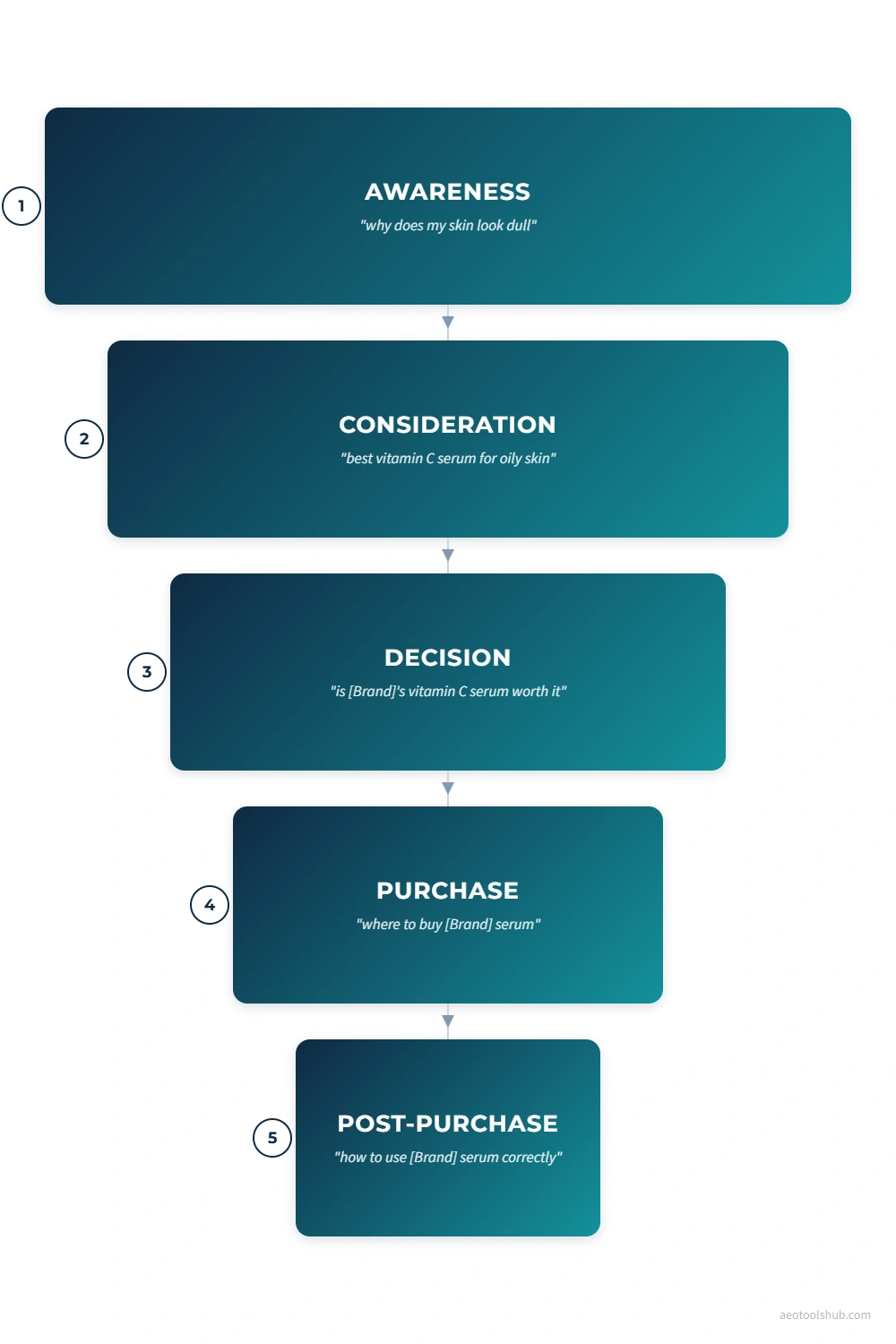
Brands that only track Awareness and Consideration prompts are, in effect, ignoring the two stages closest to revenue. If you show up well when someone is browsing but disappear the moment the question turns transactional, such as where do I actually buy this, that is a real, fixable gap. But you will never see it if Purchase-stage prompts are not in your set to begin with.
How often to look at the data
Checking daily is tempting and mostly unproductive. AI answers move around from one run to the next simply because the underlying models are probabilistic, not because your visibility genuinely changed overnight. I cover the full process for setting a baseline you can trust in How to Set Up an AI Visibility Baseline. The short version: give it real time before drawing conclusions, and resist the urge to change your prompt set every time a number moves.
Reading the data without kidding yourself
It is tempting to report the metric that looks best in a given month. Resist it. If your visibility score has actually dropped but your share of voice climbed because a competitor pulled back, say both things. The second does not cancel out the first, it explains it. Clients trust dashboards less than they trust someone willing to tell them when a number moved for a reason that has nothing to do with their content getting better.
Common mistakes I see
Competitor sets that do not reflect reality. Leave your strongest real competitor out of the tracked list, or fill it with names that barely show up in AI answers, and your share of voice looks stronger than it is, purely because the denominator is soft. I have seen this play out on real projects: a client’s competitor set was missing the one rival genuinely fighting for the same AI answers, and the reported share of voice stayed comfortably high every week while overall visibility stayed flat or low. Add that competitor back in and the number drops overnight. Nothing about the brand’s actual standing changed. Only the list did.
Leaning on a single AI engine. ChatGPT, Perplexity, and Google AI Overviews each retrieve and cite differently. Strong visibility on one does not transfer to the others.
Over-indexing on branded prompts. More on this in the baseline guide, but the short version: near-guaranteed visibility on branded prompts flatters your overall numbers and hides where you are losing ground.
Frequently asked questions
How is AI visibility different from tracking Google rankings?
Google rankings measure position on a page that, however personalised, still resolves to a fairly stable results list for a given query. AI visibility measures whether and how you are mentioned inside a generated, non-deterministic answer. There is no fixed position to check, and the same prompt can produce a different answer on a different run.
Do I need a paid tool, or can I track this manually?
You can spot-check manually, but you cannot track it manually in any way that produces a trend you can trust. A single manual prompt is one sample from a probabilistic system. You need repeated, scheduled runs across multiple engines to see a real pattern, which is exactly what tracking tools automate.
How many prompts do I need to track?
Enough to cover your funnel stages and both branded and non-branded intent without becoming unmanageable. See How to Set Up an AI Visibility Baseline for the specifics on prompt selection.
Where to start
If you are setting this up for the first time, do not start by picking a tool. Start by mapping eight to ten prompts for each of the five funnel stages above, forty to fifty in total, in your customers’ own words, not yours. Everything downstream, including which tool you pick, which metrics you trust, and how you read the baseline, is only as good as that starting set. Get the prompts right first. I will walk through exactly how to build and run that baseline, prompt by prompt, in the next guide in this series.