
How to Get Your Brand Cited by AI Search Engines
The signals that make AI engines choose one source over another, and how to send them consistently. A practical guide for brands and marketers.
Jul 5, 2026 · ~10 min readEvery day, AI search engines answer thousands of questions related to your brand, your category, and your competitors. For each one, the engine makes a citation decision: which sources to include, which brands to name, which expertise to draw on. Most brands have no strategy for influencing those decisions.
This guide explains how AI citation decisions are made, what signals move the needle, and the specific actions you can take to increase the probability your brand appears in AI-generated answers. Not by gaming AI, but by making your content genuinely more accessible, more credible, and more useful to the systems doing the selecting, in that order. We’re putting them in that order deliberately, and the structure of this guide follows it: technical accessibility first, then content, then authority. Most AEO content puts content first. We think that’s backwards, and we’ll explain why.
How AI engines decide what to cite
Before diving into tactics, it helps to understand the mechanism. AI citation isn’t random, it reflects a structured, if not fully transparent, selection process with two main stages.
The retrieval step: finding candidate sources
When a user submits a query, the AI engine searches its index for candidate sources. This retrieval step is governed by signals familiar from traditional SEO: relevance to the query, domain authority, recency, technical crawlability. A page blocked by robots.txt, with low domain authority, or lacking relevance signals for the query won’t make it into the candidate pool, and therefore cannot be cited, no matter how good its content is.
The generation step: selecting what to include
From the retrieved candidates, the generative model selects which content to draw from when constructing its answer. This selection favours sources that are clearly structured, directly relevant to the query, and credible. Vague, padded, or hard-to-parse content tends to be filtered out here even if it passes retrieval.
The signals that influence both steps
The most important signals operate across both stages, and we’ve listed technical accessibility first because it’s a precondition for the other four, not because we’re being pedantic about ordering. A page can score well on every other signal and still be invisible if a crawler can’t reach it.
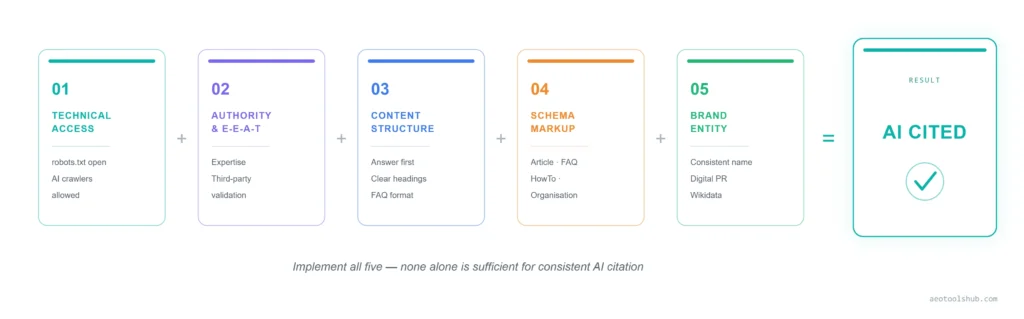
- Technical accessibility: can AI crawlers reach, render, and parse the page at all? This is the gate everything else passes through.
- Content clarity and structure: does the page answer the question directly and legibly?
- Domain and page authority: is the source credible in its category?
- Brand entity strength: is the brand well-represented and consistently described across independent sources?
- Recency: is the content current?
Optimise technically for AI crawlers
Check your robots.txt isn’t blocking AI bots
This is the most commonly overlooked barrier to AI citation, and in our experience the single highest-leverage fix available to most sites, because it’s a binary problem with a binary fix. Many sites, particularly those that implemented aggressive bot-blocking following the rise of AI scraping concerns, have inadvertently blocked the crawlers used for search and citation specifically. The ones to check:
- OAI-SearchBot (ChatGPT Search citations, distinct from GPTBot which is training-only)
- PerplexityBot (Perplexity)
- Claude-SearchBot (Anthropic’s Claude search feature, distinct from ClaudeBot which is training-only)
Google AI Overviews, AI Mode and Gemini don’t need a separate crawler directive beyond standard Googlebot access, per Google’s own Search Central documentation. Check your robots.txt now. If any of the three above are disallowed, you’re invisible to that platform regardless of how good your content is.
Schema markup: the types that matter for AI
Structured data helps AI engines classify and extract your content accurately. The highest-priority schema types for AEO and GEO:
- Article: signals content type, author, date published/modified
- FAQPage: explicitly marks up question-answer pairs for direct extraction (note: this no longer produces a visual rich result in Google Search as of May 2026, but engines still parse it for structure)
- HowTo: for step-by-step instructional content
- Organization: establishes your brand entity with name, URL, logo, social profiles
- BreadcrumbList: helps engines understand site structure
Schema doesn’t guarantee citation, but it reduces friction in the extraction process and increases the accuracy with which your content is represented.
Page speed and crawlability basics
Slow pages, broken internal links, and poor crawl depth all reduce the probability of your content being fully indexed by AI crawlers. A technical SEO audit, covering Core Web Vitals, crawl errors, internal linking, and sitemap accuracy, remains a useful input to your AEO/GEO programme. If crawlers can’t efficiently reach and parse your content, citation probability drops regardless of content quality.
Build content AI can find and understand
Answer the question directly in the first 200 words
AI engines disproportionately weight the opening section of a page. If your first paragraph doesn’t address the target query directly, the model may pass your page over in favour of one that does, even if your content overall is more comprehensive. The discipline here is to put the answer first, then the context, not the other way around.
This is a real departure from traditional content writing, which often builds toward the answer through introductory context. For AI optimisation, a clear, citable answer in the opening paragraph is one of the highest-impact content changes you can make, second only to the technical fixes above.
Use clear headings that mirror how people phrase questions
Headings are strong signals for AI extraction. When a heading reads like the question the user asked, the model can easily match the heading to the query and extract the content beneath it. Generic headings like “Overview” or “Introduction” provide no such signal. Review your H2s and H3s on high-value pages. If they don’t read like answers to real questions, rewrite them.
Structure for extraction: paragraphs, lists, and tables
AI models extract information more reliably from structured formats. Short, focused paragraphs, bulleted or numbered lists for multi-part answers, and comparison tables for evaluative content all improve the probability of your content being parsed correctly and cited accurately. Dense, unbroken prose is harder to extract from and is at higher risk of being misrepresented or skipped.
Cover the question fully, not partially
AI engines prefer sources that address a query comprehensively rather than partially. A page answering the top-level question but missing the natural follow-on questions leaves gaps a competing source fills. FAQ sections are effective here: they explicitly cover the question variants users ask and that AI engines retrieve, independent of whether Google still shows a rich result for them.
Build the authority AI engines recognise
E-E-A-T signals in the AI era
Google’s E-E-A-T framework, Experience, Expertise, Authoritativeness, Trustworthiness, was developed for evaluating web content quality, but the principles extend to how AI engines evaluate sources for citation. A page written by a credentialled author, on a domain that demonstrates expertise in its category, with clear sourcing and accurate information, is a stronger citation candidate than anonymous content on a low-authority site.
Practically: add author bios with verifiable credentials, link to primary sources, keep information accurate and current, and make sure your “About” and contact information is clear and complete.
Third-party mentions and digital PR
AI engines build their understanding of brands partly from what third parties say about them. A brand mentioned in industry publications, cited in relevant studies, or covered in the press has a richer, more credible entity profile than one whose web presence exists only on its own domain.
Digital PR, securing coverage in publications AI engines recognise as authoritative, is one of the most reliable ways to build AI visibility over time. It’s slow but compounding: each additional credible mention strengthens the brand’s position in AI retrieval.
Consistent brand entity across the web
AI engines parse brand information from many sources simultaneously. Inconsistencies, different descriptions of what your company does, different categorisations, conflicting founding dates, create noise that weakens your entity profile. Audit the key sources: your website’s structured data, your Google Business Profile, your LinkedIn company page, and major review platforms. Bring them into alignment.
Platform-specific citation tactics
Each platform’s citation behaviour differs enough to change your priorities in practice, on top of the underlying retrieval mechanics covered in full in How the major AI search platforms work. In brief:
- ChatGPT Search leans on Bing’s index, so brands with strong Bing SEO signals (authority backlinks, clean technical setup, strong on-page relevance) have an edge. It cites sources explicitly and favours pages that answer directly and cite their own sources well.
- Perplexity cites a shorter source list per answer than Google AI Overviews does, which raises the value of each citation you do get, so fresh, clearly-sourced, regularly updated content matters more here than sheer volume.
- Google AI Overviews draws on Google’s own index. Strong rankings correlate with inclusion but don’t guarantee it, per Google’s own documentation there’s no special technical bar beyond standard Search eligibility, the differentiator is how directly your content answers the query.
How to track whether it’s working
Measuring AI citation visibility requires dedicated tools, it isn’t measurable via Google Search Console or standard rank trackers, which only track traditional search performance. AI visibility platforms track citation frequency, share of voice in AI responses, and query coverage across the major AI engines.
Establish a baseline before you start making changes, so you can attribute improvements to specific actions rather than guessing at what worked.
Frequently asked questions
How long does it take to start getting cited by AI?
This depends heavily on your starting point, so treat any specific number with caution. What we can say directly: technical fixes, unblocking a crawler, fixing a rendering issue, tend to show up in visibility checks within days to a few weeks, since there’s no content production cycle involved. Authority-building work (digital PR, entity strengthening) takes meaningfully longer and compounds over months rather than weeks.
Do I need a Wikipedia page to get cited?
No, but it helps. AI engines weight Wikipedia as a high-authority source, and brands with Wikipedia entries tend to have stronger entity profiles. That said, most brands regularly cited by AI don’t have one, and Wikipedia’s notability bar is genuinely hard to clear for small and medium brands. More realistic alternatives: a well-maintained Wikidata entry (a much lower bar, and some AI systems read it directly), listings in credible industry directories and databases, consistent coverage through PR and trade press, and a strong presence on the review platforms that matter in your category. Consistent, credible representation across several of these sources does more for citation likelihood than chasing Wikipedia notability alone.
Does ranking well on Google help with AI citations?
Yes, particularly for Google AI Overviews, which draw on the same index. For ChatGPT Search (Bing-based) and Perplexity (its own index), Google rankings matter less directly, but the same underlying signals, content quality, authority, technical health, tend to produce strong results across all of them. SEO and AEO/GEO aren’t in competition. They’re complementary.
Can a small brand with limited content get cited?
Yes, particularly for specific, niche queries where the brand is a genuine expert and there are few competing authoritative sources. Small brands with focused, well-structured content in a defined niche can achieve strong AI citation rates for their core queries, even without the broad authority of large incumbents.
What is the single most important thing to fix first?
Check your robots.txt. If you’re blocking the relevant AI crawlers, no other optimisation matters, those engines cannot see you. Once access is confirmed, the next priority is restructuring your top 5 to 10 pages to answer their target queries directly in the opening paragraph. These two steps, in that order, are the highest-impact starting point for most brands.
Where to go next
The goal this week: establish your baseline visibility in ChatGPT, Perplexity, and Google AI Overviews for your three most important queries. Then check your robots.txt. Then restructure your highest-traffic informational page to answer the primary question directly in the opening paragraph.
Access, then structure, then authority. That order isn’t arbitrary, it’s the order the retrieval and generation process actually rewards.