
My guide to getting cited by AI search engines covers E-E-A-T as one signal among five, in enough detail to explain why it matters and not enough to actually implement it. That’s deliberate, a pillar page that resolved every subtopic in full wouldn’t leave anything for a guide like this to do. So here’s the resolved version: what E-E-A-T is when an AI engine reads it rather than a human quality rater, the schema layer that makes author credibility machine-readable, and a real before-and-after so you can see the difference instead of just being told it exists.
What E-E-A-T actually is, and who’s checking
E-E-A-T, Experience, Expertise, Authoritativeness, Trustworthiness, comes from the Search Quality Rater Guidelines Google gives to the human raters who manually assess whether search results are genuinely helpful; the Experience component was added in December 2022, extending the original E-A-T framework that dates back to 2014. It was never a ranking algorithm you can reverse-engineer line by line, it’s a framework raters use to judge quality, and Google’s own guidance on creating helpful, reliable, people-first content draws on the same standard: it’s explicit that the goal is people-first content written by someone with real, demonstrable involvement in the topic.
AI engines didn’t invent a separate version of this. They lean on the same underlying signal for a related but distinct reason: when a model is deciding which source to trust enough to cite, “who wrote this, and are they credible” is one of the cheapest, most reliable proxies for content quality it has available. A page with a named, verifiable author who’s demonstrably done the thing they’re writing about beats an anonymous page making the same claims, all else equal. That’s the whole mechanism. What follows is how to make it legible to a machine rather than just true in principle.
The schema layer the pillar doesn’t cover
Here’s the gap. Writing a good, credentialed author bio is necessary but not sufficient, because prose bios are exactly the kind of unstructured content an AI system has to infer meaning from rather than read directly. Person schema closes that gap. It’s the schema.org type built specifically to describe a human in machine-readable terms, and the properties that matter most for E-E-A-T specifically are jobTitle, worksFor, alumniOf, sameAs, and one that almost nobody implements: hasCredential.
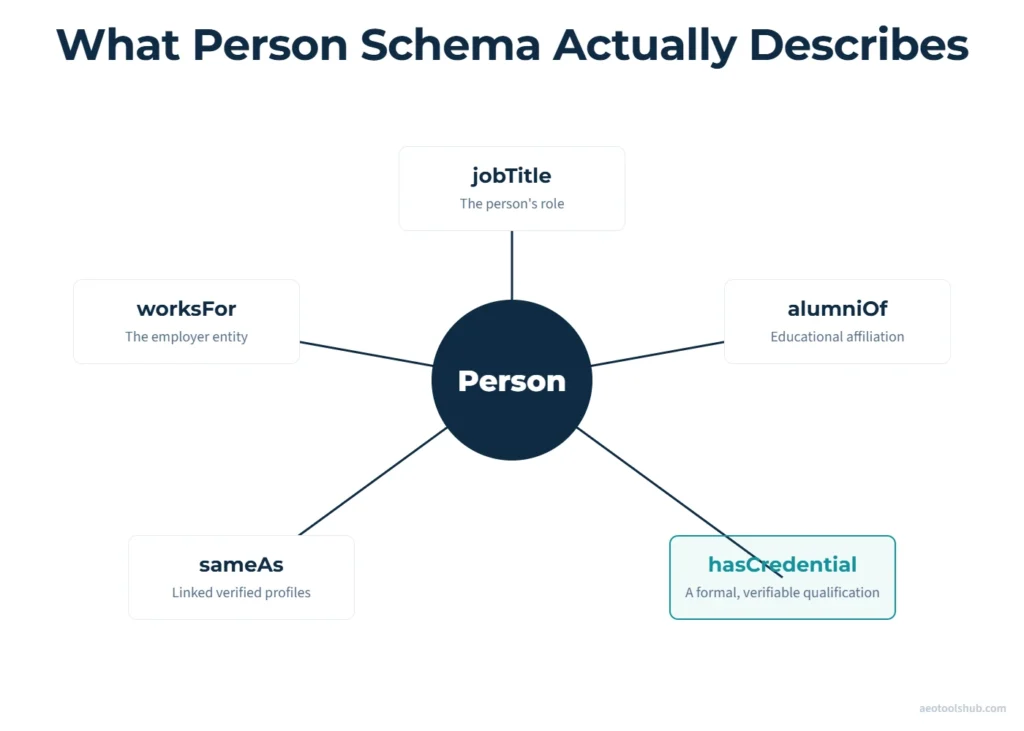
hasCredential links a person to a formal, verifiable qualification, a degree, a professional certification, an accreditation, using the EducationalOccupationalCredential type. It’s been part of schema.org’s Person type since 2020, but schema.org itself still lists it in the newer, less-established tier of its vocabulary, and in practice almost no sites implement it. That gap between availability and actual adoption is exactly why it’s worth being an early mover on. A bare-bones useful implementation looks like this:
{
  "@context": "https://schema.org",
  "@type": "Person",
  "name": "Author Name",
  "jobTitle": "Formulation Chemist",
  "worksFor": {
    "@type": "Organization",
    "name": "Brand Name"
  },
  "hasCredential": {
    "@type": "EducationalOccupationalCredential",
    "credentialCategory": "degree",
    "name": "MSc Cosmetic Science"
  },
  "sameAs": [
    "https://www.linkedin.com/in/authorname",
    "https://orcid.org/0000-0000-0000-0000"
  ]
}
Attach this to your author bio page, and reference it from every article the author’s byline appears on. sameAs is doing double duty here, it’s the same consistency mechanism that matters for brand entities generally: every linked profile is a second, independent confirmation that this person is who the page says they are.
My JSON-LD Schema Generator can produce Person markup like the example above without you writing it by hand, and my Schema Markup Validator will confirm it’s valid before it goes live.
Worked example: the difference schema and specificity make
Take a skincare brand publishing under a formulation chemist’s byline, since it’s the vertical I default to for these examples. Here’s a fairly typical author bio, the kind that shows up on most brand blogs:
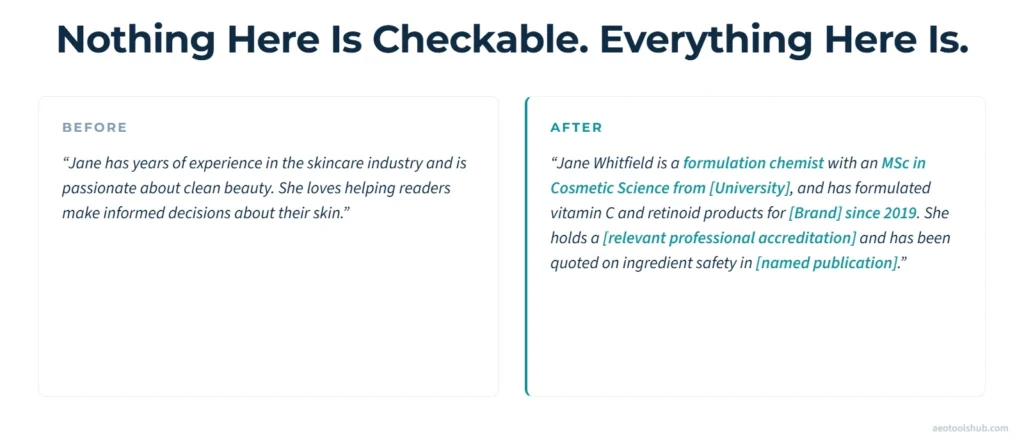
“Jane has years of experience in the skincare industry and is passionate about clean beauty. She loves helping readers make informed decisions about their skin.”
Nothing here is checkable. “Years of experience” is unquantified, “the skincare industry” isn’t a role, and there’s no credential, no employer link, no way for a reader or a model to verify a single claim in it.
Here’s the same person, described with the specificity E-E-A-T actually rewards:
“Jane Whitfield is a formulation chemist with an MSc in Cosmetic Science from [University], and has formulated vitamin C and retinoid products for [Brand] since 2019. She holds a [relevant professional accreditation] and has been quoted on ingredient safety in [named publication].”
Every claim in the second version is a fact someone could check: a degree, an employer, an accreditation body, a publication. That’s the difference between a bio that reads well and one that actually functions as an E-E-A-T signal, and it’s the same distinction the Person schema above is built to encode.
What actually counts as a credential, and the honest warning
Don’t invent this. A credential that doesn’t hold up to a two-minute check (a degree from an institution that doesn’t exist, a “certification” from a body nobody’s heard of, a job title nobody at the company can confirm) does more damage than having no credential at all. AI engines cross-reference brand and author claims against independent sources exactly the way they cross-reference brand facts generally. An unverifiable claim doesn’t just fail to help, it becomes a consistency problem the next time something about your brand gets checked.
The credentials that genuinely move the needle are the boring, real ones: a relevant degree, a recognised professional body membership, verifiable years in a specific role, a named employer that’s checkable. If your team genuinely doesn’t have formal credentials in the subject matter, the honest move is leaning harder on the “Experience” half of E-E-A-T instead, documented, specific, first-hand experience with the product or category, rather than manufacturing an “Expertise” claim that won’t survive scrutiny.
Third-party validation still does more than your own bio
Your own site is the one channel you fully control, and it’s also the one an AI engine trusts the least by default, since anyone can write anything about themselves. This is where digital PR earns its place in an E-E-A-T strategy rather than sitting in a separate bucket: a quote from your formulation chemist in a trade publication, a credentialled author cited by an outlet you don’t control, does more for authoritativeness than the same claim published only on your own blog. My guide to digital PR for AI visibility covers the mechanics of earning that kind of coverage in more depth than belongs here.
Self-audit checklist
Run this against your site’s highest-traffic informational pages, not the whole site at once:
- 1Does every article have a named, real author, not “Admin” or the brand name as the byline?
- 2Does that author have a bio page, and does the bio contain specific, checkable claims rather than vague enthusiasm?
- 3Is Person schema implemented on the bio page, with
jobTitle,worksFor, andhasCredentialwhere a real credential exists? - 4Do
sameAslinks actually resolve to real, active, verifiable profiles, not dead links or generic company pages? - 5Has this author, or the brand, been referenced by at least one source you don’t control, in the last twelve months?
A page that scores well on all five is doing genuine E-E-A-T work. A page that scores well on none of them is invisible to this signal entirely, regardless of how good the actual content is.
Frequently asked questions
Does adding Person schema guarantee better AI citation rates?
No single signal guarantees anything in this space. Schema makes an existing, genuine credibility signal legible to a machine, it doesn’t create credibility that wasn’t there.
What if my content is written by a team, not a named individual?
Attribute it to a real person where you can, even for team-written pieces, a named editor or lead author is a stronger signal than “Editorial Team.” Where genuinely collaborative, Organization-level schema and a clear editorial-standards page are the fallback, though weaker than a credentialled individual byline.
Is hasCredential worth the effort given how few sites use it?
That’s precisely the argument for doing it now rather than waiting. Early, correct adoption of an under-used but genuine schema property is a low-cost, low-competition move, unlike fighting for space on schema types everyone’s already implemented.
How is this different from the E-E-A-T section already in the AEO pillar?
The pillar explains why E-E-A-T matters and what the four letters stand for. This guide is the implementation layer underneath that: the actual schema, a real before-and-after, and where the line sits between a genuine credential and one that’ll get flagged.
Where to start
Pick your three most-read articles, check whether each byline survives the five-point audit above, and fix the weakest one first. The schema and the bio rewrite together are usually a half-day of work per author, small relative to most other items on an AEO checklist, and one of the few that compounds across every piece that author’s name touches going forward.