
How Google AI Overviews Work
Google says there’s nothing special you need to do to appear in AI Overviews. The data on how citations actually get chosen tells a more complicated story.
Jul 15, 2026 · ~8 min readRanking #1 doesn’t guarantee a citation, and Google says so itself
Google’s own developer documentation is unusually direct about this: “there are no additional requirements to appear in AI Overviews or AI Mode, nor other special optimisations necessary.”1 The advice is to keep doing standard SEO fundamentals: crawlable pages, indexable content, a genuine attempt at being helpful. No special schema, no AI-specific markup, nothing you need to bolt on.
What Google doesn’t say is how the selection actually happens once a page clears that bar, and third-party data fills in some of the gap. A Surfer SEO analysis of 10,000 keywords, covered by Search Engine Land, found that around 68% of pages cited in AI Overviews weren’t ranking in Google’s own top 10 for the query, or for any of the related sub-queries Google generates behind the scenes.2 Among the most prominent citations, the ones shown first, that figure drops to 46%, but it’s still nowhere near the overlap you’d expect if AI Overviews simply promoted the existing top 10. Being indexed and eligible for a normal search snippet is the baseline requirement. It isn’t the same thing as ranking well.
The fan-out mechanism, and why it matters more than your main keyword
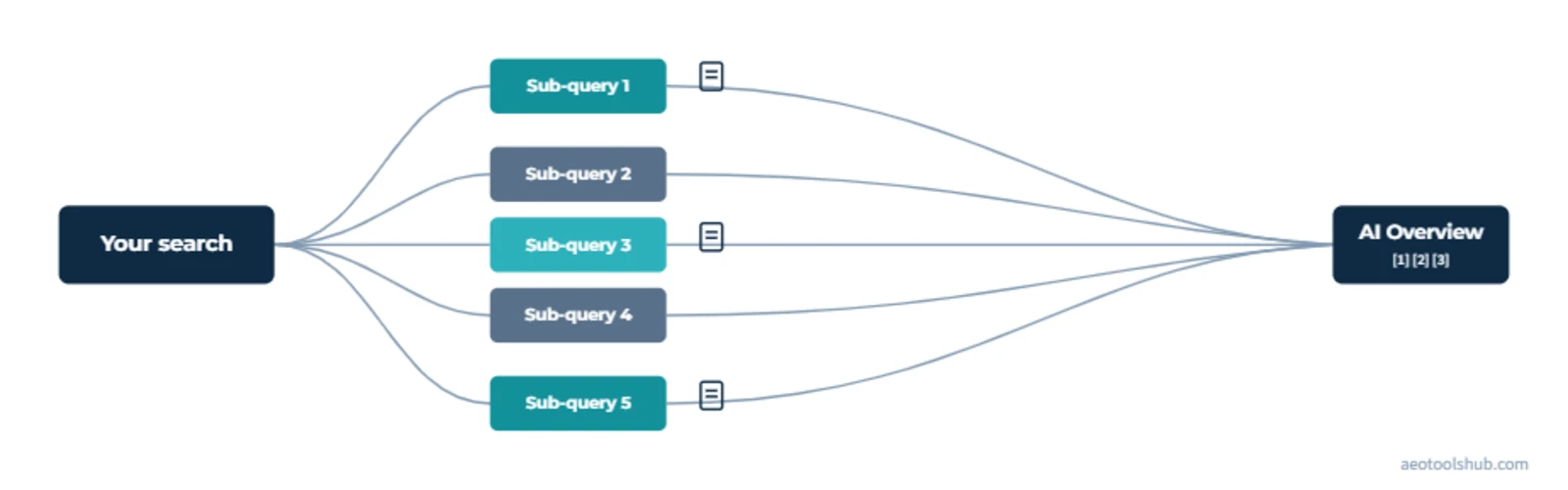
Both AI Overviews and AI Mode use a technique Google calls query fan-out: rather than answering the single query you typed, the system issues multiple related searches across subtopics before assembling a response, which is also how it manages to surface a wider and more varied set of links than a standard results page.1 A search for one product might quietly trigger separate lookups on pricing, alternatives, and common complaints, each pulling in its own set of candidate pages.
Surfer SEO’s study measured this directly: pages ranking for at least one fan-out query, not just the main term, were 161% more likely to be cited, with a strong correlation (Spearman 0.77) between the number of fan-out queries a page ranked for and its odds of being cited.2 Pages that ranked for both the main query and at least one fan-out accounted for 51% of citations in the study, against roughly 20% for pages that only ranked for the head term. The catch, and it’s a real one, is that fan-out queries vary by user and context. Only about 27% stayed consistent across repeated runs of the same search in Surfer’s data, so this isn’t a keyword list you can chase directly. The more reliable takeaway is to build genuinely broad coverage of a topic rather than a single page aimed at one query.
Google increasingly cites Google
One trend worth knowing about before reading too much into any citation study: Google’s AI Mode is citing Google’s own properties more than any other domain. SE Ranking’s analysis of over 1.3 million citations found Google.com was the single most-cited source at 17.42%, more than the next six domains (YouTube, Facebook, Reddit, Amazon, Indeed, and Zillow) combined, up from just 5.7% in June 2025.3

Including YouTube, Google-controlled properties now make up roughly a fifth of all AI Mode citations.
This isn’t evenly spread. Travel queries cited Google itself in 53% of cases, entertainment in 49%, real estate in 31%, largely through Google Search result panels, Google Business Profiles, Flights, and Maps. Careers and jobs queries were the exception, where Indeed outranked Google as a source by a wide margin. If you’re competing in a category where Google leans hard on its own properties, that’s a structural ceiling worth planning around rather than a content problem you can fix.
What actually predicts inclusion
Strip away the mechanics and Google’s own guidance still holds up as the honest starting point: the same helpful, well-structured, genuinely useful content that earns a normal ranking is what AI Overviews draws from, judged against the same fundamentals, not a separate set of rules.1 On top of that baseline, the fan-out data points to a concrete lever: covering a topic broadly enough that a page, or a cluster of pages, shows up for the obvious follow-up questions, not just the headline query.
This lines up with the tech-first argument that runs through most of our guides here. None of the above matters if a page isn’t indexed and snippet-eligible to begin with, which is Google’s own stated floor for inclusion.
What doesn’t work
Chasing individual fan-out queries as if they were a fixed keyword list is a waste of effort. Google’s own data shows they shift with context and personalisation, and only around a quarter stay stable across repeat searches. Adding AI-specific schema markup in the hope of an edge doesn’t do anything either; Google’s documentation states plainly that no special schema.org markup is needed for AI features.
Assuming that self-citation shuts you out of a whole category is also too pessimistic. Google still leaves room for outside sources even in travel or real estate, just proportionally less of it, which makes the content that does get through more valuable, not less. And once your content is live, Google Search Console’s AI performance reporting, added in mid-2026, is the most direct way to check how it’s actually performing here instead of relying on quarterly third-party studies.
FAQ
Do I need special schema markup to appear in AI Overviews?
No. Google’s own documentation states there’s no special schema.org markup or AI-specific file needed. Standard structured data that matches your visible content is enough.
Does my page need to rank in the top 10 to be cited?
Not necessarily. A Surfer SEO study found that around 68% of AI Overview citations came from pages that weren’t in Google’s top 10 for the main query or any related fan-out query, though the share is lower among the most prominent citations.
What is query fan-out?
It’s the technique Google uses to generate AI Overviews and AI Mode answers by issuing multiple related searches across subtopics, rather than answering only the single query typed in. Pages that rank for these related queries, not just the main term, are substantially more likely to be cited.
Why does Google cite itself so often in AI Mode?
SE Ranking’s research found Google.com citations in AI Mode nearly tripled between June 2025 and early 2026, concentrated in categories like travel, entertainment, and real estate where Google’s own properties (Search panels, Business Profiles, Flights, Maps) are strong existing sources.
How can I check my own AI Overview performance?
Google Search Console added AI performance reporting in 2026, which is the most direct first-party way to see this. Third-party AI visibility tracking tools can supplement it with cross-platform comparisons.
Next steps
For how this compares with ChatGPT and Perplexity, start with our guide to how the major AI search platforms work. And if you want to track your AI Overview citations directly rather than waiting on the next study, our roundup of AI visibility tracking tools covers the platforms built for exactly that.