
How ChatGPT Search Ranks and Cites Brands
ChatGPT reads far more of the web than it ever shows you. Here’s what separates the pages it quietly discards from the ones it puts in front of users.
Jul 15, 2026 · ~8 min readRetrieved and cited aren’t the same thing
Most advice about ranking in ChatGPT treats it like a single event: either you show up or you don’t. In practice there are two separate hurdles, and conflating them is why so much “ChatGPT SEO” advice misses the point.
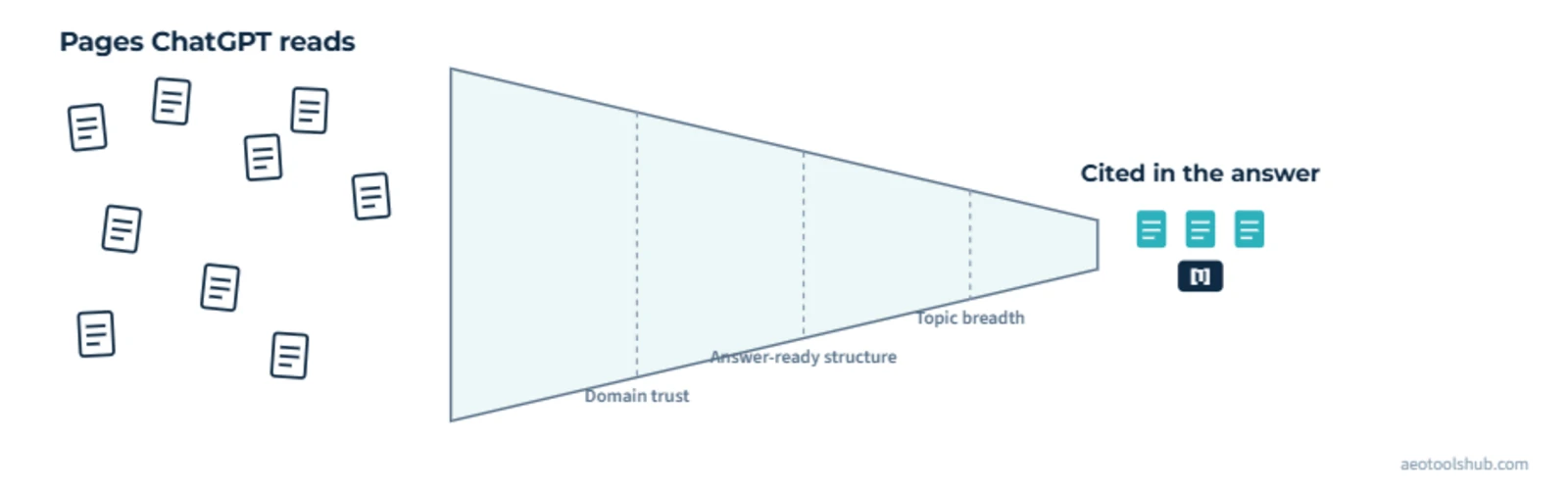
The first hurdle is retrieval: does ChatGPT pull your page into the pool of content it reads while building an answer? The second is citation: does that page survive long enough to appear as a linked source in the final response? A study by Search Engine Land found that ChatGPT pulls roughly six times more pages than it ends up citing, with visibility concentrated among a relatively small set of domains and a bias towards sites that cover a topic broadly rather than a single page written to rank for one query.1 Most of what ChatGPT reads never reaches the user at all. It gets discarded silently, with no ranking position, no “page two,” nothing you can check in Search Console.
That changes what “optimising for ChatGPT” should actually mean. Getting into the reading pool and getting quoted from it are different problems, and they respond to different fixes.
How ChatGPT actually searches the web
When ChatGPT decides a question needs current information, it doesn’t run one query and rank the results the way Google does. According to OpenAI’s own description of the feature, ChatGPT rewrites what you typed into one or more targeted queries and sends them to search partners, then reads the pages that come back before writing a response with source links attached.2 A question about a niche drug trial, for instance, might get rewritten into something closer to a researcher’s search string before it ever leaves ChatGPT’s side.
What it does with the results afterwards is the more interesting part. Ahrefs studied this directly, comparing the pages ChatGPT cites against Google’s own top 10 for the same queries across thousands of search terms.3 For short, classic keyword-style searches, only about 10% of ChatGPT’s cited URLs also appeared in Google’s top 10. For the longer, conversational “fan-out” queries that people actually type into a chat box, the overlap dropped to under 7%. If ChatGPT were simply reflecting Google’s rankings back at you, those numbers would be much higher.
The most plausible explanation, echoed by Ahrefs’ own analysis, is that ChatGPT retrieves from a mix of sources, its own index, partner search APIs, possibly Google and Bing SERPs among them, and then applies its own re-ranking on top.3 Ranking on page one of Google gets you into the conversation. It doesn’t buy you a seat at ChatGPT’s table.
What decides whether a page gets cited
Once a page is inside the pool ChatGPT has read, citation works differently to a search ranking. There’s no position three. A source either makes it into the answer or it doesn’t, and unlike a Google results page, ChatGPT typically surfaces a short handful of sources rather than a long scrollable list.
Because the model is synthesising a written answer rather than assembling a list of links, the pages that get pulled in tend to be the ones that let it lift a clean, self-contained answer without having to stitch one together from scattered paragraphs. A page that states its main point plainly near the top, in language that reads correctly on its own once quoted, has a real structural advantage over one that builds up to its conclusion across several paragraphs of preamble. This is the same “answer-first” principle that underpins featured snippets in classic Google search, just applied to a model that’s writing prose instead of extracting a sentence.
Why the same domains keep winning
Search Engine Land’s study also found that citation visibility clusters around a relatively narrow set of domains per topic, and that ChatGPT tends to favour sites with broad, topic-wide coverage over a single isolated page.1 One well-optimised article rarely does the job on its own; a domain that has built out a genuine cluster of related content on a subject has a better shot.
The Ahrefs data adds a useful twist here. Domain overlap between ChatGPT’s citations and Google’s top 10 was consistently higher than URL overlap (31.8% versus 10% for short-tail queries), which means ChatGPT often trusts the same website Google trusts, just not the same page.3 It’s finding a different, better-fitting page from within a domain it already considers credible, rather than picking a domain at random.

That’s a reasonable argument for building depth across a topic cluster (see our guide on how the major AI search platforms work for the wider pattern) instead of pouring all your effort into a single hero page and hoping it’s the one that gets picked.
What doesn’t move the needle
A few assumptions worth retiring. Chasing a specific Google ranking position as a proxy for ChatGPT visibility doesn’t hold up well given how little the two overlap, especially for the conversational queries ChatGPT is actually built for. Sprinkling FAQ or HowTo schema across a page doesn’t force a citation either; structured data helps machines parse a page correctly, it doesn’t override what the model decides is worth quoting.
The same goes for building a single standalone page purely to “win” one AI search query. Citation tracks with domains that already look credible on a topic, and a page with no supporting context around it, no related articles, no clear topical footprint, is easy to overlook even if the content itself is accurate. None of this works if the site isn’t crawlable and parseable in the first place; that’s the foundation everything else in this article sits on top of.
FAQ
Does ranking #1 on Google guarantee a ChatGPT citation?
No. Ahrefs’ study found only around 10% overlap between ChatGPT’s cited URLs and Google’s top 10 for short, keyword-style queries, and under 7% for the longer conversational queries ChatGPT is built to handle. A high Google ranking helps you get discovered, but it isn’t the same signal ChatGPT uses to decide what to cite.
How many sources does ChatGPT typically show in a search answer?
Noticeably fewer than a Google results page. ChatGPT tends to surface a short list of sources rather than ten-plus links, which means each citation slot is more competitive, not less.
Does adding FAQ or HowTo schema help get my page cited?
Schema helps the model parse your page’s structure correctly, but it doesn’t force a citation on its own. It’s a supporting technical fix, not a ranking lever in itself.
Is ChatGPT just showing me Google’s results?
Not according to the data. ChatGPT pulls from a mix of sources and applies its own re-ranking on top, which is why its citations diverge so much from Google’s top 10, even though OpenAI’s search partners include the same underlying indexes.
What’s the highest-leverage thing to fix first?
Crawlability and parseability come before anything else. If ChatGPT’s search partners can’t crawl and read a page cleanly, none of the content-structure advice matters. After that, focus on answering the core question plainly near the top of the page, in language that still makes sense if it’s lifted out and quoted on its own.
Next steps
If you want the wider picture of how the major AI engines differ in what they retrieve and cite, our guide to how the major AI search platforms work is the place to start. And if you’d rather track this directly instead of guessing, our roundup of AI visibility tracking tools covers the platforms built to monitor exactly this kind of citation activity over time.