
Every guide on this topic tells you to “answer the question early” and “use clear headings.” True, but useless on its own, because it doesn’t say why those two things matter more than the dozen other on-page tweaks people obsess over. So before any advice, the mechanics.
AI search engines don’t read your page top to bottom the way a person does. When ChatGPT, Perplexity or Google’s AI Overviews pull content into an answer, they’re retrieving individual passages, not entire pages, scoring each one for relevance to the question, and stitching the best-scoring passages into a response. A page can rank nowhere close to position one in classic search and still get cited, if one paragraph on it happens to be the cleanest available answer to the exact question being asked.1 That’s a different unit of competition than SEO ever was. You’re not really competing page versus page. You’re competing passage versus passage.
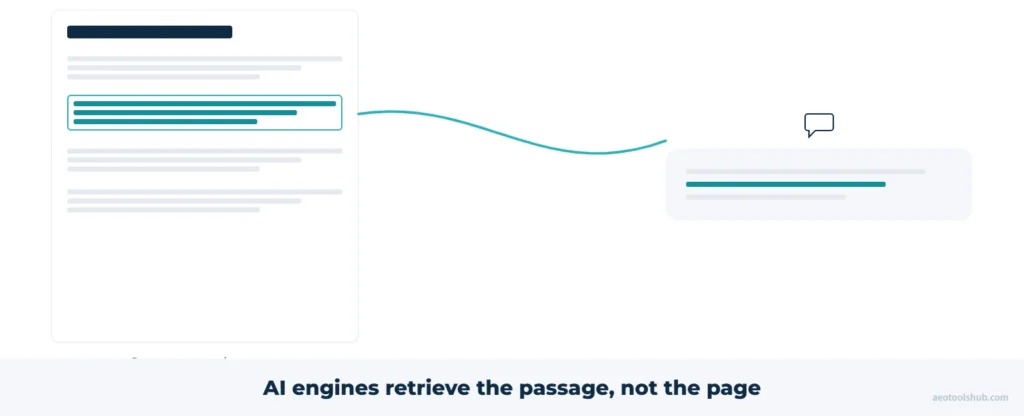
This is also, not coincidentally, how the retrieval systems behind these tools are built more generally. Splitting documents into chunks before deciding what to retrieve is standard practice across retrieval-augmented generation systems, and how well a chunk stands on its own, without needing the rest of the document for context, is one of the biggest levers on whether that chunk gets used at all.2 Once you know that, “write self-contained passages” stops being a vague content tip and starts being a specific, testable instruction: could this paragraph be lifted out of the page, dropped into a chat window with no other context, and still make complete sense? If not, it’s not going to survive extraction.
Everything below is that one idea, applied to the specific parts of a page where it matters most.
Answer first, every time, no exceptions
The single highest-leverage change most articles need: the answer to the implied question shows up in the first two or three sentences, not after three paragraphs of throat-clearing. AI engines weight the opening of a section heavily precisely because it’s the passage most likely to be a complete, self-contained answer.
Here’s the difference in practice, using a skincare example, since it’s a category where this mistake is everywhere.
Before, a fairly typical opening for “does vitamin C serum actually work”:
“Skincare can feel overwhelming with so many active ingredients on the market today, and vitamin C is one that’s generated a lot of buzz in recent years. Before diving into whether it’s worth your money, it’s worth understanding a bit about what vitamin C actually is and where the science comes from.”
Nothing in that paragraph is wrong, and nothing in it is extractable. An AI engine reading it has no answer to lift, only a promise that one is coming.
After:
“Yes, topical vitamin C works for most people, backed by strong clinical evidence for brightening skin tone and boosting collagen production, provided it’s formulated at 10-20% concentration and stored away from light and air, since it degrades quickly once oxidised.”
Same topic, same eventual point the article was going to make anyway. The rewritten version just makes it in sentence one instead of paragraph four, and it’s a passage that could survive being cited on its own with nothing else around it.
Heading hierarchy isn’t a formatting choice, it’s a map
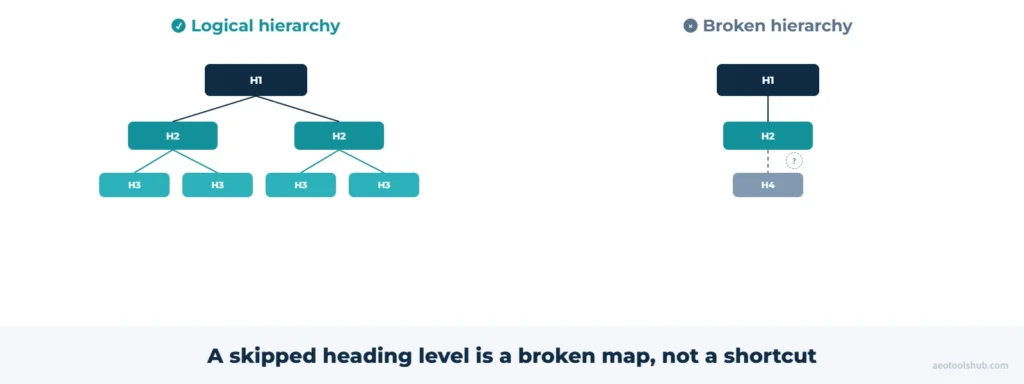
AI systems, like accessibility tools before them, build an outline of a page from its heading tags: H1 at the top, H2s as the main branches, H3s nested under the H2 they belong to. This isn’t new or AI-specific. The Web Content Accessibility Guidelines have required logical, non-skipping heading structure for exactly this reason, helping any automated tool construct an accurate map of a page, since long before AI search existed.3
Skip a level (an H2 straight to an H4, say) and you haven’t just annoyed a screen reader, you’ve handed a retrieval system a broken map. It has to guess where that section belongs in the hierarchy, and it guesses wrong often enough that the safer move is simple: H2 for every main question your article answers, H3 only for genuine sub-questions nested underneath, never skipped, never used purely for visual size.
The practical test: could someone reconstruct the shape of your article from the heading list alone, with no body text? If the headings read as a coherent outline on their own, you’re structured correctly. If they read as a mix of questions, statements and vague labels (“Overview,” “More details”), an extraction system is working harder than it needs to, and harder usually means it moves on to a competitor’s page instead.
Write sentences that don’t lean on their neighbours
This is the part that trips up even writers who’ve internalised “answer first.” A paragraph can open with a direct answer and still fail extraction if every sentence after it depends on the one before, through pronouns without clear antecedents, or through “this” and “that” doing the heavy lifting instead of naming the thing.
Compare:
Leans on context:
“It’s most effective when applied in the morning. This is because it helps protect against free radical damage from UV exposure throughout the day, and pairing it with this is what really makes the difference.”
Pull that middle sentence out on its own and “this” refers to nothing. An extraction system either has to resolve the pronoun correctly (not guaranteed) or skip the sentence.
Self-contained:
“Vitamin C serum is most effective when applied in the morning, since it helps protect skin against free radical damage from UV exposure across the day. Pairing vitamin C with a separate SPF, rather than relying on either alone, is what produces the real difference in outcomes.”
Slightly longer, deliberately so, because naming the subject again instead of pointing back at it is what makes the second sentence usable on its own.
Format for the shape of the answer, not for decoration
Lists, tables and short definition blocks aren’t there to break up a wall of text, they’re there because certain kinds of answers are structurally suited to certain formats, and a well-matched format is easier to extract cleanly than the same information buried in a paragraph.
A comparison (“vitamin C serum vs niacinamide, which one for sensitive skin”) belongs in a short table, not three paragraphs of prose that forces a reader, or an AI engine, to build the comparison themselves. A process (“how to introduce a new active into your routine”) belongs in a numbered list, one clear action per step, not a paragraph with “first,” “then” and “finally” buried mid-sentence. A definition belongs in one direct sentence that opens with the term itself, not a windup before the term is even mentioned.
Get the format wrong and you’re not just making the page slightly harder to read, you’re making the exact structure an extraction system is looking for absent from a page that might otherwise have earned the citation.
A rewrite checklist worth keeping
Run any section through these four questions before calling it finished:
- 1Does the opening sentence answer the section’s implied question, with no runway beforehand?
- 2Could this paragraph be lifted out of the page and still make complete sense, with no earlier context required?
- 3Does every heading, read on its own with no body text, tell you exactly what that section covers, in the correct nested position?
- 4Does the format (prose, list, table) match the shape of the answer, rather than defaulting to paragraphs out of habit?
None of this replaces good research or an honest, useful answer, it’s not a trick that rescues thin content. It’s the difference between a genuinely good answer that never gets seen because it’s buried in paragraph four, and the same answer showing up in the response someone actually reads.
This is also exactly the discipline behind getting your brand cited by AI search engines more broadly, structure is one input into that, alongside the authority and technical-access signals covered there. And if you want to see how this plays out on specific platforms, how Google AI Overviews work and how ChatGPT Search ranks and cites brands both go deeper on the retrieval mechanics for that specific engine.
FAQ
Does writing for AI extraction hurt readability for actual human visitors?
No, if anything it tends to help. Answer-first structure, logical headings and self-contained paragraphs are all things human readers scan for too, particularly on mobile. The one place to watch is over-shortening: don’t strip out genuine nuance just to hit a word count, extraction rewards a complete, accurate answer, not an artificially terse one.
How long should a passage be to get extracted?
There’s no verified official figure from any AI engine, and be sceptical of anyone quoting an exact word count as gospel. The reliable guidance is qualitative: long enough to fully answer the question, short enough that nothing in it depends on a sentence outside it. Two to four sentences is a reasonable practical range for most answer-first openings.
Do I need to rewrite my entire site to be more extractable?
No. Prioritise the passages most likely to answer a real question someone would type into an AI engine, typically your opening paragraphs, FAQ answers and any comparison or how-to sections. See my guide on getting cited by AI search engines for how to prioritise which pages to fix first.
Does this replace the need for good SEO?
No, it sits on top of it. Technical access (can the engine retrieve your page at all) and authority signals still matter enormously, see my SEO fundamentals guide for that layer. Structure is what happens once a page is already retrievable and credible.