
SEO Fundamentals: The Foundation AI Search Actually Runs On
AI search didn’t kill SEO. It raised the bar on the fundamentals. Here’s what those fundamentals are, what’s genuinely changed, and why AEO and GEO can’t work without them.
Jul 5, 2026 · ~10 min readEvery few months someone publishes a piece arguing that SEO is dying, usually with a chart showing zero-click searches going up and organic traffic going down. The chart is real. The conclusion is not. What’s actually happening is narrower and less dramatic: the fundamentals that made a site rank well in Google are the same fundamentals that make it retrievable and citable by AI engines. Nothing was replaced. A new layer got added on top.
We see this constantly with clients who come to us wanting AEO or GEO work and assume it’s a separate discipline from their existing SEO programme. Almost every time, the sites that struggle most with AI visibility are the ones with weak SEO foundations to begin with. The AEO problem and the SEO problem are usually the same problem, just noticed at a different point.
This guide covers the five pillars that define SEO success, which one of them AI search made effectively mandatory rather than optional, what’s genuinely new about optimising for AI engines, and what hasn’t changed at all despite what a lot of recent content would have you believe.
The five pillars of SEO, and which one AI search made non-negotiable
Content, authority, experience, technical health and measurement have been the five pillars of organic search for years. Most SEO frameworks present them as roughly equal in weight, and for traditional search that’s a fair way to think about it. AI search changes the ordering. One pillar now sits underneath the other four instead of alongside them.
Here’s the list, deliberately reordered to put that pillar first instead of where it usually sits in classic SEO frameworks:
- 1Technical health — crawlability, clean HTML, structured data and indexing controls. If an AI crawler cannot reach or parse your page, none of the other four pillars matter, because the content behind them never gets read. This is the one pillar that gates the rest.
- 2Content — topical coverage, search intent matching, and increasingly, whether your content answers a question directly enough for a model to lift and cite it.
- 3Authority — backlinks still count, but AI engines also weigh how consistently your brand is described across third-party sources, not just how many sites link to you.
- 4Experience — Core Web Vitals, page usability, and whether a human who does click through actually finds what they were promised.
- 5Measurement — you now need to track citation frequency and share of voice in AI answers alongside rankings and organic traffic, or you’re optimising blind.
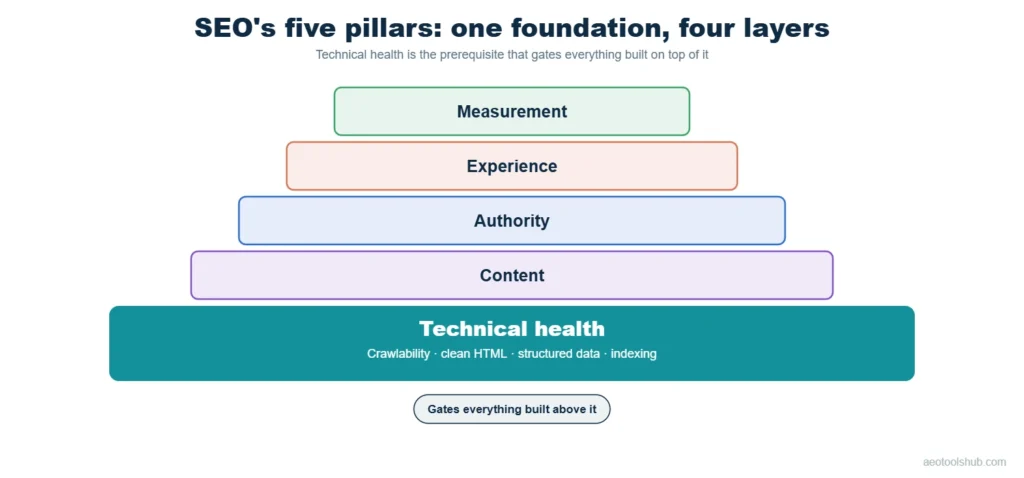
Putting technical health first is not a stylistic choice. It reflects how AI retrieval actually works: a crawler either gets a clean, parsable version of your page or it doesn’t. There’s no partial credit for having brilliant content that the crawler cannot see. We’d argue this was always true for classic SEO too, technical debt has always capped what content and authority work could achieve, but AI search removes the wiggle room. Google could sometimes rank a technically messy page anyway if the content was strong enough. AI engines are far less forgiving about that trade-off.
None of that makes technical health sufficient on its own, worth being clear about. A perfectly crawlable, perfectly parsable page with generic, thin content still won’t get cited, because the model has nothing worth extracting once it arrives. The gating runs in both directions: bad technical health blocks everything else from being seen, and bad content gets seen but ignored. Technical health is the floor, not the whole building.
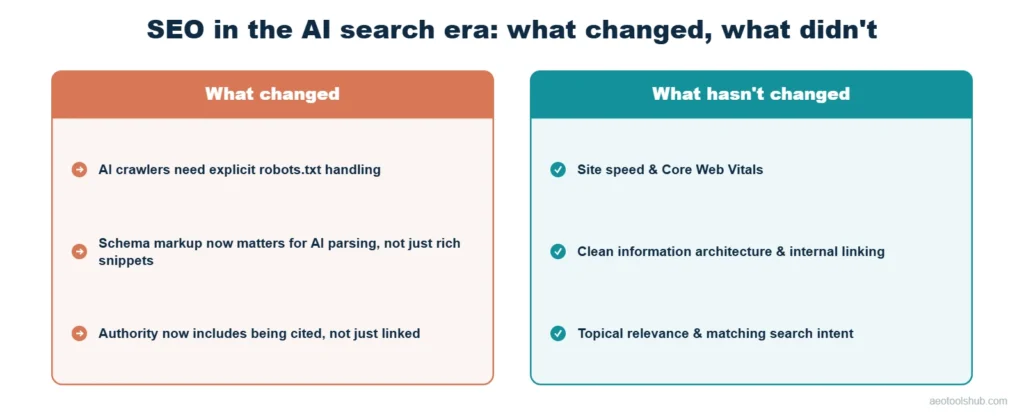
What’s genuinely different about SEO in the AI search era
Crawlability now means AI crawlers too, not just Googlebot
A robots.txt file that only accounts for Googlebot and Bingbot is now an incomplete file. OAI-SearchBot, PerplexityBot and Claude-SearchBot all need explicit consideration for AI search visibility, and we still find sites, including some run by teams who consider themselves SEO-sophisticated, that block one or more of these without realising it (see our full breakdown of each platform’s crawlers). Often it happened by accident: an aggressive bot-blocking rule went in to fight AI scraping for training data, and it caught the retrieval crawlers in the same net. Google AI Overviews and Gemini don’t need a separate crawler on top of standard Googlebot access.
Structured data went from nice-to-have to how you get parsed correctly
Schema markup used to be mostly about rich snippets: star ratings, recipe cards, that kind of visual upgrade in the search results. Worth flagging since it’s a live example of how fast this space moves: Google actually deprecated FAQ rich results in Google Search entirely as of May 2026 (see Google’s own FAQPage documentation), after restricting them to a small set of authoritative government and health sites back in 2023 (see Google’s 2023 announcement). So FAQ schema no longer buys you a visual dropdown in classic Search results. Google has said it will still parse the markup to understand the page, and that’s the part that matters for AI extraction: FAQPage schema hands a model pre-formatted question-and-answer pairs instead of asking it to infer structure from prose, independent of whether Google Search still renders it visually. The rich-snippet upside is gone for FAQ specifically. The parsing upside for AI retrieval isn’t.
Authority now includes being cited, not just being linked to
Backlinks remain a real signal. But AI engines also build an entity model of your brand from how consistently you’re described across the web: your own site, review platforms, industry press, Wikidata, Google Business Profile. Two brands with an identical backlink profile can have very different AI visibility if one has a coherent, consistent public description and the other has scattered, conflicting information about what it actually does.
What hasn’t changed at all
A lot of “SEO in the AI era” content overstates how much has actually changed, because a clean before-and-after narrative is more shareable than “most of this is the same as it was in 2019.” We’d push back on that framing directly, and Google’s own position backs this up: its Search Central documentation states plainly that existing SEO best practices apply to AI Overviews and AI Mode, and there are no additional technical requirements or special markup needed to appear in them (Google’s AI features documentation).
Site speed and Core Web Vitals
Page speed was a ranking factor before AI search and it still is, Core Web Vitals remain part of Google’s page experience signals (see Google Search Central’s Core Web Vitals documentation). It also affects how efficiently a crawler can index your site within its crawl budget, which matters just as much to an AI retrieval system as it does to Googlebot. No amount of AEO tactics compensates for a site that times out or ships ten seconds of render-blocking JavaScript before the content appears.
Clean information architecture
A logical site structure with sensible internal linking was good practice for both users and search engines long before anyone used the word AEO. It’s still good practice, for the same reasons. If a crawler cannot work out which pages on your site are the authoritative ones on a given topic, an AI model has the same problem when it’s deciding what to cite.
Topical relevance and matching search intent
Writing content that actually answers what someone is asking, rather than what you’d like to talk about, has been the core of good SEO for well over a decade. It’s also the entire premise of answer-first content for AEO. This is not a new skill you need to learn. It’s the same skill, applied with slightly sharper discipline because an AI model has even less patience for padding than a human skimmer does.
Where to focus if you’re starting from a weak SEO base
If your SEO fundamentals are shaky, resist the urge to jump straight into AEO-specific tactics like FAQ schema or answer-first reformatting. Fix the technical foundation first: confirm your robots.txt allows the major AI crawlers, resolve any indexing errors in Search Console, and check that your priority pages actually render cleanly without JavaScript, since that’s frequently what an AI crawler sees. Once that’s solid, move to content and authority work. AEO-specific tactics layered on top of a broken technical base tend to produce very little, because the crawler never gets far enough to benefit from them.
For the detailed playbook on structuring content and building the authority signals AI engines look for, see How to get your brand cited by AI search engines. For the definitions and the three-way comparison, see AEO vs GEO vs SEO.
Frequently asked questions
Is SEO still worth investing in if I want to focus on AEO/GEO?
Yes, and the two are not really separable in practice. AEO and GEO tactics assume a technically sound, well-structured site is already in place. Investing in AEO while skipping SEO fundamentals is a bit like renovating the top floor of a house with a cracked foundation.
What’s the single biggest SEO mistake that also hurts AI visibility?
Blocking or throttling crawlers, whether deliberately through an overcautious robots.txt or accidentally through a CDN or bot-management tool. It’s the most common issue we find in audits, and it’s also the one with the most binary consequence: either the page can be read or it can’t.
Do backlinks still matter for AI search?
Yes, though they’re one input among several rather than the dominant signal they once were for Google rankings. AI engines also weight brand mentions on sites that never linked to you at all, which is a genuinely new wrinkle for anyone used to thinking about authority purely in link-building terms.
How is measuring SEO success different from measuring AI visibility?
Traditional SEO measurement centres on rankings, clicks and organic traffic, all available through Google Search Console. AI visibility requires a dedicated tracking tool, since citation frequency and share of voice inside AI-generated answers don’t show up in Search Console at all. The two measurement systems need to run side by side.
Should I hire an SEO specialist or an AEO specialist first?
If you don’t already have solid SEO in place, hire for SEO first, or find someone who covers both. A specialist who only knows AEO tactics but can’t diagnose a crawlability problem will hit a ceiling fast, because most of what limits AI visibility on a weak site is a plain SEO issue wearing an AEO label.
Next steps
Run a crawlability check before anything else: confirm OAI-SearchBot, PerplexityBot and Claude-SearchBot are all allowed in robots.txt, and spot-check how two or three of your priority pages render with JavaScript disabled. If that comes back clean, the rest of this guide tells you where the remaining gaps are likely to be.