
Someone asking “what’s a good skincare brand for sensitive skin” used to mean ten blue links and a scroll. Increasingly it means a single AI answer with three or four brands named, sometimes with a product card attached, and no scroll at all. That’s a fundamentally different competition to win than a search results page, and D2C brands are further into it than most categories, because so much of D2C buying behaviour was already comparison-heavy and review-driven before AI search existed.
This is where GEO earns its keep as a distinct discipline for D2C specifically, more than for most B2B or SaaS content. The signals that get a consumer brand named in an AI answer aren’t the same signals that get a software company cited in a technical guide, and treating them the same way wastes effort.
Why D2C shows up differently in AI answers
A B2B buyer asking an AI tool about project management software is looking for feature comparisons and credible third-party analysis, the kind of ground our guide to getting cited by AI search engines covers in full. A consumer asking about a skincare brand is looking for something closer to word of mouth: does this actually work, do real people rate it, is it worth the price. AI engines have picked up on that distinction. They lean harder on review platforms, community discussion and social proof for consumer-purchase queries than they do for B2B research queries, and less on the kind of domain-authority signals that dominate technical topics.
That means the levers that move AI visibility for a skincare brand look different to the levers in our general GEO guide. Not contradictory, just weighted differently.
The core levers for D2C brand GEO
Reviews and UGC carry more weight here than almost anywhere else
This isn’t a hunch. A Seer Interactive study of over 800,000 AI responses across ChatGPT, Gemini, Perplexity and Google AI Mode found that brands with no active review profile were cited in roughly 1% of relevant answers. Establishing a Trustpilot presence alone lifted that to 53.5%. Brands with 80+ reviews who actively responded to them reached 75.3%.1,2 For a skincare brand specifically, that’s not a marginal optimisation, it’s close to the single highest-leverage thing on this list.
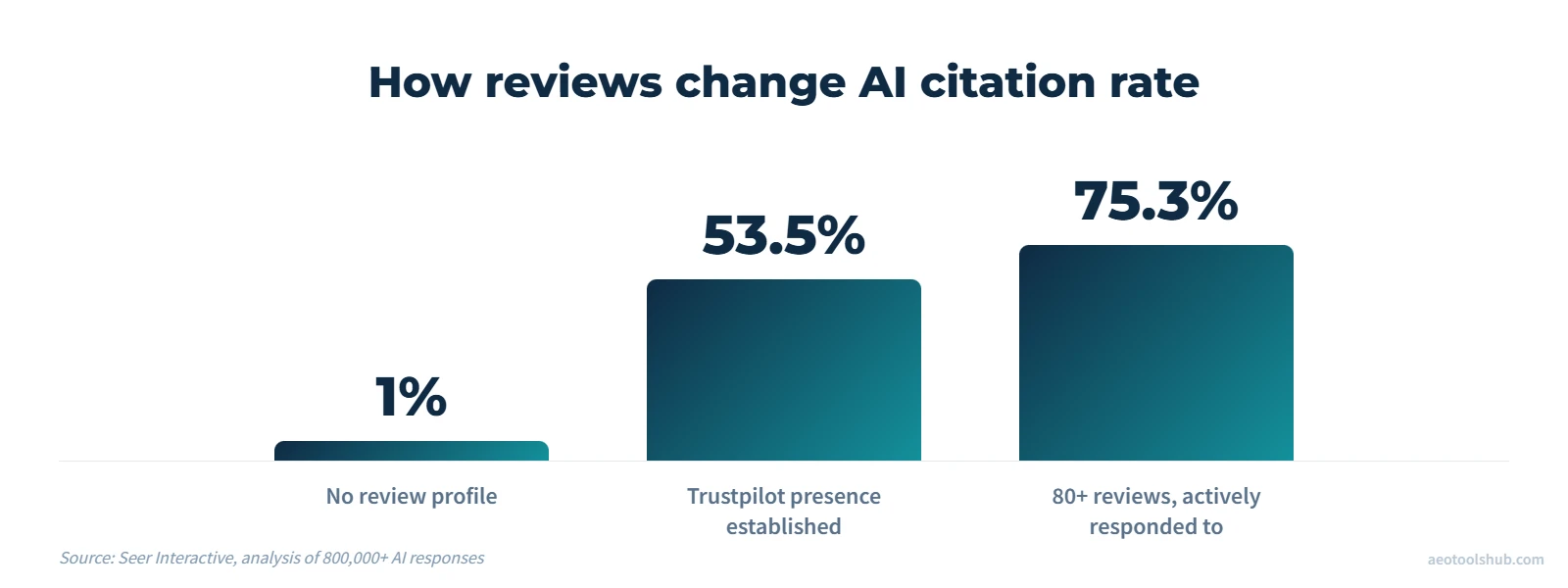
The practical version: claim and actively manage your Trustpilot profile, respond to reviews (positive and negative), and don’t let review volume stall below the threshold where AI engines treat you as established. Reddit and TikTok comment sections matter too, for the same reason they matter in Perplexity’s citation behaviour generally, genuine, specific discussion reads as more credible than a brand’s own claims about itself.
Founder story and brand-narrative consistency
AI engines build an entity profile of a brand from everywhere that brand is described, not just its own website. A skincare brand’s founder story, ingredient philosophy and “why we started this” narrative need to say the same thing on the site, in press coverage, on the Instagram bio and on any marketplace listing. Inconsistency here creates the same kind of noise our AEO pillar warns about generally, it’s just more visible for a brand whose whole pitch often rests on a specific founder story or ingredient philosophy.
Digital PR angles that are specific to D2C
Product roundups, gift guides and “best of” lists are a distinct opportunity for D2C brands in a way they simply aren’t for most B2B categories, because they’re a native content format for consumer products and AI engines already treat them as a citable source type. A well-placed mention in an established outlet’s gift guide or “best skincare brands” roundup is a different, and often more attainable, opportunity than trying to get a brand’s own site cited directly. Worth its own dedicated playbook, which we’ll get to separately, but the short version is: pitch the roundups your category already supports, don’t try to invent new ones.
Owned comparison and decision content
The queries that convert are comparison queries: “X brand vs Y brand,” “is this worth the price,” “what’s actually in this product.” A skincare brand with a genuinely useful ingredient-transparency page, or an honest comparison page against a well-known competitor, gives an AI engine something concrete to lift and cite, in the same way our guide on measuring AI visibility recommends tracking these query types specifically. Marketing copy that never mentions a competitor by name, or never states a plain price, has nothing an AI engine can quote confidently.
AI Shopping: the newest surface for D2C GEO
Everything above is about being mentioned in a written answer. There’s a newer, more direct surface D2C brands specifically need to pay attention to: AI shopping features that recommend and, increasingly, let a user check out a specific product without ever leaving the chat.
OpenAI’s Instant Checkout, first launched in autumn 2025 and expanded under a wider “Buy it in ChatGPT” rollout in early 2026, lets a user purchase a product directly inside a ChatGPT conversation.3 Perplexity Shopping and Google AI Mode’s shopping features work on a similar principle: an AI system pulls structured product data (price, availability, specifications, reviews) and presents a small shortlist a user can act on immediately.4 Amazon retired its standalone Rufus assistant on 13 May 2026, folding the same shopping-recommendation functionality into a broader assistant called Alexa for Shopping, and Gemini’s shopping integrations extend the same pattern further.5
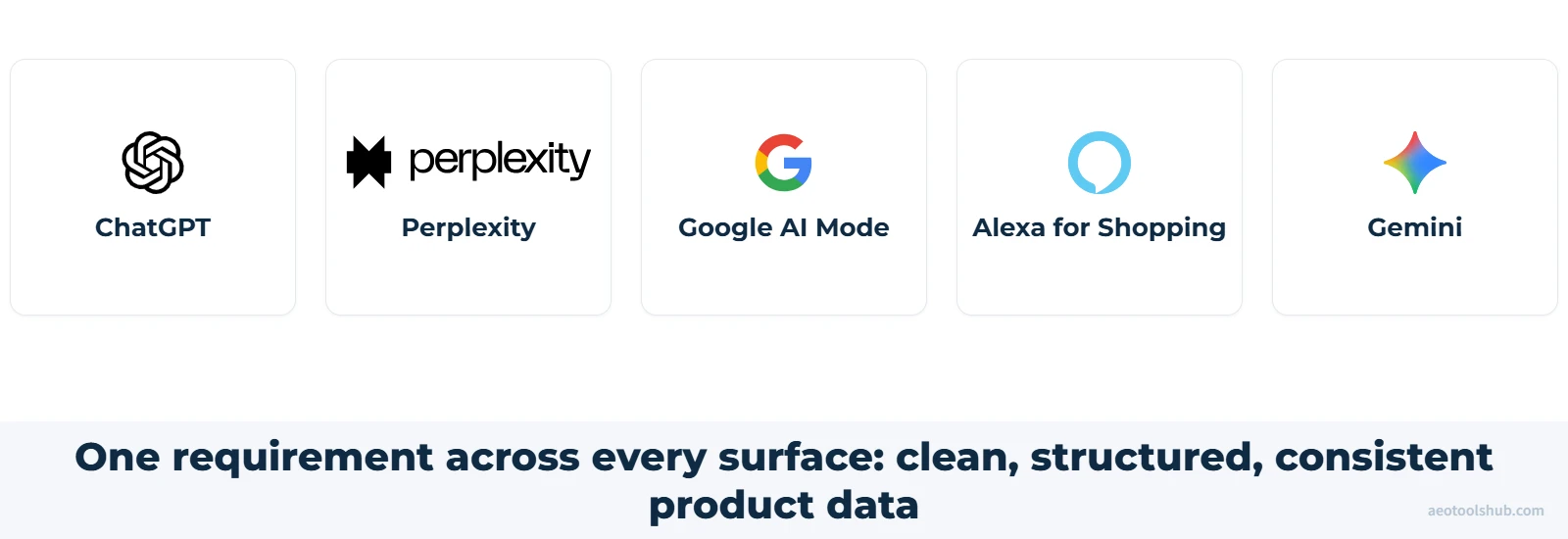
The common technical requirement across all of these: your product data needs to be clean, structured and consistent everywhere at once, not just optimised for your own site. That means accurate, up-to-date product feeds, consistent pricing and availability data, and structured data that an AI shopping agent can parse with confidence, the same underlying discipline as good technical SEO, applied to a shopping-specific data layer rather than a page.6
This is genuinely measurable now, not a speculative trend, and in our view it’s the part of GEO advice most likely to be out of date within a year, simply because the platforms themselves are moving fast. AI visibility tracking tools have started tracking shopping-specific metrics separately from general brand citations: product-level visibility, win rate against competing products, and average position within AI-generated shopping results. If a tool you’re using for AI visibility tracking doesn’t yet break shopping out from general brand mentions, that’s worth asking about, because the two behave differently enough to need separate attention.
What doesn’t work
A few things brands try that either don’t move the number or actively hurt it. Buying or incentivising reviews is the fastest way to get a Trustpilot or platform account flagged, and once a profile loses credibility, the AI-citation benefit disappears along with the human trust it was meant to build. Review-gating, only asking happy customers to leave a review while quietly filtering out the rest, tends to produce a review profile that reads as suspiciously uniform, and it’s increasingly easy for both platforms and AI systems to detect. And keyword-stuffed product description pages, written for an old-fashioned idea of on-page SEO, do nothing for an AI engine that’s trying to extract an honest answer to “does this actually work.”
How to measure it
None of this is worth doing blind. Track citation frequency for brand-level queries the way our AI visibility measurement guide lays out, but for a D2C brand specifically, also track the comparison and decision-stage queries separately from broad awareness queries, and keep an eye on shopping-specific metrics as a distinct category once you have a baseline.
There’s a layer above simple citation counts too: sentiment. Being mentioned isn’t automatically good, an AI engine can name your brand and still describe it as “expensive for what you get” or “mixed reviews.” Peec’s own sentiment score rates the tone of every AI mention on a 0–100 scale based on the language used, separate from whether you were cited at all, and it’s worth tracking alongside citation frequency rather than instead of it.7 That covers what the AI itself says. The layer underneath it, the raw Reddit threads and TikTok comments referenced earlier, needs separate monitoring, because a negative pattern there is often the leading indicator, showing up well before it surfaces in an AI answer. If budget allows, an enterprise platform like Brandwatch or YouScan gives you the deepest read on that layer, YouScan in particular is built to catch the sarcasm and community-specific slang that trip up generic sentiment models on Reddit, though pricing on both runs into sales-call territory.8 If you want the signal without the enterprise spend, Brand24 covers Reddit and TikTok sentiment at a published $199 to $999 a month and is one of the few tools in this space explicitly built around AI and LLM visibility rather than bolted on as an afterthought.9
A brand can be well cited in general answers and still invisible in the shopping surfaces that actually drive a purchase, or the other way round, and you won’t know which without measuring them separately.
FAQ
Do reviews really matter more than backlinks for AI visibility in D2C?
For consumer-purchase queries specifically, the data says yes. The Seer Interactive study found citation rates moving from roughly 1% with no review presence to over 75% with an established, actively managed review profile, a larger swing than most technical SEO changes produce on their own.
Is AI Shopping worth optimising for if my brand doesn’t sell on Amazon?
Yes. ChatGPT’s Instant Checkout, Perplexity Shopping and Google AI Mode’s shopping features all work with a brand’s own product data and don’t require an Amazon listing. The common requirement is clean, structured, consistent product data wherever it’s published.
Should I respond to negative reviews or just try to get more positive ones?
Both, and responding matters more than volume alone. The studies behind this guide’s review-citation figures specifically credit brands that actively respond to reviews, not just accumulate them.
How is GEO for D2C different from general GEO advice?
The underlying mechanics are the same, retrieval, authority, structured content, but the weighting is different. Consumer-purchase queries lean much more heavily on reviews, UGC and shopping-specific data than the technical, authority-driven queries typical of B2B and SaaS categories.