
What is Generative Engine Optimisation (GEO)? The Complete Guide
GEO is the practice of optimising your brand so that AI-generated search answers include you. Here’s what it is, how it differs from AEO and SEO, and what it takes.
Jul 5, 2026 · ~9 min readThe way people find information is changing. A growing proportion of searches, especially the research-heavy, multi-step kind, are now handled by generative AI tools that produce a synthesised answer rather than a list of links. For brands, this creates a visibility problem that traditional search optimisation wasn’t designed to solve.
Generative Engine Optimisation (GEO) is the discipline that addresses it. If SEO put you on the first page, GEO puts you in the answer itself. And the same rule applies here that applies everywhere else on this site: none of it works if the model can’t retrieve your page in the first place.
This guide explains what GEO is, how it works, how it differs from both SEO and AEO (including a straight answer on whether that difference actually matters day to day), and what the practical starting points look like for brands that want to show up in AI-generated responses.
What is Generative Engine Optimisation?
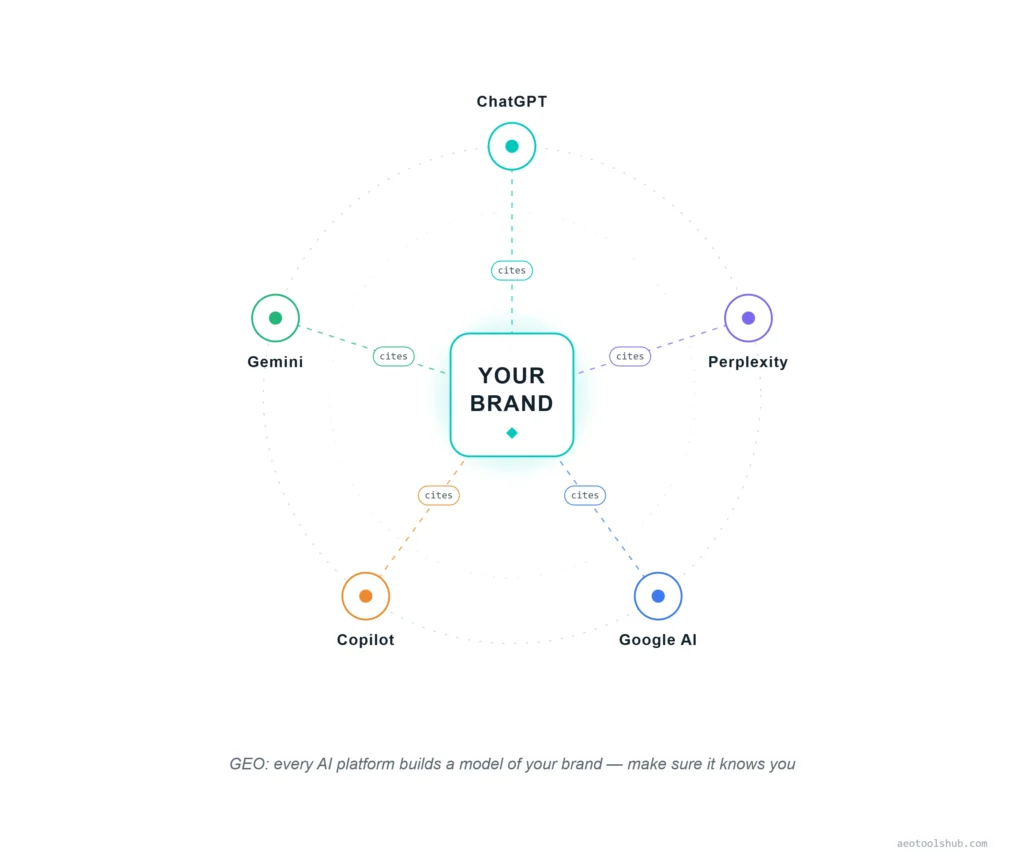
Generative Engine Optimisation (GEO) is the practice of structuring your content and brand presence so AI-powered search engines retrieve, cite, and recommend you when generating answers to user queries. It’s named for the generative AI models, large language models, that power tools like ChatGPT, Perplexity, Google Gemini, and Microsoft Copilot.
Where traditional search optimisation focuses on how your page ranks in a results list, GEO focuses on whether your brand appears in the generated answer at all, and how prominently. The goal isn’t click-through rate, it’s presence, authority, and citation in the moment someone is getting their answer.
How generative AI search works
When a user submits a query to a generative AI search tool, the system doesn’t look up a pre-computed answer. It retrieves a set of current, relevant sources from the web, then generates a response that synthesises information from those sources. This is a two-step process, retrieval then generation, and it’s worth separating them clearly because they respond to different levers.
Retrieval is a technical gate: it depends on crawlability, indexing, and whether the platform’s crawler can access and parse your page at all. This step doesn’t care how well-written your content is. A page blocked in robots.txt or hidden behind client-side rendering the crawler doesn’t execute simply isn’t a candidate, regardless of quality.
Generation is where content quality, structure and authority actually get evaluated. From the retrieved candidates, the generative model selects which content to include and how to present it. Pages that answer the question directly, clearly signal their relevance, and carry strong authority markers are more likely to be included. Vague, thin, or poorly structured content tends to get filtered out here, assuming it survived retrieval to begin with.
GEO vs AEO: are they actually the same thing?
Worth being precise here: GEO is the only rigorously defined term in this pairing, coined in a 2024 academic paper as retrieval-time content visibility optimisation. AEO was never an academic term, it’s an industry label that emerged around the same time to describe the same underlying work. This is our stance, not an industry-wide consensus, and we want to say that plainly: if you’re building a GEO programme and an AEO programme as two separate workstreams with two separate roadmaps, you’re duplicating effort for no real benefit. The technical fixes, the content restructuring, the authority-building, all of it is identical work regardless of which acronym is on the slide.
That said, we do draw one practical line ourselves, and it’s worth being upfront about it: when we label something AEO, it’s usually content and technical work, page structure, schema, crawlability. When we label something GEO, it’s usually the off-page and authority side, digital PR, third-party mentions, reviews, entity consistency. That’s a division of labour for how we plan and title content, not a claim that the underlying mechanism differs, and it roughly matches how a real share of the industry uses the two terms, per Search Engine Journal’s own January 2026 assessment, though plenty of others still use the two fully interchangeably.
Our honest recommendation: pick one term for how you talk about this internally and with clients, and don’t spend energy maintaining a rigid boundary between them. We use AEO more often on this site because it maps more intuitively to what a marketer already understands from SEO. That’s a communication choice, not a strategic one. One thing that isn’t a matter of preference: neither AEO nor GEO covers a model’s training data, that’s a separate, slower-moving discipline called LLMO, and we don’t fold it into either term. For the full three-way comparison including SEO, see AEO vs GEO vs SEO.
GEO vs traditional SEO: what changes?
The core shift: traditional SEO optimises for ranking in results pages using backlinks and keyword-matched long-form content. GEO optimises for inclusion in AI-generated answers using structured, directly-extractable content and entity/authority signals AI systems trust, on top of the same crawlability and indexation baseline SEO already requires. For the full breakdown across SEO, AEO and GEO side by side, see AEO vs GEO vs SEO.
The most important shift is in how you measure success. A page optimised for GEO might receive less direct traffic than an SEO-optimised equivalent, because the user gets the answer in the AI interface and doesn’t need to click through. The value is in brand exposure, authority, and downstream trust, not always in the click. That’s a real adjustment for teams used to justifying content investment purely on traffic numbers.
The key GEO ranking signals
Technical crawlability, first because it has to be
We’re leading with this one on purpose. Content structure, authority and freshness only matter for pages the model can actually retrieve. If your robots.txt blocks the wrong crawler, or your key pages render empty without JavaScript, everything below is irrelevant for those pages specifically. This is the cheapest fix on this list and the one most often skipped, because it doesn’t feel like “real” GEO work the way rewriting a page does.
Content structure and directness
Generative models favour content that answers questions clearly and immediately. The first 100 to 200 words of a page are disproportionately important: if your opening paragraph directly addresses the query, the probability of being cited increases significantly. Use descriptive headings, short paragraphs, and structured formats like lists and tables wherever they add clarity.
Authority, credibility and third-party mentions
AI engines weight source credibility heavily. This is partly technical (domain authority, backlink profile) and partly entity-based, how well-represented your brand is across independent, reputable third-party sources. Brands cited in industry publications or featured in reviews carry more weight than brands whose only web presence is their own site. Digital PR and strategic media placements are GEO investments, not just brand exercises.
Freshness and recency
Generative AI search tools prioritise current information, particularly for queries where recency matters (product comparisons, statistics, “best” recommendations). Content that’s regularly updated, with accurate publication and update dates marked up correctly, is more likely to be retrieved for time-sensitive queries than content that hasn’t been touched in years.
Brand entity strength
AI models build an understanding of brands as entities: a combination of what your website says about you, what third parties say about you, and how consistently that information appears across the web. A brand with a clear, consistent description, a well-maintained Google Business Profile, and coverage across relevant publications has a stronger entity than one whose information is inconsistent or sparse.
Which AI engines does GEO target?
ChatGPT Search
OpenAI’s search integration draws primarily on Bing’s web index to retrieve sources, then generates a cited response. Citation behaviour rewards direct, authoritative pages. OpenAI announced in April 2025 that ChatGPT search had passed 1 billion web searches in a single week (official announcement), making it a significant visibility surface for brands in research-heavy categories.
Perplexity
Perplexity is a search-native AI engine, its entire interface is built around generating cited answers, retrieved from its own index rather than Bing’s or Google’s. Perplexity’s CEO confirmed 780 million monthly queries as of May 2025 with month-over-month growth above 20% at the time (reported figures). Being cited on Perplexity drives both brand exposure and direct referral traffic, making it particularly valuable for informational content.
Google AI Overviews and AI Mode
Google’s AI Overviews appear at the top of results for a large and growing proportion of searches. AI Mode, a more conversational interface within Google Search, is expanding rapidly. Both draw on Google’s existing index, and per Google’s own documentation, there are no additional technical requirements to appear in them beyond standard Search eligibility, strong Google rankings remain a genuinely relevant factor.
Gemini and Microsoft Copilot
Google Gemini and Microsoft Copilot (Bing-based under the hood) are additional surfaces where GEO applies. Copilot in particular appears across Microsoft 365 products, meaning brand mentions can surface in business contexts beyond traditional web search.
How to start with GEO
The most practical entry points for GEO are the same as those for AEO. Start with an audit of where you currently stand: search for your brand and your core topics across ChatGPT, Perplexity, and Google AI Overviews to understand your current baseline visibility. Then:
- 1Review your robots.txt — confirm you’re allowing the crawlers tied to actual search/citation features: OAI-SearchBot, PerplexityBot, and Claude-SearchBot. Google AI Overviews and Gemini use standard Googlebot access.
- 2Restructure your highest-value pages — make sure the core answer appears in the first paragraph
- 3Add FAQ sections — to your key informational pages
- 4Implement schema markup — Article and FAQ schema as a baseline
- 5Audit your brand entity — check for consistency of name, description, and category across all web properties
For the full tactical guide, see How to get your brand cited by AI search engines.
Frequently asked questions about GEO
Is GEO the same as AEO?
That’s our stance, though the industry hasn’t settled on one answer, see the section above for the fuller picture, including the view some hold that they’re meaningfully different. Whichever term you use, neither one includes a model’s training data, that’s LLMO. See AEO vs GEO vs SEO for the full three-way comparison.
Does GEO replace SEO?
No. Traditional search still drives the majority of organic traffic for most brands. GEO is an addition to your existing strategy, one that becomes increasingly important as AI search usage grows. Brands that abandon SEO in favour of GEO prematurely are likely to lose more than they gain.
How do I know if GEO is working?
The most direct signal is manually testing your own prompts, searching your brand and category terms in ChatGPT, Perplexity, and Google AI Overviews, and tracking whether and how often you’re mentioned or cited. That works fine for spot checks. Dedicated AI visibility tracking tools become useful once you want to monitor this systematically across dozens of queries and competitors over time, since manual checks don’t scale well past a handful of prompts.
Which AI engine should I prioritise first?
It depends on your audience more than on any universal ranking of the platforms. Consumer and e-commerce brands generally see the fastest return prioritising Google AI Overviews, since it builds directly on existing SEO signals and reaches the largest audience. B2B and research-heavy categories often get more value focusing on Perplexity first, given its user base and citation density. See our platform-by-platform breakdown for a fuller answer.
How quickly can GEO improve my AI visibility?
Technical fixes, unblocking a crawler, fixing a rendering problem, tend to show up fastest, often within days to a few weeks, since there’s no content production cycle involved. Content restructuring and authority-building take longer and depend heavily on how often the specific platform re-crawls your site. We’d be cautious of anyone promising a fixed timeline without knowing your starting point.
Next steps
GEO rewards brands that invest early. The AI search landscape is still forming, citation patterns aren’t yet entrenched, and there’s genuine first-mover advantage for brands that build strong AI visibility now, before their competitors do.
The fastest way to test GEO fit: run a quick entity audit. Search your brand name plus your top two or three product or service categories in ChatGPT, Perplexity, and Google AI Overviews, and note whether you’re mentioned at all and which source got cited if you are. If nothing comes up, the issue usually isn’t content quality, it’s that your brand doesn’t have a clean, disambiguated entity presence yet: consistent naming across your site, structured data that ties your brand to known entities, and third-party profiles AI models already trust. That foundation matters more than content volume in the early stages.