

Most of what I publish here is about getting cited, my pillar on the subject covers the retrieval and generation mechanics in full. This guide is about a narrower, related question that gets conflated with citation constantly: not “does the AI know I exist,” but “does the AI actually put me forward as the answer.” Those are genuinely different outcomes, and the gap between them is where a lot of AEO effort quietly goes to waste.
Mention, suggestion, recommendation: three different things
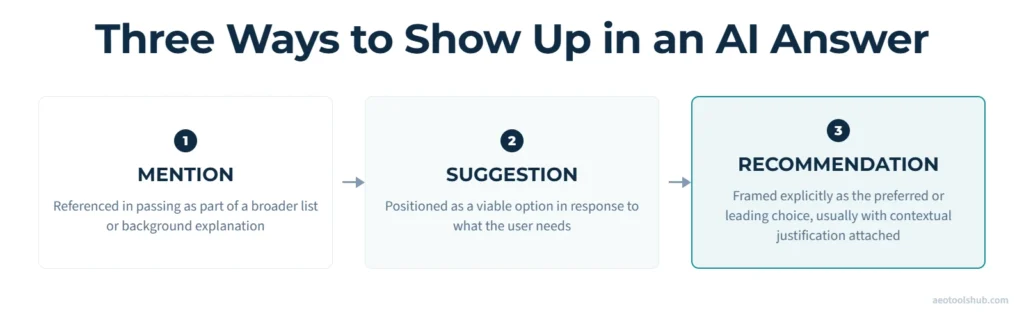
The clearest framing I’ve found for this comes from a February 2026 Search Engine Land piece on what it calls LLM consistency and recommendation share, and it draws a distinction worth adopting wholesale rather than reinventing badly. A brand can show up in an AI response in three genuinely different ways: as a mention, referenced in passing as part of a broader list or background explanation; as a suggestion, positioned as a viable option in response to what the user needs; or as a recommendation, framed explicitly as the preferred or leading choice, usually with contextual justification attached: a stated use case, a specific strength, a reason it fits this particular situation.
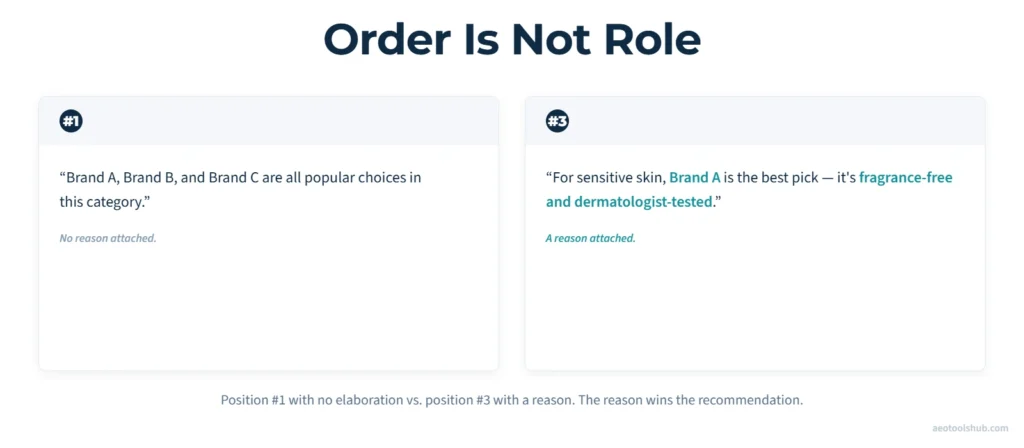
Most AI visibility tracking now captures presence, average position, and sentiment as standard metrics, but rarely isolates how a brand was framed within a single response: named in passing, offered as one option among several, or singled out as the one to pick. Position and sentiment both get closer to that question without fully answering it. Position is an approximation of framing, not a measure of it, it captures order, not role: a brand ranking first across a batch of prompts can still be first in a flat, no-elaboration list every time, while a brand ranking third can be the one singled out with a reason attached each time it appears. Sentiment adds a read on tone, positive, negative, or neutral, but a mention can score neutral-to-positive while still being a passing name-check rather than an actual recommendation with a reason attached. That’s a reasonable starting point, you can’t recommend a brand you never mention. But treating “named” and “recommended” as interchangeable is exactly the mistake this guide is arguing against. Being one of five options listed with no elaboration is a different competitive position from being named first with a reason attached, and a tracking setup built around presence, position, and sentiment alone still can’t fully tell the two apart.
Where this actually matters: comparison and category queries
The distinction is close to meaningless on a purely factual query, “what is retinol,” there’s no recommendation to make, only an answer to give. It matters enormously on comparison, alternative, and “best for” queries, the ones where an AI system has to actively choose which brands to put forward rather than simply answer a question. My own channel-breakdown research already shows how differently competitors rank depending on the metric and engine you check, which is exactly the kind of instability that makes getting the framing right on these queries worth the extra attention. Decision-stage queries are a minority of total AI answer volume next to informational ones, but a recommendation on one sits closer to the moment someone actually buys something than an informational mention ever does.
What actually earns a recommendation, not just a mention
Per the same Search Engine Land framework, response ordering and emphasis function as an implicit ranking even when no explicit ranking exists. A brand that consistently appears first, or comes with a fuller description, holds a stronger recommendation position than one that shows up fourth with no elaboration. What produces that fuller description, in practice, is content the model can lean on to justify the choice: comparison content that states an actual tradeoff rather than generic praise, use-case framing (“best for sensitive skin,” not just “a good moisturiser”), and specifics a model can quote directly instead of paraphrasing vaguely.
This is the same underlying discipline my content-for-AI guide argues for generally, self-contained, specific, quotable passages, applied here to the particular passage type that produces a recommendation rather than a citation: a clear statement of who a product or brand is genuinely best suited for, and why, not a hedge-everything description that could apply to any competitor in the category.
Sentiment is a separate axis from presence
Here’s the part that trips people up most. A brand can be well cited, frequently named, present in most relevant answers, and still rarely recommended, because presence and framing are measuring different things. An AI engine can name your brand accurately and still describe it as “a solid option, though pricier than alternatives” right next to a competitor framed as “the top choice for most users.” Both brands were mentioned. Only one was recommended.
Sentiment scoring is one way to catch this gap: tools like Peec’s rate the tone of every AI mention on a 0-100 scale based on the actual language used, whether it reads as an enthusiastic endorsement or a lukewarm, hedged inclusion. Tracking citation frequency without tracking sentiment tells you whether you’re in the conversation, not whether the conversation is putting you forward or quietly ranking you behind someone else.
Third-party validation carries the recommendation, more than your own content does
For decision-stage queries specifically, third-party comparison and review content does more of this work than a brand’s own site ever will, for a fairly obvious reason: a product page can’t credibly argue it’s better than a named competitor, but an independent review or comparison piece can, and does, constantly. This is the same mechanic my digital PR guide covers for citation generally, extended here to the specific case of recommendation: earning coverage on the review sites, comparison articles, and community threads that already frame products against each other does more for recommendation share than optimising your own pages ever will on its own.
What doesn’t move it
Raw citation volume without positive framing is misleading. Chasing more mentions, more prompts where you show up somewhere in the answer, without checking how you’re framed relative to competitors, can look like progress on a dashboard while your actual competitive position stays flat or worsens. It’s also worth being realistic about volatility: LLM outputs are genuinely non-deterministic, the same prompt run twice can return a different brand order, so a single favourable answer isn’t a signal worth acting on, and neither is a single unfavourable one. This is a pattern to track over weeks, not a snapshot to screenshot and report.
How to actually check where you stand
- 1Track at the category level, not just the brand level. “Best [category] for [use case]” queries are where recommendation dynamics actually show up. Branded queries mostly just confirm you exist.
- 2Read the framing, not just the presence. When you appear, are you named with a reason attached, or listed with no elaboration? That distinction is usually visible just by reading the actual response text, not something a presence-only score will show you.
- 3Track sentiment alongside citation frequency. A rising citation count and a flat or falling sentiment score together is a real pattern worth investigating, not a contradiction to explain away.
- 4Sample repeatedly, not once. Run the same category prompts across a few days before drawing a conclusion. One good answer or one bad one is noise until it repeats.
- 5Check who’s being cited to justify the top recommendation. If a competitor’s recommendation is consistently backed by a specific third-party review or comparison piece, that’s usually a legible, fixable target, not a mystery.
- 6Export the raw responses and classify them at scale. Most trackers store the full response text for each prompt run, not just a presence flag. Exporting that data and running it through an LLM classifier turns a manual, one-by-one read into something you can do across hundreds of prompts.
Frequently asked questions
If I’m cited often but never recommended, is that a real problem?
For informational queries, not necessarily, being a source isn’t the same job as being the answer. For comparison and decision-stage queries specifically, yes, it usually means a competitor’s content is doing the “here’s who this is actually for” work that yours isn’t.
Can a small brand ever out-recommend a bigger competitor?
Yes, more easily on recommendation than on raw citation volume, since a narrow, specific use-case claim (“best for X”) competes on relevance rather than scale. A big, generalist competitor’s content is often too broad to win a narrow comparison the way a focused smaller brand’s content can.
Does this apply outside e-commerce and consumer brands?
The mechanics are the same for B2B and SaaS “alternatives to X” and “best tools for Y” queries, the framing signals (use-case specificity, third-party comparison content) just come from different source types, G2 and Capterra reviews rather than Trustpilot or Reddit threads.
How is this different from just tracking share of voice?
Share of voice, as my metrics guide covers, measures your slice of total mentions relative to competitors. It doesn’t tell you whether those mentions were framed as an endorsement or a footnote. You can lead on share of voice and still lose on recommendation share if your mentions are consistently the least confidently framed ones in the answer.
Where to start
Pull five to ten of your category’s real “best for” or “alternatives to” queries, the ones an actual buyer would type, and read the full response text for each, not just whether your brand appears. Note whether you’re named with a specific reason or just listed. That single read usually tells you more about your actual recommendation position than a week of dashboard-watching.