
Reddit, G2, PDFs: Which AEO Tactics Actually Work on Which LLM
Most AEO tactics aren’t platform-exclusive, they just work with different intensity. The real evidence, tactic by tactic, including where my own tracked data disagrees with the published studies.
Aug 20, 2026 · ~16 min readHere’s a contradiction worth sitting with before reading another word of tactical advice. My own tracked-account data shows Reddit converting at a 2.02 citation rate on ChatGPT against just 0.18 on Perplexity, for one brand, one vertical, over four months. A March 2026 study covering 30 million citations found Reddit wasn’t universally dominant, Wikipedia led on ChatGPT and YouTube led on Google AI Mode and AI Overviews, but Reddit was the single most-cited domain on Perplexity and Gemini specifically, where it sits alongside G2, LinkedIn, YouTube and Wikipedia among Perplexity’s top cited domains for B2B-relevant queries. Both of these are real, and neither contradicts the other once you separate “most cited overall” from “most cited on this specific engine.” That platform-by-platform variation is the actual subject of this piece.
Most AEO tactical advice treats platforms as if they had separate, exclusive playbooks: a ChatGPT strategy, a Perplexity strategy, a Google AI Overview strategy, each with its own dedicated guide and its own tactics. It’s a tidy way to organise content. It’s also mostly fiction. The tactics underneath, Reddit engagement, review platforms, PDFs, content structure, aren’t exclusive to any one engine. They work everywhere, just with wildly different intensity, and pretending otherwise produces guides that have to quietly admit, halfway through, “actually, this works better somewhere else.”
This piece does it differently: one tactic at a time, per platform, with the actual evidence behind each rating, including the parts where the evidence disagrees with itself.
Two different readers get value here, in different ways. If you’re an SEO or marketer building a real cross-platform programme, the matrix below is the reference to keep coming back to. If you’re the person deciding where to put budget, a Head of Marketing, a CMO, an agency owner, the G2 and Reddit playbooks further down are the parts with real step-by-step execution.
Two mechanisms worth knowing before the tactics
The ratings below make more sense once two structural differences are clear. Neither one is a tactic. Both shape which tactics even apply.
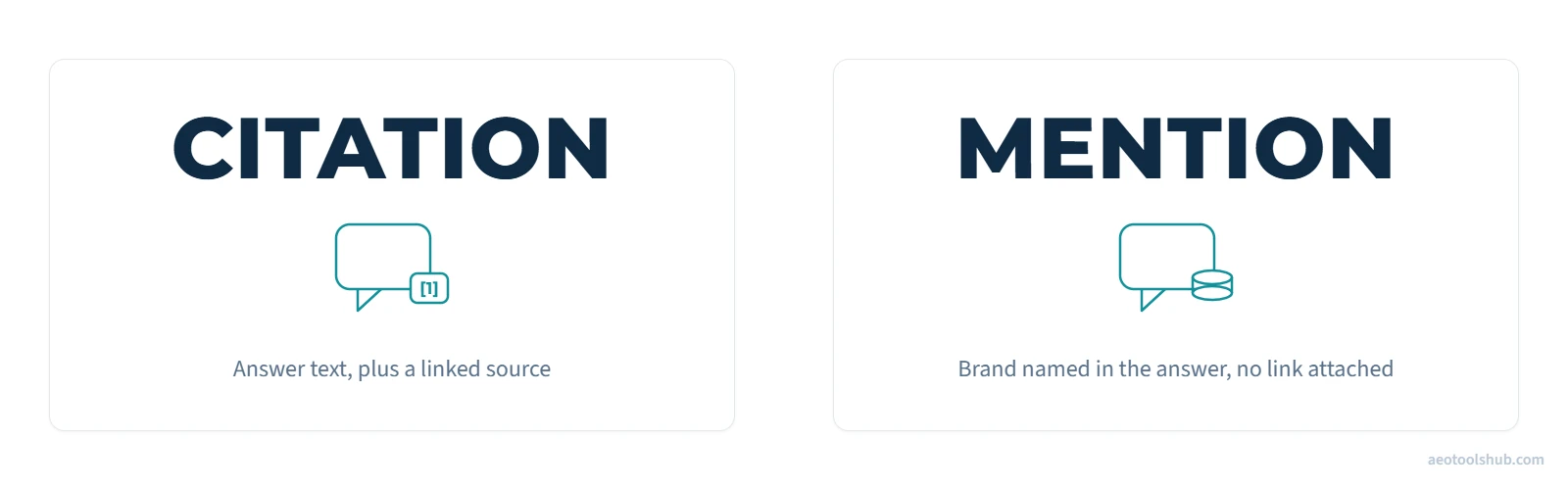
ChatGPT doesn’t only answer from what it retrieves live off the web. A large share of everyday questions get answered at least partly from what the model learned during training, with no citation mechanism triggered at all, because nothing was retrieved in real time. That produces a mention-without-citation pattern: ChatGPT can name your brand in an answer with nothing to click, no source panel, nothing a plain SERP rank tracker would ever catch. A citation and a mention are different signals, and a tool that only reports one of them is giving you half the picture. Check that whatever you use to track AI visibility separates the two rather than folding them into one blended score. Full mechanics in my guide to how ChatGPT ranks and cites brands.
Perplexity and Google AI Overview work differently again, and differently from each other. Perplexity is citation-first by design, it always shows its sources, and it tracks Google’s own top results closely: 65% URL overlap on short, keyword-style queries and roughly 81% domain overlap, against ChatGPT’s ~10%, per Ahrefs’ comparative study. Full mechanics in how Perplexity decides which sources to cite. All three engines also do some version of the same underlying move: breaking one query into several sub-queries, retrieving for each, then synthesising an answer. The intensity and style differ. ChatGPT tends to run a tighter, sequential fan, working through a handful of sub-queries in order. Perplexity leans parallel, especially in Pro Search and Deep Research, firing many sub-queries at once. Google’s version, branded query fan-out, is the broadest of the three. None of the three expose their actual internal sub-queries, not even Google’s own Search Console, which only shows whether a page earned impressions under AI Overviews or AI Mode, not the sub-queries that produced them. But Google’s fan-out is the only one with that indirect, page-level verification path at all, which is why it gets its own row in the matrix below and its own dedicated workbook: how to map and cover a fan-out query cluster for Google AI Overviews.
The tactic-by-platform matrix
Ratings below are Strong, Moderate, or Weak/unproven, each with the actual source behind it. Where the evidence conflicts, I’ve said so rather than picking a side.
| Tactic | ChatGPT | Perplexity | Google AI Overview |
|---|---|---|---|
| Ranking in Google organic search | Weak (~10% URL overlap, ~7% on conversational queries) | Strong (65% URL / 81% domain overlap) | Mixed (62% of citations come from outside the top 10, up sharply since Jan 2026) |
| Covering a query’s likely sub-questions (fan-out/decomposition) | Present, tighter sequential fan | Present, parallel fan, especially Pro Search/Deep Research | Strong, broadest fan; impressions verifiable in GSC, sub-queries themselves aren’t |
| Reddit & community engagement | Strong on my own tracked data (2.02 citation rate) | Contested – strong per a 30M-citation study, weak on my own data (0.18) | Moderate on my own data (0.53), untested at scale |
| G2, Capterra & review platforms | Unproven, not evidenced either way | Strong, named directly in third-party citation-source research on Perplexity | Unproven, not evidenced either way |
| PDFs & technical documentation | Weaker, parses less consistently | Strong on direct observation, not independently benchmarked | Unproven, not evidenced either way |
| Content structure (answer-first, one clean claim) | Strong | Strong | Strong, via fan-out breadth and helpful-content baseline |
| Domain-wide topical depth vs. one hero page | Strong, citation clusters around broad-coverage domains | Implied, tracks Google, which rewards this | Strong, via fan-out coverage |
| Digital PR & third-party listicles | Plausible, not directly measured | Plausible, not directly measured | Plausible, not directly measured |
| Wikipedia & entity signals | Unproven, no data found | Was strong mid-2025 (12.5% mention share), unconfirmed since | Unproven, no data found |
A few of these deserve more than a table cell. Ranking in Google organic is the clearest split in the whole matrix: nearly irrelevant for ChatGPT, load-bearing for Perplexity. If you already do standard SEO well, that work is close to wasted on ChatGPT specifically and close to essential for Perplexity, which is a strange thing to have to say out loud but is exactly what the overlap numbers show. Google AI Overview sits in between and has been moving fast: only 38% of its citations now come from pages already ranking in the top 10, down from 76% seven months earlier, per Ahrefs’ February 2026 analysis of 863,000 keywords, a shift tied to Google making Gemini 3 the default AI Overviews model in January 2026. Ranking well still helps there, it’s just no longer close to sufficient on its own, which is exactly what the fan-out row above is about.
Wikipedia is worth a specific caution. The one data point I found (a mid-2025 Ahrefs study showing it as one of Perplexity’s strongest domains) is nearly a year old by the time you’re reading this, and Reddit’s own citation share moved enough in nine months to go from absent to dominant on the same platform. I’m not building out full entity-optimisation tactics here; that deserves its own dedicated guide rather than a rushed paragraph in a table, and it’s coming.
The G2 & Capterra review-generation system
Of everything in the matrix, G2 and Capterra reviews have the clearest single-platform case: the same 30-million-citation study cited earlier puts G2 among Perplexity’s top cited domains for B2B queries specifically, and nothing in the public data suggests the same holds for ChatGPT or Google AI Overview yet. If that’s your situation, here’s the actual system for running it. Most B2B teams have a G2 profile and no repeatable process behind it.
- 1Time the ask to a milestone, not a satisfaction filter. For most B2B products that’s shortly after a successful onboarding, a renewal, or a specific “win” moment (a report generated, a result hit), a point most customers reach, not a private survey used to screen out unhappy ones first. G2 and Capterra, like every review platform covered in this guide, treat sentiment-based gating (only asking once you’ve confirmed someone’s happy) as a policy violation. The timing lever is about catching people at a natural, high-context moment, not filtering who gets asked.
- 2Make the ask specific, not generic. “Would you leave us a review?” gets ignored. “Would you take 3 minutes to share what convinced you to switch from [category], it genuinely helps other teams evaluating the same decision you just made” gets answered, because it gives the customer a concrete, low-effort framing for what to write.
- 3Route the request through the channel your customer is already in. An in-app prompt right after a success moment converts better than a cold email days later. If you don’t have in-app messaging, a personal email from the account owner or founder beats an automated triggered send, especially early on when review volume is low and every single one matters.
- 4Respond to every review, positive or critical, within a few days. This isn’t just goodwill. G2’s own published Score methodology weights review recency heavily, reviews carry the most weight in their first 90 days and stay meaningfully weighted for 18 months, plus response quality, and Capterra runs on similar logic. An actively managed profile reads as a more credible, current source on the platform itself, which plausibly carries over to how confidently an AI engine treats it as a citation candidate, though that second link, platform ranking to AI citation odds, is inference on my part, not something either platform states directly.
- 5Run this as an ongoing cadence, not a one-off push. A burst of 20 reviews in one week followed by silence for six months looks exactly like what it is. A steady trickle, even five or six a month, builds a review profile that looks current every time it’s checked, which matters because freshness is one of the signals that influences whether an engine treats a source as worth citing right now versus stale.
The catch: they cite G2, not you
Worth being upfront about before you commit real time to this. When an engine cites your G2 or Capterra listing, the click, if the reader clicks at all, lands on G2’s domain, not yours. Scroll down that listing page and you’ll usually find sponsored placements from your direct competitors sitting right next to your profile. You built the review, G2 owns the page and the ad inventory around it.
That’s a real tradeoff, not a reason to skip the review system above. A citation that names your brand still shapes the answer a prospect reads, even when the link underneath points at a third-party domain, and for evaluative B2B queries a G2 citation is often the most realistic path to being named at all. But it’s a reason not to treat G2 as your only lever. Pair the review system with the content changes further down: pages that live on your own domain, written the way these engines’ citation formats reward, are how you also earn citations that send traffic somewhere you control.
If you’re D2C or e-commerce instead
The equivalent platforms for a D2C or e-commerce brand are Trustpilot, Google Reviews, and Amazon reviews. The underlying rule from step 1 above, ask everyone who hits the milestone, don’t pre-screen by sentiment, is the same everywhere, including G2 and Capterra. What changes here is enforcement and, on Amazon, the rules themselves.
Trustpilot’s guidelines for businesses and Google’s review policy both state the gating rule explicitly and both platforms will remove reviews or flag accounts that filter the ask by happiness first; inviting all customers, or an unbiased subset (every third customer, for example), is the compliant version. Amazon goes further still: it doesn’t just ban gating, it bans incentivising reviews at all. Any free or discounted product, refund, or other value exchanged for a review has been prohibited outright since 2016, with one narrow exception, Amazon’s own Vine programme, where the seller pays Amazon to distribute free units to vetted reviewers. There’s no self-run version of “personal note after a win moment” on Amazon if anything of value changes hands.
What that means in practice: invite every customer, or an unbiased slice of them, at a fixed point after delivery or first use, not selected by satisfaction. Keep the ask specific, what they used it for, what problem it solved, that part of the logic holds regardless of platform. Steps 3 through 5 above hold as written: route through the channel the customer’s already in, respond to every review within a few days, run it as a steady cadence. None of that is SaaS-specific. And the same G2 tradeoff applies here too: a citation to your Trustpilot or Amazon listing sends the click to a page you don’t control. Pair it with your own content, don’t treat it as your only lever.
The Reddit playbook, and why it depends on your market
Back to the contradiction from the opening. My own data says Reddit works far better for this brand on ChatGPT than Perplexity. A 30-million-citation study says Reddit is Perplexity’s single most-cited domain overall. An earlier Ahrefs study from nine months before that found Reddit didn’t crack Perplexity’s top 10 at all, and that Wikipedia and YouTube led instead. Read together, these three data points aren’t a contradiction to resolve, they’re a pattern: Reddit’s standing shifts by market, by vertical, and by month, and no single number, mine included, is a rule you can apply blind. Check your own domain report before assuming Reddit is where your effort should go on any given engine.
What doesn’t shift is the execution. Here’s what participation actually looks like, because “show up authentically” on its own is useless advice. Say you sell a niche SaaS tool for freelance invoicing. The subreddit where your category actually gets discussed isn’t r/marketing, it’s r/freelance or r/smallbusiness, wherever your real buyer already asks “what do you all use for X.” A useful answer there names your tool alongside two or three real alternatives, states the actual tradeoff (price, a specific feature, who it’s not a good fit for), and discloses the affiliation if there is one. That post gets upvoted because it’s useful, not because it’s promotional, and an upvoted, useful thread is exactly the kind of content these engines have historically leaned on when forming an opinion about what belongs in a category.
- 1Find the actual forum or subreddit where your buyer asks “what do you use for X,” not the marketing-adjacent one your team assumes is relevant.
- 2Answer with real tradeoffs, including where your product isn’t the best fit. A one-sided pitch reads as a plant and gets buried; a balanced answer doesn’t.
- 3Disclose the affiliation. “I work at [company], here’s my honest take” survives moderation and reads as more credible, to human readers now and to whatever eventually gets trained on later, than an anonymous plug.
- 4Do this consistently, not as a one-off. One good post is a data point; a pattern of real participation over months is what actually shapes how a category gets described, on whichever engine your own data says is worth it.
PDFs and technical documentation
Don’t overlook this while you’re at it. In my own checks, Perplexity parses and cites publicly linked PDFs, research reports, whitepapers, technical or policy documentation, more readily than ChatGPT or Google AI Overview do. I haven’t found a study that quantifies that gap, so treat it as a direct observation worth testing on your own content, not a benchmarked stat. If your product has API docs, a technical whitepaper, or a research report sitting on your site as a PDF, that’s citable content in a format Perplexity specifically favours, worth folding into whichever of the above playbooks you’re running.
One more low-effort addition, related but separate: Perplexity runs its own crawler, PerplexityBot, with its own index, but reporting on Perplexity’s infrastructure indicates it supplements that with Bing’s index as a real-time source. It’s not a major lever, but if you haven’t already submitted your sitemap to Bing Webmaster Tools, it’s a five-minute task that costs nothing and removes one more reason a page might not get picked up.
The universal layer: structure, depth, consistency
A handful of things in the matrix rate Strong across all three engines, which makes them the actual foundation, not just one row among many.
Write single-topic content that answers one question completely, and state the direct answer near the top before supporting it. A page that reduces to one clean, quotable claim is easier for any of these models to lift and attach a citation to than a sprawling page trying to cover an entire category. One caveat: don’t strip out category context entirely chasing that focus. A page so narrow it never mentions where it sits in the category struggles when the actual query is comparative, “best tools for X,” “X vs Y,” which describes a large share of evaluative search. Keep the single clean claim as the core of the page, but include a section, or even a few lines, placing it against the category.
Build real topical depth instead of a single hero page. ChatGPT’s citation visibility clusters around domains with broad, topic-wide coverage rather than one isolated article; Google AI Overview rewards the same thing structurally through fan-out, pages that rank for several related sub-queries get cited up to 161% more often than pages that only rank for the head term, per a Surfer SEO study. A domain that’s built out a real cluster on a subject has a better shot everywhere than one good page ever will.
Keep your brand description consistent everywhere it appears, your own site, socials, review platforms, press coverage. Ten different sources describing what you do ten different ways gives a model more room to blur your identity with something else, or to leave you out of a category it’s unsure you belong in. Getting named in comparison and listicle content you don’t control matters more than it sounds like it should, too, though this one stays in the “plausible, not directly measured” tier of the matrix; I haven’t seen a study that isolates its effect the way the Ahrefs data does for the tactics above. Treat it as a reasonable bet, not a proven lever, and don’t expect a fast result from any of this: training-driven mentions in particular move on the timeline of the next model’s training cutoff, realistically months, not days.
How to check what actually works for you
Everything above is directional, not a rule to copy blind, and the Reddit contradiction at the top of this piece is the proof. Track citation rate per engine separately, not a blended cross-platform number; my AI visibility metrics guide covers why a single blended score hides exactly this kind of engine-specific movement. If you’re running the G2 system above, check whether your G2 or Capterra profile itself starts appearing as a cited source for your category’s evaluative queries, that’s the most direct signal it’s working, separate from any lift in your own site’s citation rate. And before investing real time in any single tactic from the matrix, pull your own domain report broken out by engine. The matrix tells you what’s plausible. Your own data tells you what’s actually true for your category, this month.
Frequently asked questions
Why does your own Reddit data disagree with the published studies?
Most likely because Reddit’s citation behaviour varies by vertical and shifts over time, not because one dataset is wrong. My numbers are one brand, one vertical, four months. The 30-million-citation study is broad and recent but aggregate, and an earlier study found the opposite pattern nine months prior. Treat any single number, including mine, as a starting hypothesis to check against your own domain report, not a fixed rule.
Do I need to run every tactic in the matrix at once?
No, and trying to would spread effort thin across tactics that don’t apply evenly to your situation anyway. Start with whichever row rates Strong for the engine that matters most to your category, based on your own domain report, not the matrix alone, then expand.
How often should this matrix get rechecked?
More often than feels necessary. The Wikipedia and Reddit data points in this piece are proof that a platform’s citation sources can shift meaningfully within nine months. Treat every rating here as dated the moment it’s published, and re-verify anything you’re betting real budget on.
What about platforms not covered here, LinkedIn, TikTok, YouTube?
Left out deliberately rather than guessed at. The ratings above are limited to tactics I have either first-party tracked data or a specific, sourced third-party study for. Once there’s real evidence for other platforms, they’ll get added rather than filled in from assumption.
Start with your own data, not this table
This matrix is a starting hypothesis, built from the best public research and my own tracked account, not a verdict on your category. Pull your own domain report by engine before committing real budget to any single row. If your data agrees with the matrix, you’ve saved yourself the guesswork. If it doesn’t, like Reddit didn’t for me, that disagreement is more useful than the matrix itself.