
I’ve spent ten years in SEO, moved from junior executive to Head of SEO at a London agency, and I’m now building an AEO/GEO practice on the same foundation. So when a client or a LinkedIn post asks whether SEO is still worth doing in 2026, I don’t reach for a hot take. I reach for the numbers, and for what’s actually inside the AEO and GEO tactics being sold as something new.
Short version: SEO isn’t dead. It’s not even sick. It’s the foundation everything else, AEO included, is built on. What’s changed is where the traffic goes and how you have to measure success, not whether the underlying discipline still matters.
The numbers people point to when they say SEO is dead
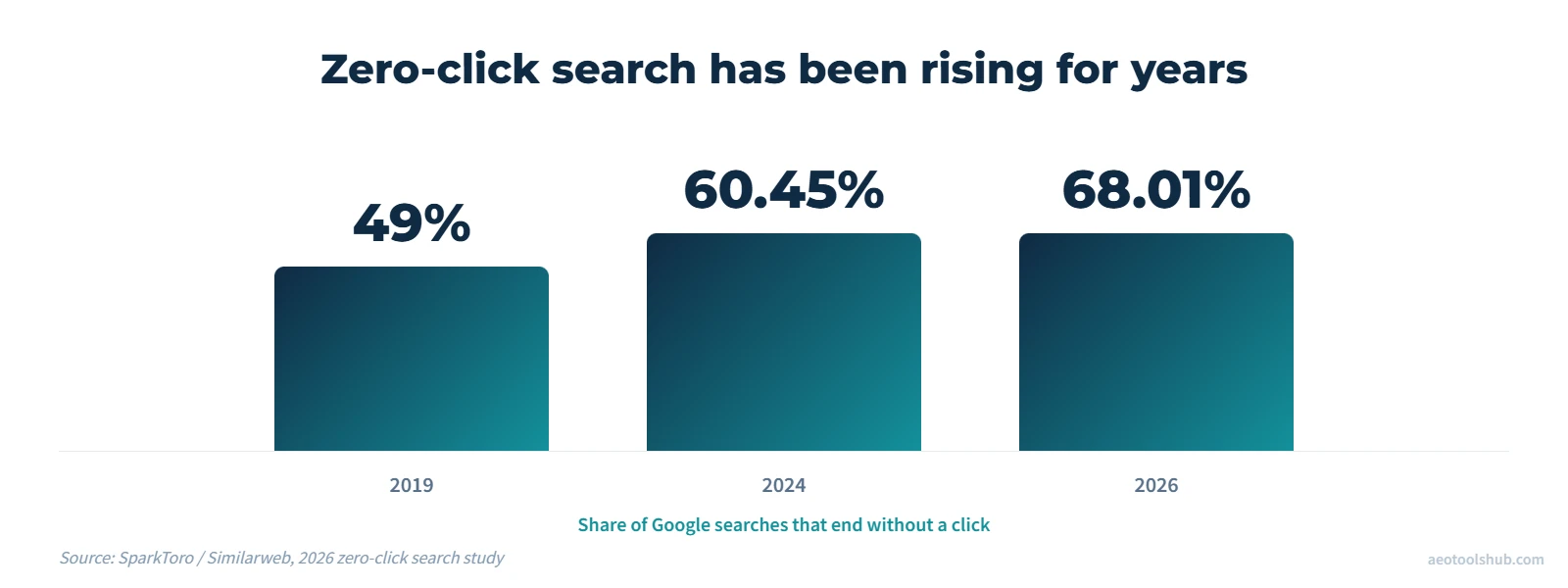
They’re not making this up. Zero-click search, a Google query that ends without a single click to any result, hit 68.01% of US searches in the first four months of 2026, up from 60.45% just two years earlier, according to SparkToro’s analysis of Similarweb clickstream data.1 AI Overviews now show up on more than one in five Google searches and, when they do, cut the top organic result’s click-through rate by close to 60%.1 If your whole SEO scoreboard is “clicks to my website,” 2026 has been a genuinely bad year, and pretending otherwise doesn’t help anyone.
Interestingly, AI Mode, the feature that gets the most hype in SEO Twitter threads, is barely a rounding error so far. It accounted for just 0.34% of searches in that same four-month window.1 It’s growing fast, and it’s probably where more of this shift happens next, but the “AI has already replaced Google” framing you’ll see in some pitches is ahead of what the data shows today.
What those numbers actually say, if you read past the headline
Rand Fishkin, who’s been publishing zero-click research since 2019 and has no obvious reason to talk his own book up in SEO’s favour, put it plainly in the same report that produced the 68% figure: “your SEO still matters as much or more than ever before, it just won’t earn you traffic the way it once did.”1 That’s the part that gets dropped from the doom-post version of this story.
A zero-click search isn’t a search where SEO did nothing. It’s a search where Google, or the AI system answering it, used your page’s content, structure and authority to build the answer, then kept the visitor instead of sending them to you. The technical work that makes a page crawlable, parseable and citable is exactly the same work that used to earn a blue link and a click. What changed is what happens after that work succeeds, not whether the work still matters.
AEO is SEO applied to alternative search engines, not a new discipline
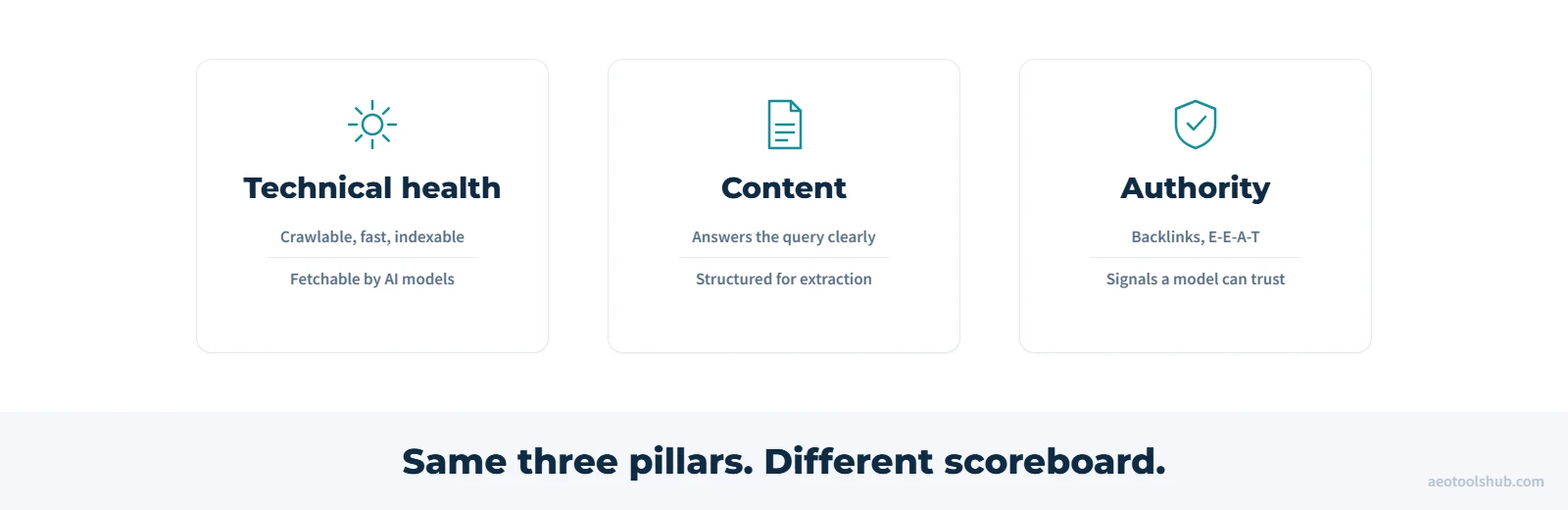
This is the part I’ll be direct about, because I think a lot of the “SEO vs AEO” framing floating around right now is dishonest, even when it’s not meant to be. Look at what every credible “how to get cited by AI” guide actually tells you to do: fix technical access so the model can crawl and read your content, structure content so it answers a specific question clearly, and build authority so the model has a reason to trust and cite the source.2 Technical health, content, authority. Those are SEO’s own three pillars, wearing a new acronym.
The honest framing isn’t “AEO replaced SEO” or “AEO is SEO’s successor.” It’s that AEO is SEO applied to a different scoreboard, AI answer engines instead of the classic ten blue links, using the same underlying levers. If you’ve built a genuinely strong SEO foundation, you already own most of what AEO asks for. If you haven’t, no amount of AEO-branded tactics fixes that, because there was never a separate set of AEO fundamentals to begin with.
Where the hype gets it wrong
Some of what’s happening in the AI-search commentary right now is useful and some of it is just repackaging. I see agencies selling a “GEO audit” that’s the same technical crawl and content gap analysis they’ve been selling for a decade, with a different cover page. I see creators declaring “SEO is dead” not because the data supports it, but because it’s a better hook than “SEO changed its distribution mechanics,” which is true and much less exciting to post about.
None of that makes the underlying work fraudulent, and I’m not going to pretend every AEO/GEO offering out there is a scam, most people selling this are working from a real, if oversimplified, read of a real shift. But a rebrand isn’t a new discipline, and a client paying twice for the same audit under two different names deserves to know that.
What’s actually different, and what to prioritise in 2026
The mechanics didn’t change; the scoreboard did, and that has real, practical consequences.
First, traffic alone stops being a reliable success metric on its own. A page can lose clicks to a zero-click answer while still being the exact source that answer was built from, which is genuinely good for brand visibility even if it doesn’t show up in your analytics as a session. Track citation and retrieval frequency alongside rankings and traffic, not instead of them, the same way our AI visibility measurement guide lays out.
Second, the technical and content fundamentals get more valuable, not less, because now two different systems depend on them, classic ranking algorithms and AI retrieval, and neither works on a page that isn’t crawlable, well-structured or written to actually answer the question it targets.
Third, authority building doesn’t get replaced by anything AEO-specific, but the targeting inside it does shift. The backlinks, press coverage and entity signals that used to feed PageRank now also feed whether an AI model trusts a source enough to cite it, and the AI side adds constraints classic link-building never had to weigh: whether the target page is plain HTML rather than paywalled or JavaScript-rendered, whether the domain is already retrieved as a source in your category rather than just generically high-authority, and whether your own entity is disambiguated via schema and Wikidata so a new mention actually attaches to you rather than a similarly-named competitor, as our digital PR guide gets into. Same pillar, same underlying assets, a more specific playbook for using them, not a different one.
Fourth, don’t mistake today’s technical checklist for a permanent one. Crawlable HTML is this decade’s version of the same story mobile-first indexing and Core Web Vitals told before it, a snapshot of what a particular generation of systems needed to access your content, not the final form of “technical health.” Autonomous purchasing agents already lean on structured product feeds as much as on crawled pages, and multimodal search is starting to work from audio and video metadata rather than markup at all. Treating HTML crawlability as the last word on technical access is the same complacency this piece calls out in agencies still selling the same audit under a new name, it just shows up a layer deeper.
Stop measuring AEO like it’s 2015 web traffic
There’s a harder problem sitting underneath everything above, and it’s the one most AEO pitches skip past. If the fundamentals haven’t changed, technical health, content, authority, why does this feel so different to run? Because the business model built on top of those fundamentals is what actually breaks when the answer gets served on the page and the click never happens.
For two decades, SEO’s economics were simple: rank, get the click, monetise the visit on your own site. That’s the model most agency reporting, and most client P&Ls, are still built around. It doesn’t survive an AI recommending you inside a chat window with no click attached to it at all.
And that’s before you even get to attribution. Someone sees your brand recommended by ChatGPT, doesn’t click, and buys two months later through a completely different channel. No last-click model, no Google Analytics report, catches that. I don’t think there’s a clean fix for this coming. What there is, is a different way to measure that already exists, we just haven’t been applying it here.
AEO doesn’t measure like website traffic used to. It measures like PR or TV advertising always did: coverage plus correlation, not a traceable funnel. Nobody running a TV campaign expects to trace an individual sale back to a single ad spot, and nobody should expect that from an AI mention either. The report just needs to combine the right three signals instead.
Coverage is the easiest of the three, and the one every AEO tool already gives you: how often the AI is actually mentioning you for the queries that matter to your category, tracked over time the same way our AI visibility measurement guide lays out.
Positioning is the one most reports skip entirely. Being mentioned and being recommended aren’t the same thing. Does the AI frame you as the market leader, the budget option, or an afterthought in a list of five? That’s a qualitative read on the actual chat responses, not something a dashboard number captures on its own.
Correlation is the one that asks you to let go of clean attribution altogether. Branded search volume moving. Leads mentioning ChatGPT or Perplexity by name in a contact form. Sales conversations that open with “I asked an AI and it pointed me to you.” None of that traces back through a single click, and none of it should have to. Set it next to your coverage and positioning numbers, watch it move alongside revenue over a quarter, not a session, and you have something closer to how brand marketing has always proven itself.
This isn’t a tidy answer, and I’d be lying if I said it was. But the honest version of “does AEO work” was never going to be a single dashboard metric. It’s this, three signals, watched together, over longer than a month.
FAQ
Is SEO actually dead in 2026?
No. Zero-click search and AI Overviews changed where the traffic from a successful search goes, they didn’t remove the need for a site to be crawlable, well-structured and authoritative. Every AI answer engine still depends on those same fundamentals to decide what to retrieve and cite.
Should I rebrand my SEO services as AEO or GEO?
Only if you’re actually adding something, tracking citation and retrieval metrics, auditing for AI-specific access issues, restructuring content for answer extraction. Relabelling the same technical audit and content calendar under a new acronym isn’t a new service, and clients researching this space are increasingly able to tell the difference.
Does getting cited by AI search engines require different fundamentals than ranking in Google?
No, it requires the same three fundamentals, technical accessibility, content quality and structure, and authority, applied with AI retrieval in mind rather than classic ranking. A site with weak SEO foundations doesn’t get a shortcut into AI citations by doing “AEO” instead.
My organic traffic is falling but I still want to invest in search. What should I actually prioritise?
Stop treating traffic as the only success metric, and stop expecting AI-driven visibility to behave like a trackable funnel. Measure it more like PR or TV always were: how often you’re covered, how you’re positioned when you are, and whether branded search and self-reported leads move alongside it, see the reporting section above for the full breakdown. Beyond that, keep investing in the same technical health, content depth and authority-building that’s always mattered, that work is what both classic rankings and AI citations are built on.