
Ten years ago, a press mention was worth exactly one thing: a backlink, and maybe some referral traffic if the outlet’s audience overlapped with yours. That’s still true for classic SEO. But an AI engine reading that same article isn’t following a link graph, it’s deciding whether to pull a paragraph of that page into an answer it’s generating right now, and whether to say where the paragraph came from. Those are two different jobs, and press coverage that’s brilliant at one can be invisible at the other.
Digital PR earns its place in a GEO strategy specifically because of that second job. Not as a replacement for backlink-driven PR, as a distinct discipline with its own targeting logic, on top of it.
Why AI citations run on a different currency than backlinks
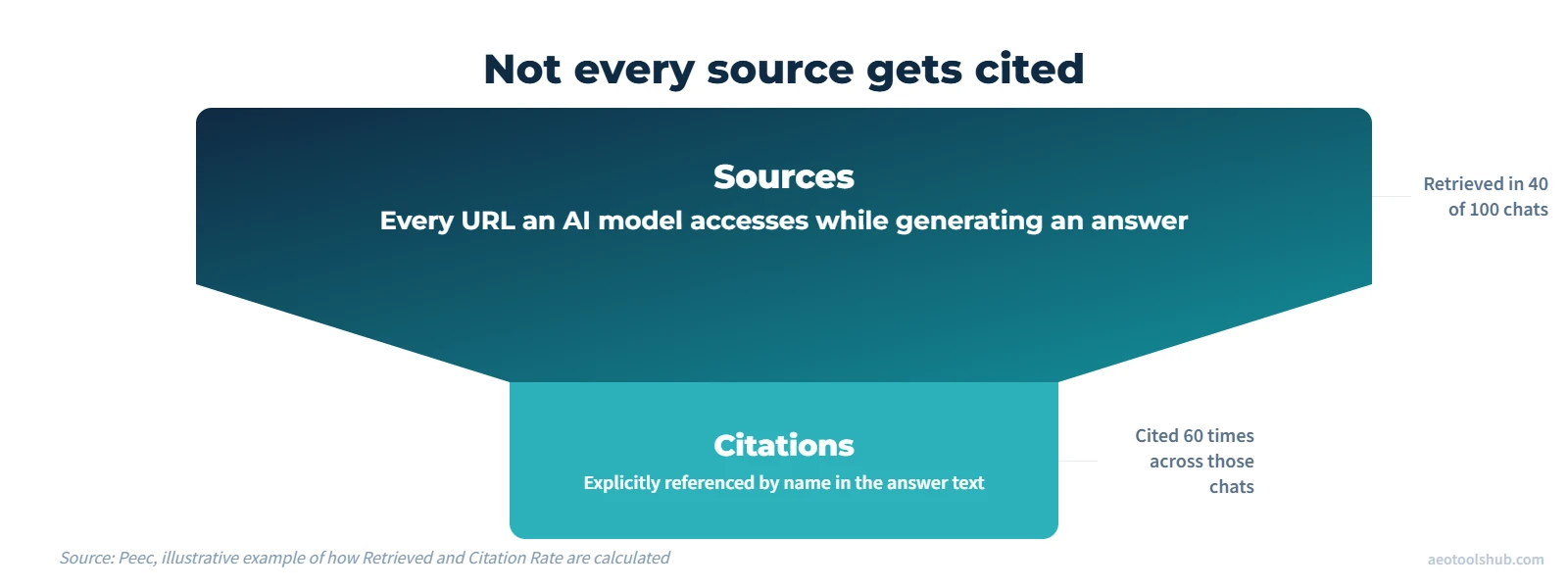
An AI engine doesn’t treat every page it touches the same way. There’s a real, useful distinction between a page the model retrieves while forming an answer and a page it actually cites in the text it shows you: sources are every URL an AI model accesses while generating a response, citations are the subset explicitly referenced in the answer itself.1 A press mention can do either. Being retrieved without being cited still shapes the answer’s substance even though your name doesn’t show up in the footnotes; being cited puts your outlet’s name (and sometimes yours) directly in front of the reader.
There’s a harder constraint sitting underneath both: AI models generally only see HTML content. They can’t read behind a paywall, and they can’t reliably load content that depends on JavaScript to render.1 A glowing feature in an outlet that paywalls everything after the second paragraph may be excellent for your reputation and close to worthless as an AI source. That’s a genuinely practical filter to apply before pitching: can this outlet’s article actually be read by a model with no login and no JS execution.
The core levers for AI-citable PR
Editorial coverage is a category of its own
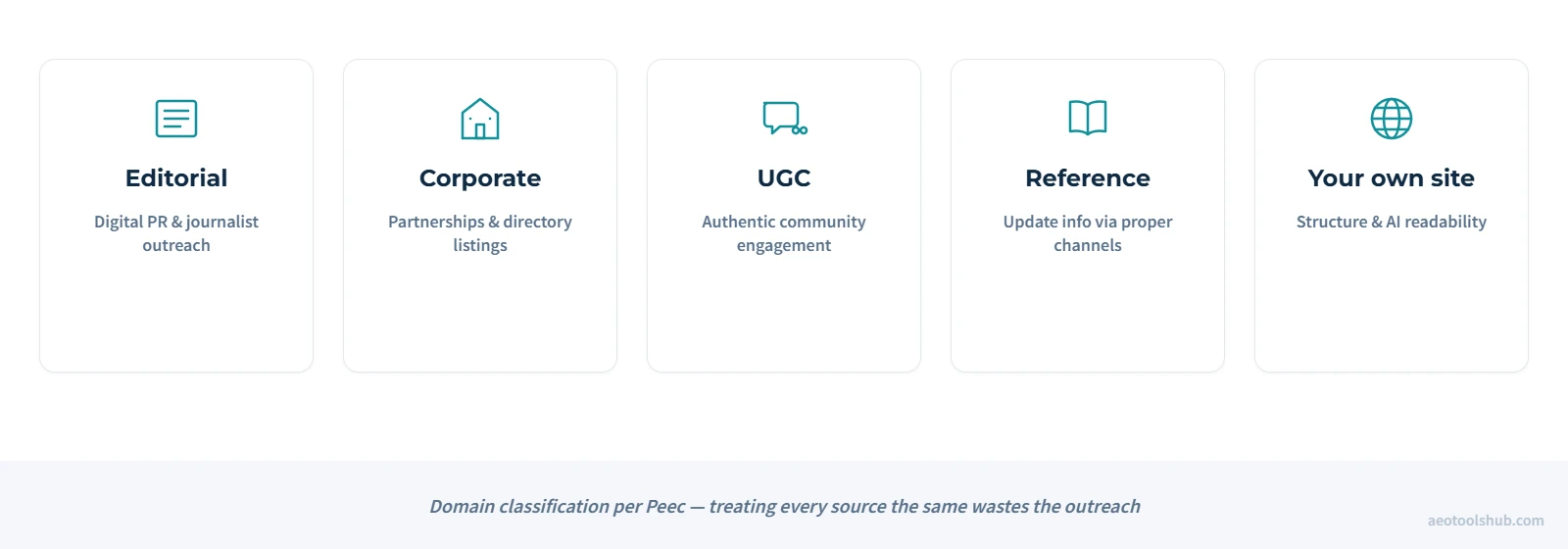
AI visibility tracking tools that classify sources typically split them by domain type: editorial (news sites, blogs, magazines), corporate (official company pages), UGC (forums, social, communities), reference (encyclopaedias, documentation) and institutional (government, education, non-profits). Each type responds to a different tactic, and editorial specifically is the one that responds to digital PR and journalist outreach, not to the community engagement that moves UGC or the partnership listings that move corporate sources.1 Treating a “get featured in TechCrunch” campaign and a “get discussed on Reddit” campaign as the same kind of work is the single most common category error in this space, they’re different sources, different levers, different outcomes.
Original data and quotable research travel further than announcements
A press release announcing a product update gives a model nothing distinctive to lift, dozens of outlets can say the same thing in the same words. A press release built around an original data point, a survey finding, a benchmark, gives the model something specific and attributable to quote. The Princeton-led academic research that coined the term Generative Engine Optimization tested exactly this: adding statistics, quotations and cited sources to content, and found these methods can boost visibility in generative engine responses by up to 40%.2 The mechanism holds for PR specifically for the same reason: a generic claim is interchangeable with a hundred others, a specific, sourced number is not, and AI systems built to sound authoritative gravitate toward content that already sounds authoritative.
A quote in someone else’s article carries their authority, not yours
Being quoted by name in a journalist’s piece on an established outlet is a different lever again, distinct from getting your own page indexed and distinct from a data-led press release. The citation, if it happens, attaches to the outlet’s domain, not yours, which is exactly why it works: the model isn’t being asked to trust a company talking about itself, it’s citing a third party who already cleared the outlet’s own editorial bar. Building a track record of expert commentary in outlets that already show up as sources in your category compounds in a way a single big placement doesn’t.
Journalist request platforms, after HARO
For years the easiest way into this kind of coverage was HARO (Help a Reporter Out), free, high query volume, low barrier to entry. Cision, which owned it at the time, permanently discontinued the rebranded Connectively platform on 9 December 2024.3 Featured then acquired both the HARO and Connectively brands: HARO came back as the same free, three-times-a-day newsletter it always was, while Connectively is being relaunched as a fuller platform (filtering, response tracking, a proper UI) for people who want more than an inbox digest, alongside Featured itself relaunching as an AI co-pilot for PR.4 Qwoted remains a separate, active alternative, a free tier plus paid plans running roughly $99 to $149 a month, connecting journalists working on a story to sources willing to comment.5 Whichever platform, the target list should be filtered the same way: is this outlet’s content plain, accessible HTML, and does it already show up as a retrieved source in your category.
Entity clarity: the layer coverage alone doesn’t fix
Everything above assumes the model, once it retrieves a piece of coverage, correctly attaches the mention to your brand or your expert rather than someone or something else with a similar name. That step isn’t automatic. Two consultants sharing a name, a brand name that’s also a common word, a small company that happens to share a name with an older, unrelated one, all break that attachment unless something in the data explicitly says these are different entities.
Organization and Person schema carrying a sameAs property exists for exactly this. It doesn’t describe an entity in more detail, it points to a set of external URLs, Wikipedia, Wikidata, LinkedIn, Crunchbase, that already describe the same thing, so a system reading the page can cross-reference and confirm it’s looking at one consistent identity rather than inferring one from a name alone.6 Google’s own documentation on Organization markup confirms some of its properties exist specifically to disambiguate an organisation from other organisations, separate from anything to do with rich results or rankings.7
Wikidata is worth prioritising first among those targets. It’s a freely licensed, machine-readable database, every entry carries its own permanent Q-number identifier, and unlike Wikipedia it has no notability threshold, an entity only needs verifiable, sourced facts to qualify for an entry.8 It’s also widely documented as the single largest structured-data feed into Google’s own Knowledge Graph, the same underlying infrastructure Gemini and AI Overviews draw on.9 None of this is fully documented in public, exactly how each model performs entity resolution internally isn’t published anywhere, Google included, but the practical pattern holds: a model finds it easier to attach a new mention to an entity that already exists as a clean, sourced, cross-linked node than to one it’s never had reason to disambiguate before.
That changes the order of operations for a PR push. Chasing editorial coverage before the entity itself is established, consistent naming, sameAs links from every owned property, a Wikidata item if the sourcing clears the bar, means each new mention is a data point the model has to work harder to place, and some of it will land on the wrong node or nowhere at all. Get the identity layer in place first, or at least alongside the outreach, and the same coverage does more.
What AI engines actually pull from press coverage
The most direct way to find where to pitch isn’t guesswork, it’s looking at where your competitors are already being used as a source and you aren’t. That gap, an outlet retrieved often and already citing rival brands, is a live opportunity: a domain like that is proven to be in the model’s rotation for your topic, so the only missing variable is your name appearing on it.10 Outlets that show up rarely, or not at all, as sources for your category are a weaker bet regardless of their general prestige. A front-page feature in a publication the AI models never seem to retrieve for your topic area is good for the CEO’s ego and does very little for citations.
What doesn’t work
A wire-only press release with no organic pickup by an actual editorial outlet rarely becomes an AI source at all, distribution volume isn’t the same as being retrieved. A single mention, cited once and never again, reads very differently to a model than a domain that returns to your brand repeatedly across multiple pieces, the second pattern is what signals that a source is treated as consistently relevant rather than a one-off. And coverage on a site that’s paywalled, gated behind a login, or rendered entirely client-side in JavaScript may as well not exist for this purpose, however good the placement looks in a clippings report.
How to measure it
Track this the way you’d track any other domain-level AI visibility metric, alongside the citation-frequency approach our AI visibility measurement guide lays out generally. Three numbers matter specifically for PR: how often a domain gets used as a source at all, how many of that domain’s pages get pulled into a single answer on average, and how often, once used, that domain is actually cited by name rather than silently drawn on.10 A domain your outreach lands on repeatedly, that’s cited by name most times it’s used, is doing far more for your AI visibility than a bigger domain that’s only ever retrieved and never quoted, exactly the gap our piece on retrieval rate vs citation rate digs into with real client data: small, specific sites regularly out-cite domains that outrank them on every traditional authority measure. Running a gap analysis against your closest competitors on exactly this basis, editorial domains where they’re cited and you aren’t, turns a PR target list from a hunch into something closer to a prioritised media list.
FAQ
Does digital PR help AI visibility the same way it helps SEO?
No, and treating it as the same campaign is a mistake. Classic SEO PR is chasing a link and domain authority. AI-citation PR is chasing being retrieved and, ideally, explicitly cited by a model generating an answer, which depends more on whether the outlet’s content is plain, accessible HTML and whether that domain already shows up as a trusted source in your category.
Do I need to be cited by name, or is being used as a source enough?
Both matter, but they’re not the same thing. A source that’s retrieved without being explicitly cited still shapes the substance of an AI’s answer even if your name never appears in it. Being cited by name is the stronger outcome and worth optimising for specifically, but don’t dismiss coverage just because it wasn’t quoted verbatim in a given answer.
What kind of outlets should a digital PR campaign target for AI visibility specifically?
Editorial domains that are already retrieved as sources for your category, and that publish as plain HTML rather than behind a paywall or a JavaScript-heavy render. A prestigious outlet that AI models rarely draw on for your topic, or that gates its content, is a weaker target than a mid-tier trade publication that shows up constantly as a source.
Is a single big press hit enough to move AI citations?
Usually not on its own. A domain that’s used as a source once and never again reads very differently to a model than one that keeps coming back across multiple pieces. Consistency across several placements on the same handful of outlets tends to outperform one large, one-off feature.
Does my brand or expert need a Wikidata item before doing digital PR?
Not strictly before, but earlier is better. A Wikidata item and consistent sameAs links help a model attach new coverage to the right entity instead of a similarly-named one, so establishing that identity layer alongside, or just ahead of, an outreach push makes the same coverage more effective rather than being a hard prerequisite.