
What is Answer Engine Optimisation (AEO)? The Complete Guide
AEO is the practice of optimising your content so that AI-powered search engines select it as a source when generating answers. Here’s what it is, how it differs from SEO, and how to get started, technical foundation first.
Jul 5, 2026 · ~9 min readSearch has changed. For most of its history, a search engine’s job was to return a list of links and let the user decide which one to click. Today, a growing share of queries never reach that list. They get answered directly by an AI engine that reads across dozens of sources, synthesises an answer, and presents it as its own.
For brands and content creators, this shift creates a new problem: ranking on page one of Google is no longer enough. You also need to be selected by AI engines as a source worth citing. That’s what Answer Engine Optimisation is about.
We’ll say upfront where we come from on this, because it shapes everything else in this guide: AEO fails without a technical foundation first. Not content, not links, technical. A page an AI crawler can’t reach or can’t parse doesn’t exist as far as that engine is concerned, no matter how good the writing is. We’ve seen brands pour budget into content restructuring while a robots.txt misconfiguration was quietly blocking the crawler that would have read it. That’s the mistake this guide is written to help you avoid.
This guide explains what AEO is, how it differs from traditional SEO, what signals AI engines use to choose their sources, and how to get started, whether you’re new to the concept or looking to build a systematic approach.
What is Answer Engine Optimisation?
Answer Engine Optimisation (AEO) is the practice of structuring and positioning your content so AI-powered search engines select it as a source when generating answers to user queries. Where traditional SEO targets rankings on a results page, AEO targets inclusion in the AI-generated answer itself, either as a cited source, a direct quote, or a recommended brand.
The term covers optimisation for any platform that generates answers from retrieved content: ChatGPT Search, Perplexity, Google AI Overviews, Google AI Mode, Microsoft Copilot, and similar tools. These platforms don’t simply index and rank pages, they read them, extract information, and use that information to construct a response. AEO is the discipline of making your content reachable, easy to parse, and credible enough to cite, in that order.
How AI answer engines work
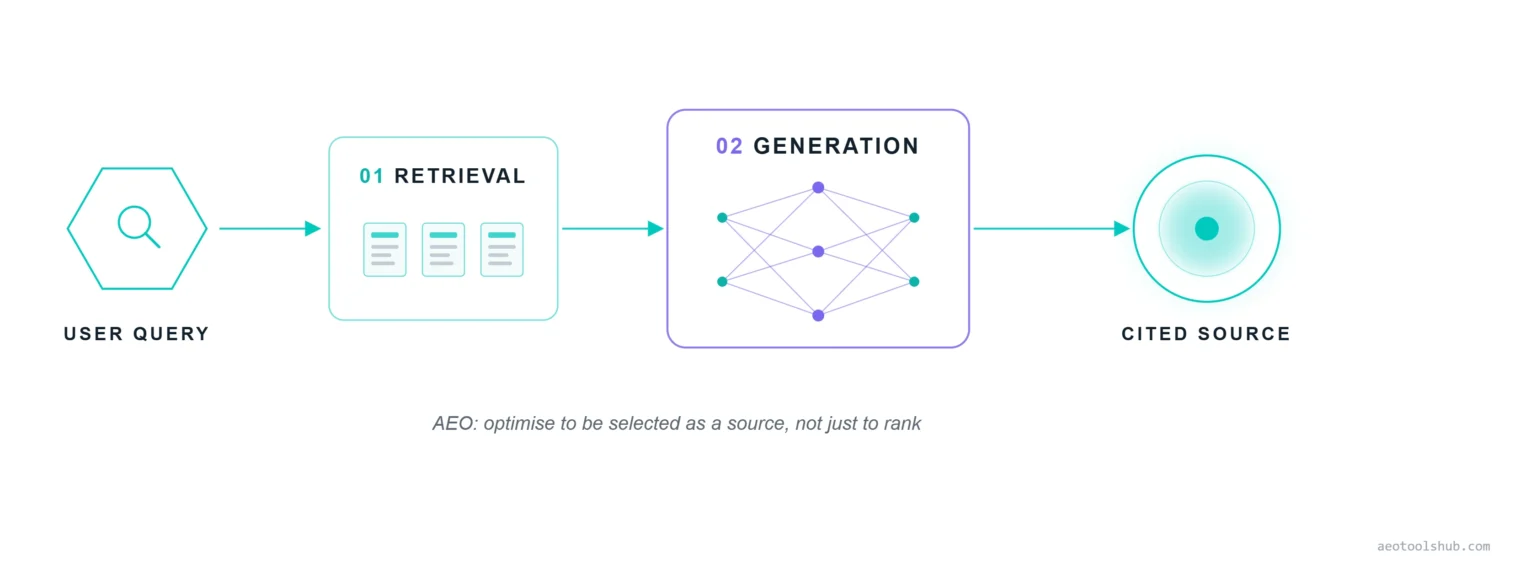
To understand why AEO tactics work, it helps to understand the two-step process behind every AI-generated answer.
Step 1: Retrieval
When a user submits a query, the AI engine searches the web (or its indexed corpus) for candidate sources. This retrieval step is a technical gate before it’s anything else. If your page is blocked by robots.txt, returns errors, or serves content that only renders after JavaScript the crawler doesn’t execute, it cannot be retrieved. It doesn’t matter how good the content is if the engine never sees it. Everything else in this guide assumes retrieval is already working.
Step 2: Generation
From the retrieved candidates, the AI model selects which sources to draw from and constructs its answer. This selection reflects the model’s assessment of which content is most relevant, most clearly structured, and most credible for the specific query. Pages that answer the question directly, use clear structure, and carry strong authority signals are more likely to be included.
AEO works at both steps: technical health affects retrieval; content structure and authority affect generation. But retrieval comes first structurally and it comes first in priority. A brilliant answer that never gets retrieved never gets a chance to be selected.
AEO vs traditional SEO: what is the difference?
AEO and SEO share a foundation, quality content, technical health, and authority, but they optimise for different outcomes on different surfaces.
What SEO optimises for
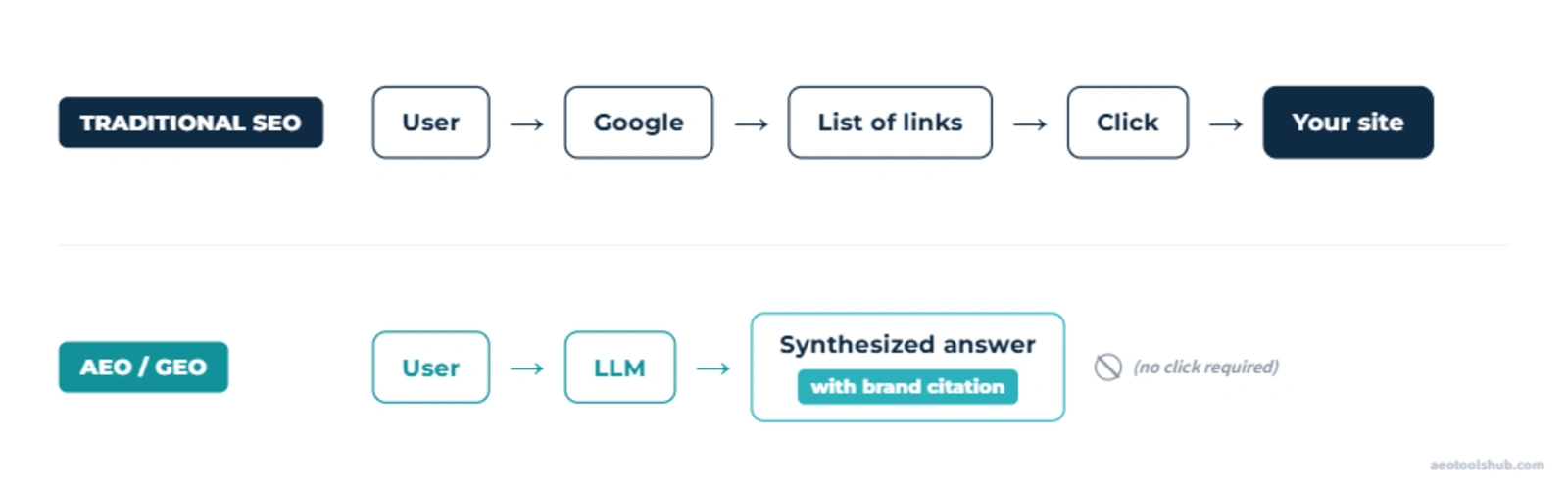
Traditional SEO optimises for rankings: the goal is to appear as high as possible in a list of results, so users choose your link over the alternatives. Success is measured in rankings, organic clicks, and traffic. The user still has to click through to your page.
What AEO optimises for
AEO optimises for citations and inclusion: the goal is to be selected as a source in an AI-generated answer, so the user receives your information whether or not they click through. Success is measured in AI visibility, how often your brand or content appears in AI responses, across what queries, and in what position.
Where they overlap and where they diverge
AEO carries over everything traditional SEO already requires, crawlability, quality content, authority, and adds a layer on top for being cited directly in AI answers rather than only ranking for clicks. That’s deliberate: a strong SEO foundation makes AEO significantly easier, brands that have already invested in crawlability, content quality and authority-building are most of the way there already. AEO doesn’t start from zero. For the full side-by-side across SEO, AEO and GEO, see AEO vs GEO vs SEO.
Why does AEO matter?
AI-powered search is growing fast, and the numbers are public. OpenAI said in April 2025 that ChatGPT search had passed 1 billion web searches in a single week, calling it one of its fastest-growing features (OpenAI’s official announcement). Perplexity’s CEO confirmed 780 million monthly queries as of May 2025, with month-over-month growth above 20% at the time (reported via Bloomberg’s Tech Summit). Both platforms have almost certainly grown further since those figures were published, but we’re citing the actual disclosed numbers rather than the inflated estimates that circulate online.
The pattern behind the numbers matters more than the numbers themselves: users are increasingly getting answers from AI instead of clicking through a list of links. When an AI engine answers a question about your category, it cites someone. If it’s not you, it’s a competitor. Brands that aren’t represented in AI answers are losing visibility with a growing segment of their audience, often without realising it, because the traffic loss shows up as a general decline rather than an identifiable cause.
Any brand that relies on informational or research-driven queries is exposed. This includes B2B SaaS, professional services, e-commerce (especially products where buyers research before purchasing), health and finance, and any industry where “best,” “how to,” or “what is” queries are common entry points. If your customers are asking AI engines questions that lead to your category, you need to be in those answers.
The core elements of AEO
Technical accessibility, the one that gates the rest
We’re putting this first deliberately, and not in the order most AEO content presents it. None of the elements below matter if an AI crawler can’t reach your page or can’t parse what’s on it. That means: robots.txt allows the relevant AI crawlers, pages don’t depend entirely on client-side JavaScript to render their core content, response times are reasonable, and there are no accidental blocks coming from a CDN or bot-management tool sitting outside robots.txt entirely. This is boring, unglamorous work. It’s also the highest-leverage fix available to most sites, because it’s usually a yes/no problem with a yes/no fix, unlike content quality, which is a spectrum you improve gradually.
Content structure and format
AI engines extract answers from content that’s clearly structured. Pages that answer the target question directly in the first 100 to 200 words, use descriptive H2s and H3s that mirror how people phrase questions, and present information in paragraphs, lists, and tables are significantly more likely to be cited. Vague, padded, or hard-to-parse content gets passed over, assuming it was retrievable in the first place.
Authority and trust signals (E-E-A-T)
AI engines, like Google, weight Experience, Expertise, Authoritativeness, and Trustworthiness. In practice: clear author credentials, third-party mentions and citations of your brand across the web, consistent and accurate information, and a track record in your topic area. A brand well-represented across independent sources (news coverage, industry publications, reviews) is more likely to be retrieved and cited.
Schema markup and structured data
Schema markup helps AI engines understand what your content is about and how to classify it during extraction. FAQ schema, Article schema, HowTo schema, and Organisation schema are all relevant here. Worth noting since it’s easy to get wrong: Google deprecated FAQ rich results in Google Search entirely as of May 2026, so FAQ schema no longer earns you a visual dropdown in classic search results. It still has real value for AEO, since Google and other engines continue to parse it to understand page structure, but don’t implement it expecting a Search Console rich-result win anymore.
Brand entity and third-party mentions
AI engines build an understanding of brands through the web’s collective coverage of them. A brand mentioned consistently and accurately across reputable third-party sources, with a consistent name, description, and category, is a stronger entity in the AI’s knowledge base. Digital PR, review platforms, and structured entity data (Wikidata, Google Business Profile) all contribute.
How to get started with AEO
Getting started doesn’t require rebuilding your content strategy from scratch. In our experience the highest-impact entry point is always the same, and it’s the one people skip because it feels too simple to be the answer:
- 1Audit your robots.txt first — confirm you’re not blocking the AI crawlers that matter for search visibility, specifically OAI-SearchBot (ChatGPT Search), PerplexityBot, and Claude-SearchBot. Google AI Overviews and Gemini use standard Googlebot access, no separate directive needed.
- 2Audit your top content — identify which pages answer informational queries and restructure them to answer the question directly in the opening paragraph
- 3Add FAQ sections — still one of the most reliably cited content formats across AI engines, even without the Google rich-result payoff it used to have
- 4Check your schema — implement Article and FAQ schema as a baseline on your key pages
- 5Assess your brand entity — search for your brand in ChatGPT, Perplexity, and Google AI to understand your current baseline
For the full tactical playbook, see How to get your brand cited by AI search engines. For platform-specific crawler details, see How the major AI search platforms work.
Frequently asked questions about AEO
Is AEO the same as SEO?
No. AEO and SEO are related disciplines that share a technical and content foundation, but they target different outcomes on different platforms. SEO targets rankings in traditional search results; AEO targets citations and inclusion in AI-generated answers. A strong SEO foundation helps AEO, but the two require different strategic priorities.
Does AEO replace SEO?
Not at this stage, and we’d argue it shouldn’t be framed that way even as the platforms mature. Traditional search still drives the majority of organic traffic for most brands, and the technical and authority signals that underpin SEO also underpin AEO. Treat AEO as an additional layer, not a replacement. Brands that abandon SEO in favour of AEO prematurely will likely lose more than they gain.
Which AI engines does AEO target?
Any AI engine that generates answers from retrieved web content. The main platforms today are ChatGPT Search, Perplexity, Google AI Overviews and AI Mode, Microsoft Copilot, and Gemini. Each has different retrieval and citation behaviour, see our platform-by-platform breakdown for the specifics.
How long does AEO take to work?
This varies enough by starting point that we’re wary of giving a single number, and you should be skeptical of anyone who gives you one without qualification. What we can say directly: technical fixes (unblocking a crawler, fixing a rendering issue) tend to show up in visibility checks within days to a few weeks, because there’s no content production cycle involved, you’re just removing a blocker. Content restructuring and authority-building take meaningfully longer, since they depend on how often the specific platform re-crawls and re-evaluates your pages.
Can small brands do AEO without a big budget?
Yes. The highest-impact AEO improvements, technical fixes, content restructuring, FAQ sections, schema markup, are low-cost and can be implemented by a single person. Where budget matters more is authority-building (digital PR, media coverage), which is harder to achieve without investment. But technical and structural improvements alone can produce meaningful gains for brands with limited resources, and they’re the improvements we’d tell a resource-constrained brand to make first.
Next steps
The fastest way to test whether AEO is working for you: pick your three highest-traffic informational pages and check whether the first 150 words answer the primary question directly, with no scene-setting preamble first. If they don’t, that’s the single highest-leverage edit available this week, reformatting existing content for direct extraction usually beats writing something new from scratch. Pair that with one schema pass (FAQPage or HowTo, wherever genuinely eligible) and you’ve covered the two changes with the fastest payoff for the least effort.