
Brand Entity Optimisation for AI: Wikipedia, Wikidata and Beyond
Two of my own guides already pointed here and said “coming later.” This is the deep, practical version: what actually earns you a Wikipedia page, why Wikidata is the realistic move for almost everyone else, and the schema work that ties it together.
Aug 2026 · ~9 min readI’ve put off writing this one on purpose. Both the LLMO piece and the platform tactics matrix name-checked Wikipedia and Wikidata and then waved at “a dedicated guide, coming later” rather than turn either into a rushed paragraph. This is that guide, and it needed the wait. Entity optimisation is the one part of AEO/GEO where a shallow how-to is actively worse than nothing, because it sends small brands chasing a notability bar most of them won’t clear.
What “brand entity” actually means here
Quick recap before the tactics, because the term gets used loosely. An AI engine doesn’t just index your web pages, it builds something closer to a profile: what your brand is, what category it sits in, how it’s consistently described across independent sources. My guide to getting cited calls this “brand entity strength” and lists it as one of the five signals that influence both retrieval and generation. Everything below is about building that profile deliberately instead of hoping it accretes on its own.
Two of the sources that feed it, Wikipedia and Wikidata, sit apart from everything else on this list because they’re not something you own or can simply publish to. You have to earn your way in, through processes with their own rules, their own reviewers, and their own very low tolerance for anything that reads as self-promotion.
Wikipedia: the hardest option, and the one most brands should skip
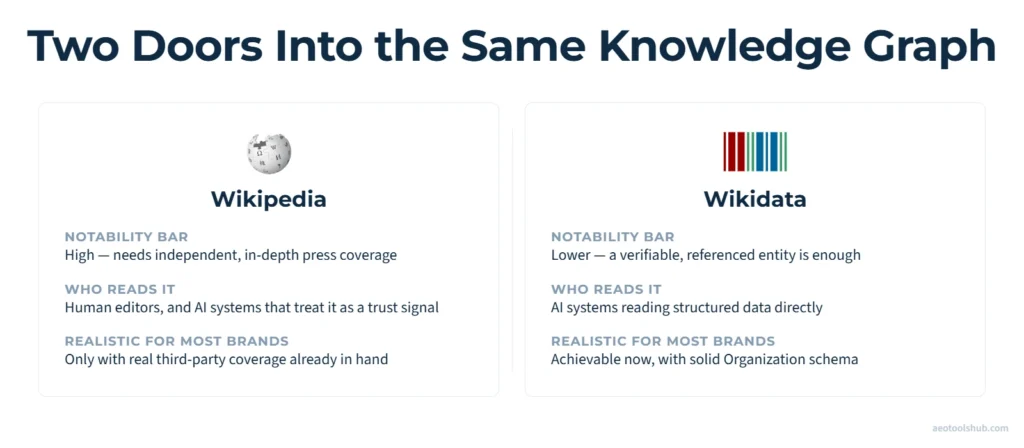
Start with the honest version, because most AEO content doesn’t. Wikipedia’s own guideline on organisations and companies, WP:NCORP, sets a bar that’s genuinely hard to clear: multiple pieces of significant coverage, from sources that are independent, secondary and reliable. Significant means in-depth, not a passing mention or a directory listing. Independent rules out more than people expect: your own press releases, sponsored content, and even a journalist interviewing your CEO for a piece that’s really just repackaging your talking points. None of that counts. Only a small fraction of the world’s companies clear this, by design. The guideline exists specifically because Wikipedia has a long history of fighting off companies trying to use it as a marketing channel.
Because of that, the practical path for most brands that want to try isn’t DIY, it’s hiring people who do this professionally and know Wikipedia’s editorial culture from the inside. I’ve been through this first-hand: a consumer electronics client I worked with went through a specialist agency to get product pages published, not brand pages, but the mechanics are the same. A few things from that experience that don’t show up in the generic “how to get a Wikipedia page” listicles:
There’s no reliable timeline. If you land a proactive, engaged editor, it can move in a few weeks. If you don’t, it can drag past a month with long silences in between. Wikipedia editors are volunteers reviewing this in their own time, against their own judgement of whether a submission belongs. You’re not paying for a guaranteed turnaround, because there isn’t one to sell.
The template requirements are the real difficulty, not the writing. It’s not that Wikipedia articles need to sound a certain way, it’s the sheer number of specific, non-obvious details the structure and sourcing conventions demand, most of which aren’t clearly documented anywhere you’d find on a first pass. Getting the format right takes someone who’s done it repeatedly, not someone reading the manual of style once.
Rejections happen, and the reasons can be arbitrary. I had a submission rejected because the reviewing editor said they weren’t familiar with that specific category of product, not because the sourcing was weak. That’s the reality of a volunteer review process: the outcome depends partly on who happens to pick up your submission, and there’s no appeal process that guarantees a different result.
If you’re paying anyone, disclosure isn’t optional. The Wikimedia Foundation’s Terms of Use legally require anyone editing for pay to disclose their employer, client, and affiliation, whether that’s on their user page, the article talk page, or via the standard {{connected contributor (paid)}} template (full policy at Wikipedia:Paid-contribution disclosure). Undisclosed paid editing gets articles deleted and accounts banned, and any agency worth hiring will insist on doing this properly rather than quietly. If someone offers to get you a Wikipedia page without mentioning disclosure at all, that’s a red flag on its own.
My honest read, having sat inside this process: it’s a job for specialists, not a DIY weekend project, and the specialist cost is real enough that it’s genuinely not a sensible move for most small or mid-sized brands. If your marketing budget is measured in thousands a month rather than tens of thousands, Wikipedia probably isn’t where that budget should go. That’s not me being precious about it, it’s what the process itself demands.
Wikidata: the realistic move for almost everyone else
This is the part of the guide that actually applies to most people reading it. Wikidata is a separate project from Wikipedia, structured data rather than prose, and its notability bar is meaningfully lower. Per Wikidata’s own notability policy, an item qualifies if it meets any one of three criteria: it already has a page on Wikipedia or another Wikimedia project, it refers to a clearly identifiable conceptual or material entity that can be described with serious, publicly available references, or it fills a genuine structural need, for instance making statements on other items more useful. That second criterion doesn’t require the kind of in-depth, multi-source coverage WP:NCORP demands. A real, verifiable brand with a handful of credible references behind it clears this far more often than it clears Wikipedia’s bar.
Worth restating why this is worth the effort at all: my own guide to getting cited already notes that some AI systems read Wikidata directly, not just via Wikipedia. It’s structured, machine-readable, and sits well above a LinkedIn page or your own “About” section in how much an AI system is inclined to trust it.
The process, in practice:
- 1Check it doesn’t already exist. Search Wikidata for your brand before creating anything. Duplicate items get merged or deleted, and it wastes the effort either way.
- 2Confirm you actually meet one of the three criteria above, and have the references ready before you start, not as an afterthought.
- 3Create the item. From the Wikidata homepage, “Create new item.” The label is your brand name as a proper noun, the description is a short phrase, not a sentence (“skincare brand”, not “a brand that sells skincare products”).
- 4Add statements with references attached. This is the step people skip and shouldn’t. Every factual claim (founding date, headquarters, industry, key people) needs a citation to a real, independent source. An unreferenced Wikidata item is a weaker signal than no item at all, since it reads as unverified rather than authoritative.
- 5Keep it current. Wikidata isn’t a one-off submission. Stale or incomplete entries undercut the exact consistency signal you’re trying to build.
This is realistically something a small in-house team can do without hiring an agency, provided someone is willing to learn the interface and take the referencing requirement seriously. It’s the single highest-value, most achievable move in this whole guide for a brand that isn’t going to clear Wikipedia’s bar.
Organization schema on your own site
This is the part you fully control, and it’s worth getting right before spending effort anywhere else on this list. Google’s own guidance on Organization structured data is refreshingly unstrict: there are no required properties, the recommendation is simply to add as many relevant ones as apply to your business, with a focus on what’s actually useful: your name (and any alternate names), a real-world presence (address, phone), and an online presence (url, logo).
The property that matters most for entity-building specifically is sameAs. Google’s own documentation is explicit that it should point to other pages that describe the same organisation: your Wikidata item once it exists, your verified social profiles, review platform pages, anything that corroborates “yes, this is genuinely the same brand.” Every sameAs link is effectively a second, independent source telling an AI system your entity is real and consistent, which is the entire point of this exercise.
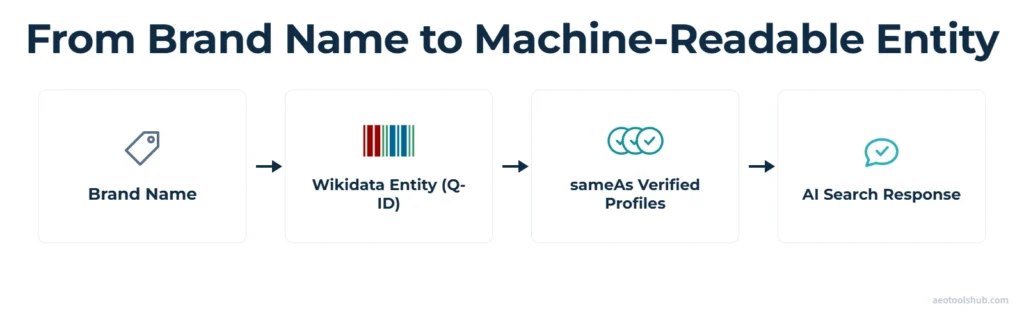
Practical minimum for most brands: name, url, logo, sameAs (linking every verified profile you have), and foundingDate if you have one worth stating. Add address if you have a real, checkable location. It’s a meaningful trust signal and costs nothing to include if it’s accurate.
If you’d rather not hand-code the JSON-LD, my JSON-LD Schema Generator builds Organization markup like this for you. Once it’s live, run the page through my Schema Markup Validator to confirm it parses cleanly before you move on.
The consistency audit that ties it together
None of the above works in isolation. An AI system builds its picture of your brand from all of these sources at once, and gaps or contradictions between them create exactly the kind of noise the getting-cited guide already warns about. Once you’ve got Organization schema live and a Wikidata item (and, if you’ve gone that route, a Wikipedia page), pull up each of the following side by side and check they tell the same story:
- Your own site’s Organization schema
- Your Wikidata item
- Google Business Profile
- LinkedIn company page
- Any review platform where you have a claimed, managed profile
Different founding years, different descriptions of what you actually do, inconsistent naming (is it “Acme” or “Acme Ltd” or “Acme Skincare”?). These are the small inconsistencies that dilute an entity profile without ever throwing an obvious error. Fifteen minutes checking all five against each other is worth more than most single-channel fixes on this list.
Set your timeline expectations honestly
This connects straight back to the two-clock argument in the LLMO piece: entity work, like training-data presence generally, moves on the slow clock, not the fast one. Getting an Organization schema live can influence how a retrieval-based engine reads your site within days. A new Wikidata item takes longer to get picked up and trusted. A Wikipedia page, if you clear that bar at all, feeds into a future model’s training run on whatever cadence that model happens to retrain on, which is months, not weeks. None of this is a lever to pull before a quarterly review and expect to see movement. It’s closer to reputation management than a campaign with a start and end date.
What doesn’t work
A few things worth naming directly, because they show up in a lot of “brand entity” advice that doesn’t hold up. Creating a Wikidata item with no references attached does close to nothing, it reads as unverified. Paying for a Wikipedia page through anyone who doesn’t mention paid-editing disclosure is a real risk, not a shortcut: undisclosed paid edits get reverted and articles deleted once discovered, and Wikipedia actively looks for exactly this pattern. And stuffing your own site’s Organization schema with unverifiable claims (an address you don’t operate from, a founding date that isn’t accurate) tends to get caught the moment it’s cross-checked against an independent source, which undermines the very consistency signal you’re trying to build.
Frequently asked questions
Does my brand need a Wikipedia page to be taken seriously by AI search?
No. Most brands cited well by AI engines don’t have one. It helps where it exists, but it’s the hardest, slowest, and most expensive item on this list. For most brands, Wikidata plus solid Organization schema is the more realistic path, and costs a fraction of the effort to pursue.
How long does a Wikidata item take to actually help?
There’s no fixed number, and treat any specific promise with suspicion. Creation itself takes an afternoon if you have your references ready. How long it takes to meaningfully shift how AI systems describe you is a slower, less measurable question, closer to months than days.
Can I create my own company’s Wikipedia page myself?
Technically yes, but it’s very strongly discouraged under Wikipedia’s conflict-of-interest guidance, and if you’re being paid to do it (including as an employee writing about your own employer), disclosure is mandatory, not optional. Most successful company pages go through a talk-page proposal or the formal Articles for Creation process rather than being published directly by someone connected to the subject.
What if a competitor has a Wikipedia page and we don’t?
That’s not automatically a gap worth closing. If your brand genuinely doesn’t clear WP:NCORP yet, trying to force a page through tends to end in rejection or, worse, a page that gets flagged and deleted later. Wikidata is the more realistic target until your brand’s independent coverage genuinely grows.
Where to start
If you take one thing from this: check whether your brand already has a Wikidata item before doing anything else, and if it doesn’t, that’s the highest-value hour you can spend from everything above. Wikipedia is worth revisiting once your independent press coverage is genuinely substantial, not before.