
FAQ Content Strategy for AEO and How to Target PAA
FAQ sections get treated as an afterthought bolted onto the bottom of an article. For AI citation, they’re one of the highest-leverage formats on the page, if you build them from real questions instead of guessed ones.
Aug 3, 2026 · ~6 min readMost FAQ sections are written last, in about ten minutes, from whatever the writer half-remembers people asking. That’s a waste, because a well-built FAQ section is one of the few content formats that maps almost exactly to how someone actually phrases a question to ChatGPT or Perplexity. A person doesn’t type “vitamin C serum” into an AI chat window, they type “does vitamin C serum actually brighten skin or is that marketing.” That’s a question, and a question-shaped answer is exactly what an FAQ entry already is, if it’s written properly.
Why FAQ content punches above its weight for AI citation
Every principle in my guide to getting cited by AI search engines comes down to giving a retrieval system a self-contained passage it can lift with confidence. A well-written FAQ entry is already in that shape by construction: a clear question, followed by a direct, complete answer, with no dependency on the paragraphs around it. You don’t have to engineer extractability into an FAQ entry the way you sometimes have to for a paragraph buried in the middle of an article, the Q&A format does most of the work for you.
That’s also why FAQ content survives a change that trips up people who think of it purely as an SEO tactic. Google stopped showing FAQ dropdown rich results in search entirely as of 7 May 2026.1 I go through exactly what did and didn’t change in the schema markup guide, the short version is that the SEO reward changed but the AEO reward didn’t: leaving FAQPage markup in place doesn’t cause any problem, per Google’s own guidance, and every AI engine outside Google’s own search product never depended on that dropdown to begin with, they read the Q&A content directly.
Sourcing real questions, not guessed ones
The single biggest quality gap between a good FAQ section and a bad one is where the questions came from. A bad FAQ section is five questions the writer invented to look thorough. A good one is built from questions real people actually asked, in their own words.
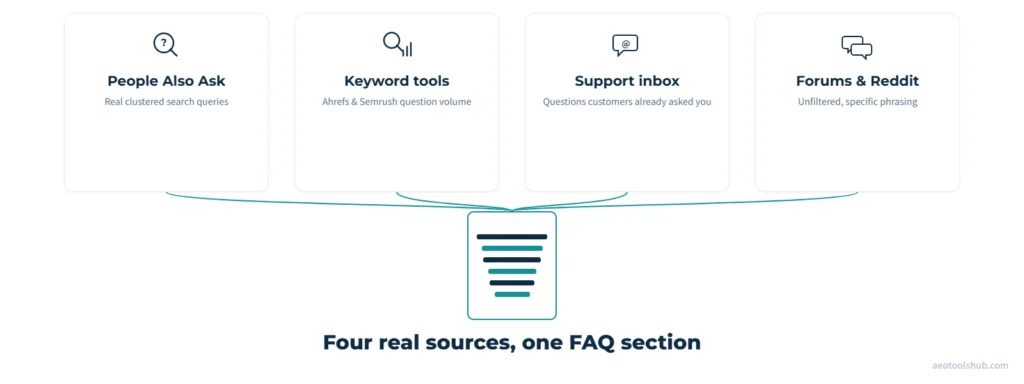
Google’s “People Also Ask” box is the most direct source, since every question in it comes from real search queries Google has clustered around your topic, not an algorithm guessing what people might ask. Tools like AlsoAsked exist specifically to pull and map this data at scale, including the second and third layer of follow-up questions that only appear once you click into the first ones. For a skincare brand, that might surface something like “can you use vitamin C and retinol together” nested under a broader “vitamin C serum benefits” query, a genuinely useful, specific question a writer working from memory would probably miss.
Keyword research tools are the second source, and they add something AlsoAsked doesn’t: search volume. Ahrefs’ Keywords Explorer has a dedicated Questions report, and Semrush’s Keyword Magic Tool has a Questions filter, both surfacing question-phrased keywords clustered around a seed term, with volume and difficulty attached. That’s useful for prioritisation specifically: AlsoAsked tells you a question exists, these tools tell you roughly how many people are actually typing it, which matters when the list needs trimming down to the ones worth answering first.
Your own customer support inbox is the third source, and it’s underused. The questions customers actually email or message you about are, by definition, questions your existing content hasn’t answered clearly enough. If five people in the last month asked whether your vitamin C serum is safe during pregnancy, that’s not a hypothetical FAQ entry, it’s a documented gap.
Reddit threads and community forums round this out, for the same reason they matter elsewhere in AEO: the phrasing is unfiltered and specific in a way marketing copy never is. Someone asking “does this actually work or is it just TikTok hype” in a skincare subreddit is asking a real question in real language, worth capturing close to verbatim rather than sanitised into something blander.
Writing an answer that survives being lifted out of context
Once you have real questions, the answer needs the same discipline covered in the AEO pillar: direct, complete, and understandable with nothing else around it.
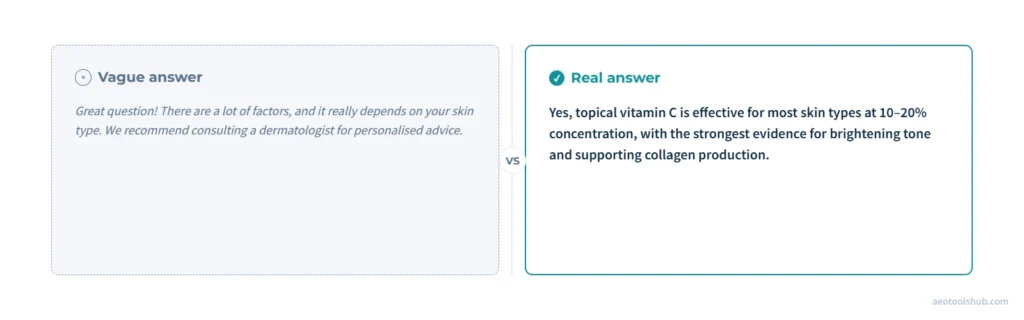
Before, a fairly typical FAQ answer:
“Great question! There are a lot of factors that go into how effective a vitamin C serum can be, and it really depends on your skin type and the specific formulation you’re using. We recommend consulting with a dermatologist for personalised advice.”
That’s not an answer, it’s a way of avoiding one. It gives an AI engine nothing to cite, because there’s no actual claim in it.
After:
“Yes, topical vitamin C is effective for most skin types when formulated at 10-20% concentration, with the strongest clinical evidence for brightening uneven skin tone and supporting collagen production. Sensitive skin should start at the lower end of that range, since higher concentrations can cause irritation in the first two to three weeks of use.”
Same underlying honesty (it does depend on skin type), but stated as a real answer with real information instead of a shrug dressed up as customer care.
Implementation: how this actually gets built on the site
On this site, FAQ sections are hand-written HTML, not Rank Math’s native FAQ block, since I wanted the accordion styling shown in the examples above. The trade-off: Rank Math only auto-generates FAQPage schema for its own native block, so a hand-written accordion gets nothing for free by default. I built a small snippet that parses that markup and outputs the FAQPage schema separately instead, the technical detail is covered in the schema markup guide. If you use Rank Math’s native FAQ block instead of a custom accordion, you get that schema automatically with no extra step, that’s the simpler default if you don’t need custom styling. If you’re not on WordPress or Rank Math at all, the underlying principle still holds: most SEO plugins and headless CMS setups offer some way to generate FAQPage JSON-LD from your FAQ content, and if yours doesn’t, hand-coding it is a small, one-time technical task rather than a reason to skip FAQ content altogether.
Two content mistakes matter more than the schema mechanics either way: don’t write FAQ answers that contradict or oversimplify what the body copy says, an AI engine or a rich-result crawler reading both should find the same claim in each, and don’t duplicate the exact same question-and-answer pair across multiple pages competing for the same query, which just makes it unclear which page should get credited for the answer.
What to avoid
A few habits that quietly undermine an otherwise solid FAQ section. Restating the article’s headline as a question (“What is vitamin C serum?” on an article whose H1 already answers that) wastes a slot that could hold a genuinely new question. Answering in a single vague sentence just to hit a target FAQ count produces exactly the kind of unextractable, uncitable content the format is supposed to avoid. And scattering near-identical questions across several articles on the site, rather than picking the one page that should own a given question and linking to it from the others, splits whatever authority that question could build in one place.
FAQ
Do I still need FAQ schema now that Google dropped the rich-result dropdown?
Keep it if the content is genuinely useful to readers or AI engines, drop it if you were only maintaining FAQ entries to chase the old dropdown. Leaving the markup in place doesn’t cause any problem per Google’s own guidance, and every non-Google AI engine reads the Q&A content directly regardless of schema.
How many FAQ entries should one article have?
As many as answer a genuinely distinct, real question, and no more. Three focused entries sourced from actual PAA data or support tickets outperform eight generic ones written to look comprehensive.
Can two different articles on the same site answer the same FAQ question?
Better to pick the page that should own that question, answer it there in full, and reference it from other relevant pages once both are live, rather than duplicating the same answer twice.
Should FAQ answers be written differently for AI engines versus human readers?
Not really, the same discipline (direct, complete, self-contained) serves both. If anything, writing for extraction tends to make an answer more useful for a human skimming the page too.