
In our AEO vs GEO vs SEO piece, I took the position that AEO and GEO are mostly the same discipline with two different names. That’s still where I land, and I said there too that it’s my stance in a live industry debate, not a settled one. What neither side of that debate accounts for is a third mechanism that doesn’t fit under either label, and it’s becoming too important to keep folding into “AEO/GEO” as if it’s the same lever.
Ask ChatGPT or Claude something about your brand with browsing switched off, no search, no live fetch, and you’ll get an answer built entirely from whatever was baked into the model when it was last trained. That’s not AEO working badly. It’s not GEO at all. It’s a different question: is your brand actually inside the corpus the model learned from? That question has a name now: LLMO, LLM Optimisation. It’s worth understanding on its own terms, because the mechanics, and the timeline, are nothing like the AEO/GEO work most of us are already doing.
What the original GEO paper actually optimises for
Before getting to LLMO, it’s worth being precise about what GEO was actually defined to mean, because the term has drifted a long way from its source. Generative Engine Optimization comes from a 2024 paper by researchers at Princeton, Georgia Tech, Allen Institute for AI and IIT Delhi, accepted at ACM SIGKDD.1 Their own framing: GEO is “a novel paradigm to aid content creators in improving their content visibility in generative engine responses,” tested against a benchmark of real user queries and the web sources those queries retrieve.1 Retrieve is the operative word. Every experiment in that paper concerns content that gets fetched, in response to a query, at the moment the model runs.
The academic definition is entirely retrieval-time, the same domain AEO already covers on this site. It’s the colloquial, industry use of “GEO” that’s drifted wider: when an agency’s “GEO strategy” quietly folds in Wikipedia and PR work aimed at what a model has memorised, that’s a reasonable thing to want, it’s just not what the academic term described, and conflating retrieval-time work with training-data work makes it harder to set the right expectations for either one.
The gap neither AEO nor GEO covers
Every AI engine works from two separate stores of information, and they behave completely differently. One is retrieval: whatever the engine fetches live from the web to answer a specific query. This is what AEO and GEO both target, and it’s why our own AEO vs GEO vs SEO piece treats them as basically the same job. The other is the model’s own training data, the fixed snapshot of text it learned from before it was ever deployed, and that’s a different problem entirely.
A model answering purely from training data isn’t checking the web for your latest press release, your updated pricing page, or the client testimonial you published last month. It’s reproducing whatever pattern of facts about your brand existed in whatever it read during training, which could be a year old or more by the time you’re reading this. Get your retrieval-side AEO/GEO perfect and you still won’t move that answer, because nothing about retrieval touches it.
Why this is a timeline problem, not just a definitional one
The practical reason this distinction earns its own name is speed. Training-data baselines update only when a model is retrained or fine-tuned, and that cycle runs in months, not days, major model versions have historically shipped on a cadence of roughly six to twelve months apart, and OpenAI’s own model documentation lists a training cutoff months before the model it powers ever reaches a user.2 Retrieval-based engines work on an entirely different clock: a new, authoritative page can start shaping a live-search answer within hours of publishing.2
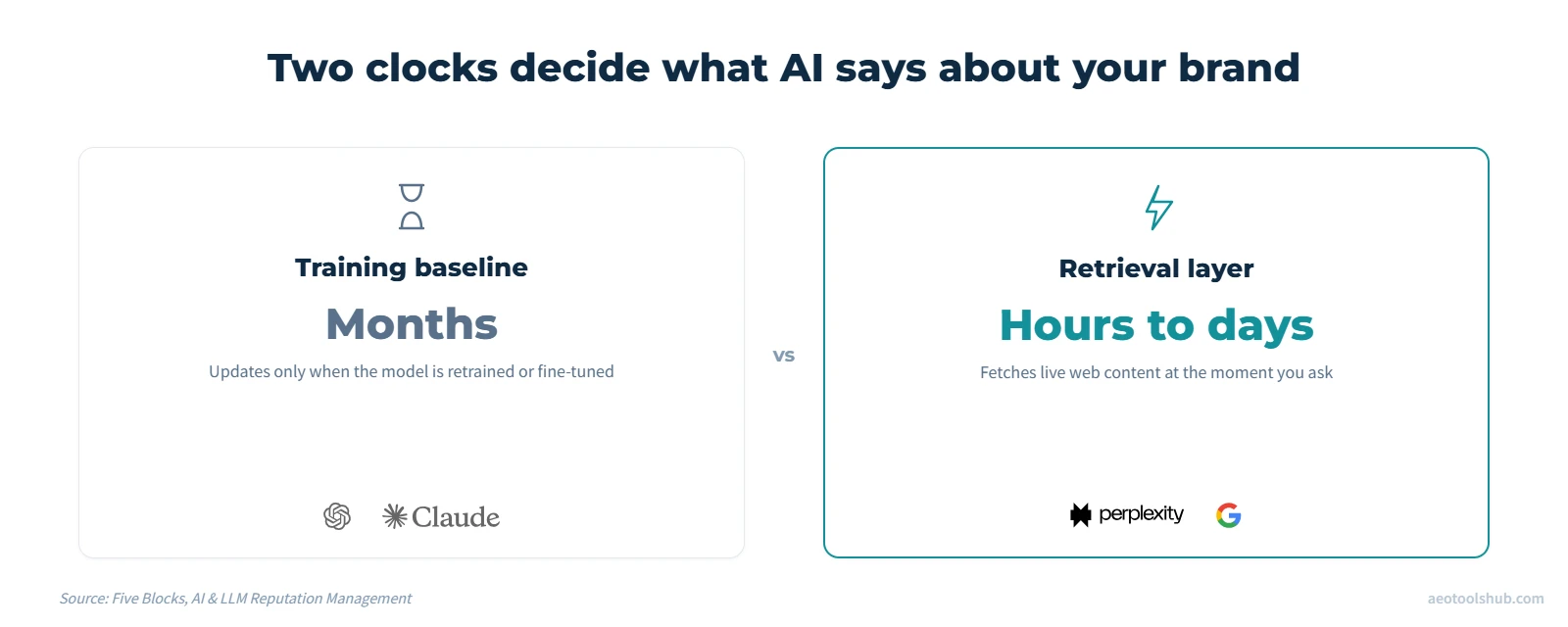
* Simplified for clarity: ChatGPT also has a retrieval-first mode, ChatGPT Search, which behaves like the right-hand card here rather than the left. This illustration groups it with the training baseline because that is the default chat experience most people mean when they ask what ChatGPT "knows" about a brand.
That gap changes how you should plan, not just how you should talk about it. Push a strong piece of digital PR today and a retrieval-heavy engine like Perplexity or ChatGPT Search can reflect it within days, which is exactly the timeline our own digital PR guide is built around. The same coverage won’t touch a model answering from pure training memory until that model’s next training run, whenever that happens to land. If a client asks why their brand still doesn’t come up when someone asks ChatGPT without web access enabled, despite a strong quarter of AEO wins, this is usually the honest answer: you’ve been optimising the fast clock, and they’re asking about the slow one.
What actually gets you into the training corpus
Nobody outside the AI labs knows precisely what’s in any model’s training mix or how heavily each source gets weighted, so treat everything below as informed probability, not a guaranteed formula. With that caveat, Wikipedia sits well above everything else. OpenAI’s GPT-3 drew roughly 3% of its training tokens from English Wikipedia, and Meta’s LLaMA models allocated around 4.5%, small-sounding percentages that are still enormous relative to almost any other single source, and an Allen Institute for AI analysis found Wikipedia to be the second-largest text source in Google’s own C4 training dataset.3 That weighting shows up on the retrieval side too: one analysis of roughly 680 million ChatGPT citations found Wikipedia accounted for nearly half, 47.9%, of the platform’s ten most-cited sources.3 Different mechanism, same underlying signal: models are built to lean on Wikipedia hard, both in training and in what they choose to fetch.
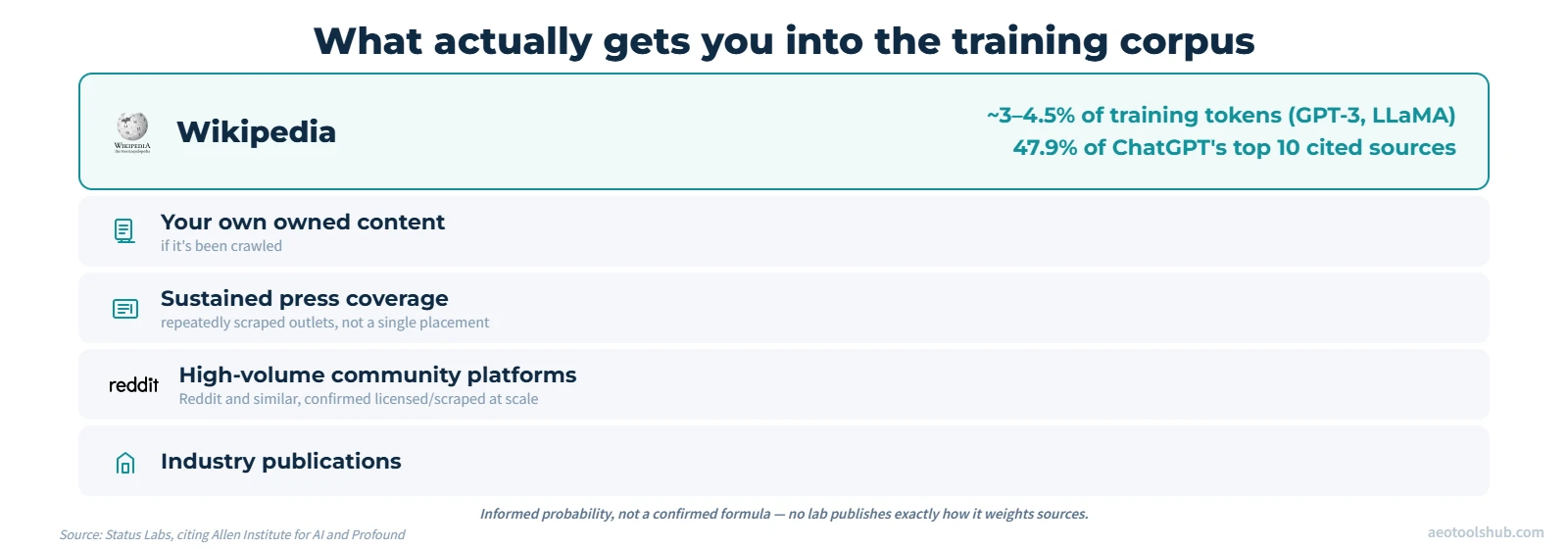
Below Wikipedia, the pattern is less precisely measured but consistently reported: your own owned content (if it’s been crawled), sustained press coverage in outlets that get scraped repeatedly rather than a single placement, and high-volume community sources like Reddit, which multiple labs have confirmed licensing or scraping at scale. None of this is a checklist you complete once. It’s closer to reputation management than a technical audit, the same discipline that goes into an actual Wikipedia notability case: consistent facts, credible sourcing, no promotional language. I’m deliberately not turning this into a Wikidata and schema how-to here, that’s a deep enough topic to deserve its own guide, coming later. For now, the point is narrower: know this lever exists, know it’s slow, and don’t expect your AEO/GEO checklist to move it.
What this actually means for how you plan
Practically, this argues for running two tracks with two different expectations, not picking one. Keep doing the AEO/GEO work, technical access, content structure, digital PR, entity disambiguation, because it moves the retrieval-based answers most people actually see, and it moves them fast. Alongside it, treat LLMO as the slow, compounding track: sustained, high-quality press coverage, a clean and well-sourced Wikipedia presence if your brand clears the notability bar, and consistency in how your brand is described across the sources most likely to end up in a future training run. Measure it on a different clock, and don’t panic if a quarter of solid work doesn’t move a training-based answer, that’s not how this lever works.
If there’s one thing worth taking from this, it’s that “not showing up in AI” isn’t one problem. It’s at least two, they respond to different work, and they resolve on different calendars.
FAQ
Is LLMO just a rebrand of GEO?
No. GEO, by its own original definition, is about content that gets retrieved and cited at the moment a generative engine answers a query, the same retrieval-time mechanism AEO targets. LLMO is about whether your brand exists inside the fixed training data a model learned from before it was ever deployed, a separate store of information that retrieval-side work doesn’t touch.
How long before my brand shows up in ChatGPT’s or Claude’s training data?
There’s no guarantee it ever does, and no public confirmation of exactly how any lab selects or weights sources. What’s known is the mechanism: training-data baselines only change when a model is retrained, a cycle that has historically run every six to twelve months for major model versions, so the honest answer is “at least until the next training cycle,” not a fixed number of weeks.
Should I prioritise AEO/GEO or LLMO?
Both, run in parallel, but with different expectations. AEO/GEO work can move retrieval-based citations within days to weeks. LLMO is a slower, compounding investment, sustained press coverage, Wikipedia presence, consistent entity signals, that pays off over a much longer horizon and shouldn’t be judged against the same short-term metrics.
Does having a Wikipedia page guarantee my brand appears in AI training data?
No. Wikipedia is disproportionately represented in the training data of major models and in what they cite live, so it meaningfully raises the odds, but it’s one input among many, and there’s no confirmed guarantee any specific source makes it into any specific future model.