
Open any AI visibility dashboard and three numbers stare back at you: visibility score, share of voice, and citation rate. They are the three you will find in almost every tool on the market, which is why they are where I always start with clients.
They are not the only metrics worth knowing, and I will get to a few more later in this piece. But most clients cannot distinguish between the three yet, treating them as three ways of saying the same thing. They are not.
I have watched a client’s share of voice climb for a month while their actual visibility stayed flat, and the only reason anyone noticed was that we were tracking both instead of reporting whichever number looked best that week.
This is the deeper dive behind the short version in How to Measure Your Brand’s AI Visibility. Each metric answers a genuinely different question, and knowing which one to trust for which decision is most of what separates a useful report from a vanity number.
Visibility score
Visibility score measures how often your brand shows up at all, across a defined set of prompts and AI engines, regardless of who else shows up alongside you. It is the closest thing this space has to an absolute number: run the same prompts, count how many responses mention you, and you get a figure that does not shift just because you changed who you are comparing yourself to.
That is exactly why I treat it as the primary metric. It is not perfect, AI answers are still probabilistic and move around run to run, but it is measuring one thing and one thing only: are you part of the conversation. Everything else on this page is really a layer of context on top of that baseline question.
One caveat: do not stop at a single blended score for the whole brand. Break it down by topic or product line before you trust it. Aleyda Solis makes this point well in one of the more rigorous AI search measurement frameworks I have read: AI outputs are dynamic enough that topic-level aggregation is what gives you a reliable trend, not one number averaged across everything you track. A brand can look solid overall while being close to invisible on the one product line that actually pays the bills, and a single blended score hides that every time.
Share of voice
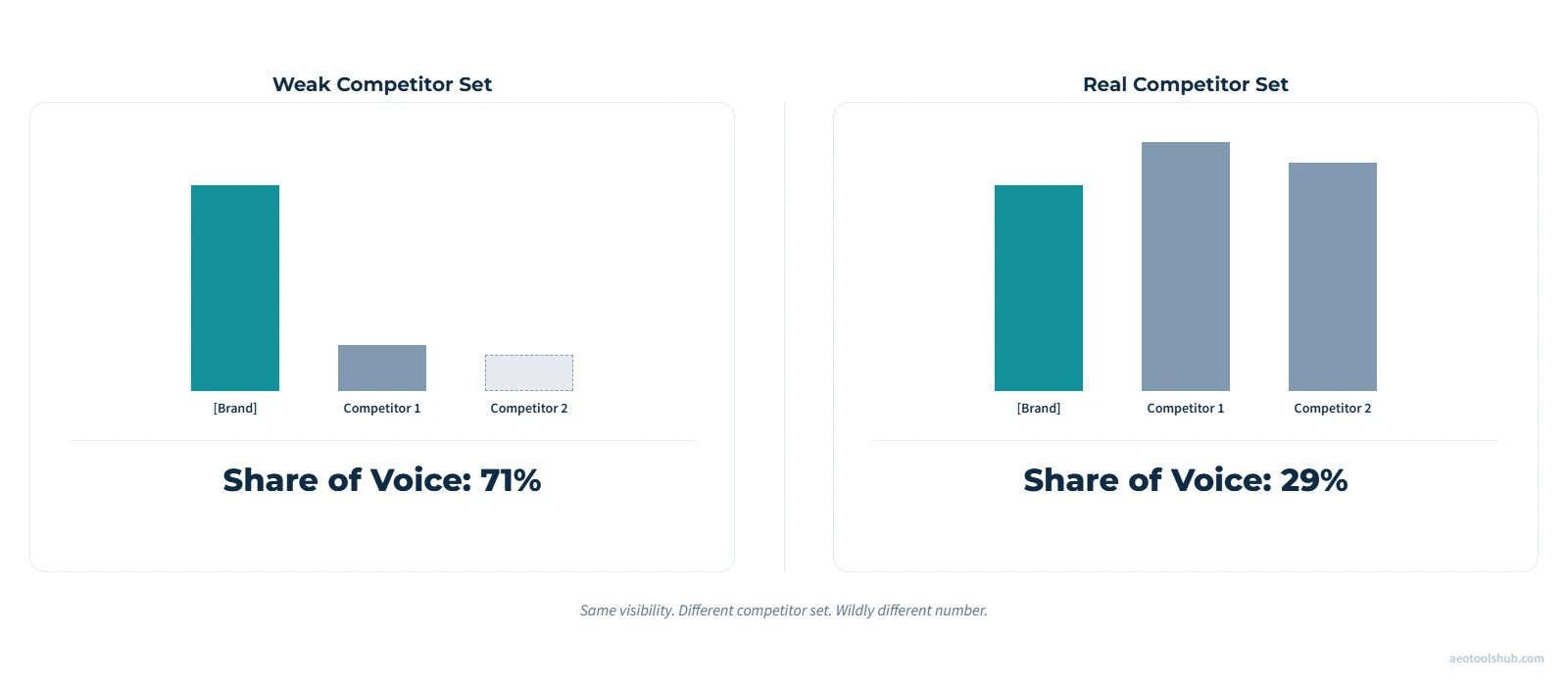
Share of voice measures your slice of the conversation relative to the competitors you have selected: what percentage of brand mentions across your prompt set belong to you versus everyone else in the list. On paper it sounds like a cleaner, more strategic number than visibility score. In practice, it has a structural problem that most dashboards do not surface: the result depends entirely on who you put in the competitor list.
Unlike a traditional keyword-based share of voice, where the denominator is a list you defined and can audit, AI share of voice is computed against a competitor set you also defined, which means two brands in the same market can report wildly different numbers just by picking different lists. Add a competitor with a strong real presence and your share looks worse. Remove one and it improves overnight, with nothing about your actual standing changing at all.
I have seen this play out for real. On one project, the tracked competitor set had never been updated to include the client’s biggest real rival, the one with the most retrieval and citations in that category, and only listed two much smaller names. That kept the client’s reported share of voice comfortably high every single week. Visibility itself was flat. The dashboard said otherwise, because the denominator was soft. Nobody was lying, the number was just measuring the wrong thing.
Use share of voice as context, never as a standalone verdict. It is useful for understanding relative position within a competitor set you trust, and close to meaningless the moment that set is unbalanced.
Citation rate
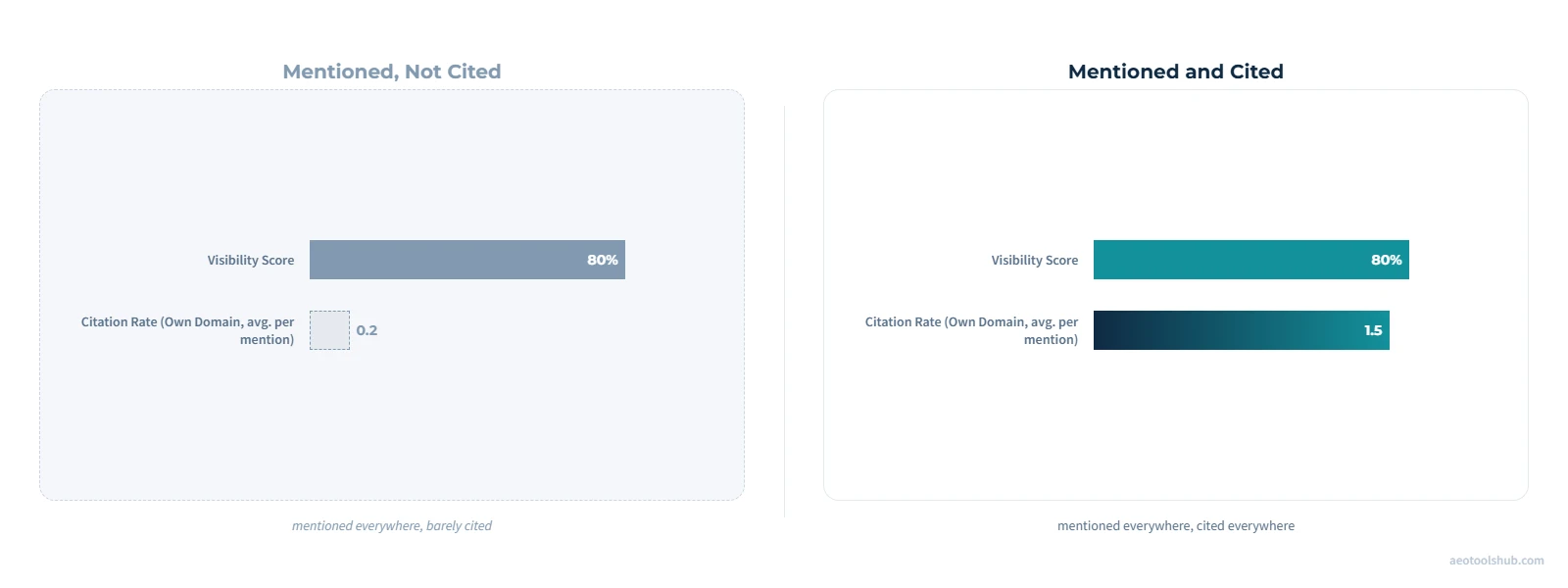
Citation rate answers a different question again, and it is the one clients understand least. It does not measure whether your brand name gets mentioned. It measures how often your own domain specifically gets pulled in and cited as the source behind an answer. Most AI engines answer through retrieval-augmented generation: they pull in real content from the web before generating a response, then cite what they actually used. Citation rate tells you how often that retrieved, cited content was yours.
The gap between visibility score and citation rate is one of the most useful diagnostics in this whole data set. A brand can have solid visibility and a weak citation rate on its own domain at the same time, and that combination means something specific: the AI knows who you are, but it is reading about you somewhere else, a review site, a forum thread, a competitor’s comparison page, rather than from your own content.
That distinction matters more than it sounds like it should. Your own site is the one channel you fully control. Third-party mentions, especially user-generated content like Reddit threads or forum posts, you can influence at best, and in plenty of cases cannot control at all. A brand earning citations on its own domain is writing its own narrative. A brand that only shows up through other people’s pages is borrowing one, and has to hope whoever wrote it got the story right.
Quick reference: which metric for which question
| Metric | What it actually measures | When to trust it |
|---|---|---|
| Visibility score | How often you are mentioned at all, across your tracked prompts | Always. It is the primary trend line, least distorted by setup choices. |
| Share of voice | Your share of mentions relative to the competitors you selected | Only alongside a competitor list you trust. Never on its own. |
| Citation rate | How often your own domain is retrieved and cited as the source | When deciding whether to invest in your own content versus PR and third-party coverage. |
Beyond the big three
Visibility score, share of voice, and citation rate are what you will find in almost every AI visibility tool on the market. They are not the only way people are trying to measure this space, and I think it is worth knowing what else is out there, even if you never add a single one of these to your own dashboard.
Aleyda Solis published a measurement framework earlier this year that goes further than most, and three of her metrics are worth borrowing even if you never adopt her full system. Recommendation rate looks at how often the AI actively suggests your brand rather than simply naming it, calculated as recommended appearances divided by total appearances. Comparative win rate looks specifically at head-to-head prompts, the “X versus Y” kind, and measures how often you come out ahead. Representation accuracy checks whether the AI is describing you correctly when it does mention you, which matters more than people assume once you start reading transcripts and finding your own product described wrong.
I like all three because they answer a different question than visibility score does. Visibility score tells you whether you are in the room. These tell you whether you are being taken seriously once you are there.
You will also see people talk about “share of answer” instead of share of voice, the idea being that owning the actual answer is a different thing from simply appearing somewhere inside it. I think the distinction is real, but it still shakes out to the same practical advice: read it alongside visibility score, never alone. You will also increasingly see vendors bundle everything, mentions, citations, position, sentiment, into one composite “AI visibility score” out of 100. I am not a fan. Every vendor weights the ingredients differently, so a 72 from one tool and a 72 from another are not the same number, the same problem domain authority has always had in classic SEO. Useful as a trend line inside one tool. Close to useless for comparing across tools.
Frequently asked questions
Which metric should I put in a client report as the headline number?
Visibility score. It is the number least affected by setup decisions like competitor selection, so it is the one that holds up as a trend line over time without needing constant caveats.
Can share of voice go up while visibility score goes down?
Yes, and it happens more often than clients expect. If a competitor’s own visibility drops faster than yours, your share of that shrinking pie can rise even while your absolute presence is flat or falling. Always read the two together.
Is a low citation rate always a problem?
Not automatically, and it depends on the type of prompt. On factual, informational prompts, a low citation rate alongside solid visibility usually does mean your content is not structured in a way AI engines want to retrieve and cite directly, a fixable, content-level issue. On comparative prompts, the “X versus Y” or “best X for Y” kind, third-party sources such as Reddit, forums, and review sites often win the citation no matter how well your own content is built, simply because a product page cannot argue against itself the way an independent comparison can. Fix extractability for the first case. For the second, the lever is earning coverage on the third-party sources already dominating that query type, not rewriting your own page.
Next steps
- 1Pull all three metrics for the same period. Never report one in isolation, since each one can tell a different, equally true story.
- 2Sanity-check your competitor list before trusting share of voice. If a competitor on the list has weak real presence, fix the list before fixing your strategy.
- 3Treat a visibility-citation gap as a content task, usually. On informational prompts, it typically means your own site is not the thing being retrieved, a fixable, structural problem. On comparative prompts, third-party sources often win the citation regardless, so look at PR and reviews instead.
Once you are tracking all three consistently, the next step is making sure you are comparing them against a baseline that actually means something. See How to Set Up an AI Visibility Baseline for how to build one that holds up under scrutiny.