
Best AI Visibility Tracking Tools in 2026
12 tools that track how ChatGPT, Perplexity, Gemini and Google AI Overviews mention your brand — grouped by type, with who each one actually suits.
Jul 5, 2026 · ~9 min readI get asked “what’s the best AI visibility tool” at least once a week now, usually by someone who wants a single name they can go and buy. I never give them one. Not because I’m dodging the question, but because it’s the wrong question.
There isn’t a best AI visibility tool. There are three different categories of tool, built to solve three different problems, and most of the “best tools” roundups you’ll find rank all 12 of them on one axis (price, usually, or a feature checklist) as if a dedicated AI-visibility platform and an SEO suite with an AI tab bolted on are interchangeable. They aren’t. I’ve used several of these myself for client work, and the ones that disappoint people almost always disappoint them because they bought the wrong category, not the wrong tool within the right one.
This guide sorts all 12 tools I’m tracking into their real categories, tells you who each one is actually built for, and points you to the category to start with based on what you’re trying to do. If you want the criteria for evaluating a tool once you’ve picked a category, that’s a separate guide — how to choose an AI visibility tracking tool. If you want the full side-by-side directory, it’s at /ai-tools-overview/.
Key takeaways
- There are three categories of AI visibility tool, not one flat market: dedicated platforms, SEO suites with AI features added, and content/ops platforms with tracking built in.
- Picking the wrong category wastes more time and budget than picking the wrong tool within the right category.
- Solo brands and agencies managing multiple clients have different “right” starting points — see the recommendations below.
- Every tool on this list is dated and sourced to its own pricing page. Pricing on these tools moves fast, so treat the figures here as a snapshot, not gospel — check the live page before you buy.
- Reviews are rolling out one at a time on a fixed testing protocol, roughly one every 4-6 weeks, starting with Peec.ai. Until a review is live, “review coming soon” is honest, not a placeholder we forgot to fill in.
Why “best AI visibility tool” is the wrong first question
Ask ten people what an AI visibility tool should do and you’ll get ten different answers, because “AI visibility” means different things depending on who’s asking. A solo Amazon seller wants to know if ChatGPT mentions their brand at all. An agency wants to run that same check across fifteen client brands without paying for fifteen separate accounts. A content team wants visibility tracking to sit inside the same workflow where they’re already producing pages.
Those aren’t feature differences. They’re different products wearing the same “AI visibility” label. So before I get into the 12 tools, here’s the model I actually use when someone asks me for a recommendation.
The three categories of AI visibility tool
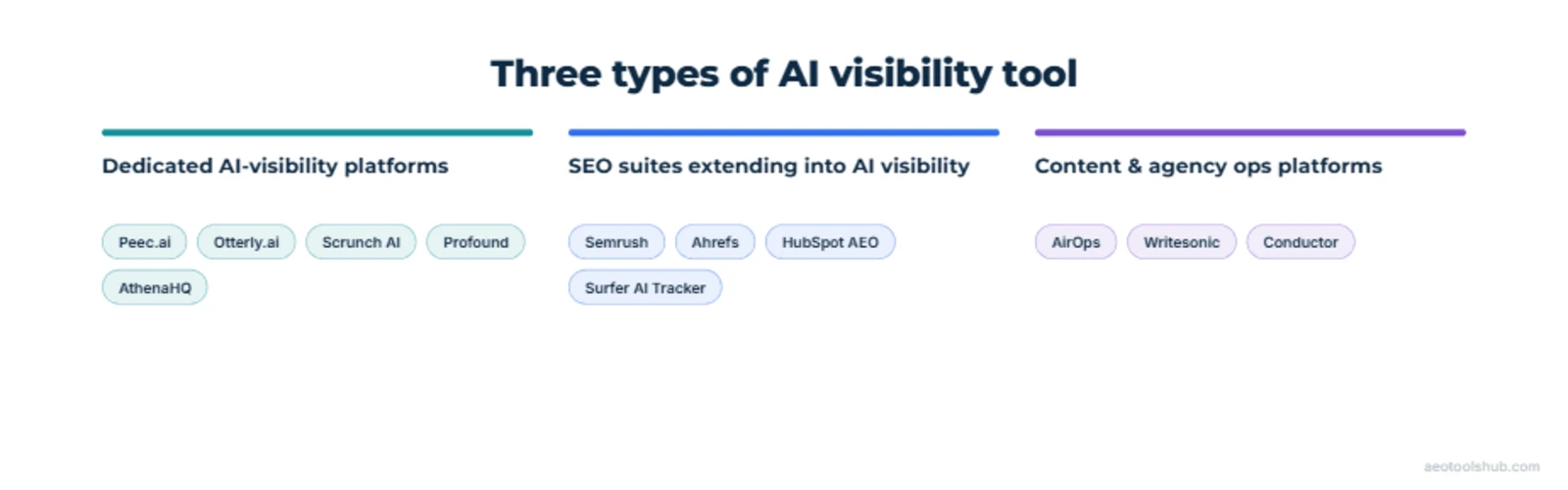
Dedicated AI-visibility platforms — built for one job
Peec.ai, Otterly.ai, Scrunch AI, Profound, AthenaHQ
This is the category most people picture when they say “AI visibility tool.” These platforms exist to do one thing: track prompts across multiple AI engines and report back on visibility, share of voice, sentiment and, on the better ones, exactly which sources got cited. Depth is the selling point. If citation-level detail matters to you, this is almost always where you end up.
SEO suites extending into AI visibility
Semrush, Ahrefs, HubSpot AEO, Surfer AI Tracker
These are tools you may already pay for, with an AI-visibility module added on top. The pitch here isn’t depth, it’s consolidation — one login instead of two. That’s a genuinely good pitch if you’re already a Semrush or Ahrefs customer and just want a sanity-check number. It’s a worse pitch if AI visibility is your primary job, because these modules tend to be shallower than the dedicated platforms on citation-level detail.
Content & agency ops platforms with visibility tracking built in
AirOps, Writesonic, Conductor
Here, visibility tracking is one module inside a bigger content production or enterprise workflow tool. You’re not buying a tracker, you’re buying a production platform that happens to also tell you whether the content it’s producing is showing up in AI answers. Makes sense if you’re already running content at scale through one of these; overkill if you just want a number.
The 12 tools, one line each
Pricing and access details below are what each vendor publishes today. I’ve linked every tool to its own pricing page rather than a reseller or comparison site — check it directly before you commit, since these tiers change often (this is also just good practice generally, and one of the more consistent findings from people who’ve actually poked at how AI engines read pricing pages: if a vendor hides its numbers behind JavaScript, even the AI engines struggle to read them, let alone a human trying to compare five tools at once).
| Tool | Category | Access model | Starting price |
|---|---|---|---|
| Peec.ai | Dedicated platform | Free trial, no card required | €85/mo (50 prompts) |
| Otterly.ai | Dedicated platform | 14-day free trial, no card required | $29/mo (15 prompts) |
| Scrunch AI | Dedicated platform | 7-day free trial | $250/mo (350 custom + 1,000 industry prompts) |
| Profound | Dedicated platform | Self-serve trial on Starter and Growth; demo only for Enterprise | Starter $99/mo, Growth $399/mo; Enterprise custom |
| AthenaHQ | Dedicated platform | Free tier plus self-serve paid tier | Free (300 credits), then $295/mo (3,600 credits) |
| Semrush AI Visibility Toolkit | SEO suite add-on | Requires active Semrush plan | $99/mo add-on |
| Ahrefs Brand Radar | SEO suite add-on | Requires active Ahrefs plan | $398/mo per platform, or $699/mo bundled |
| HubSpot AEO | SEO suite add-on | Free grader (one-time) + paid tier | $50/mo (25 prompts) |
| Surfer AI Tracker | SEO suite add-on | Standalone Pro/Peace of Mind plans, billed yearly | $182/mo (50 prompts) |
| AirOps | Content/ops platform | Free-to-start Solo tier | $0/mo entry (Solo); paid-tier pricing not published |
| Writesonic | Content/ops platform | Included from entry tier | $79/mo (Starter tier, 50 prompts) |
| Conductor | Content/ops platform (enterprise) | 3-week free trial, no card required | Custom quote only (annual contracts typically $27k–$150k+) |
Prices above are shown in each vendor’s own billing currency, not converted — most of these tools charge in USD, but Peec.ai bills in EUR. Check the linked pricing page for your local currency and the current rate.
Reviews are being rolled out one at a time on a fixed testing protocol, roughly one every 4-6 weeks rather than all at once — see the note below on how we’re approaching this. Until a tool has a published review, treat the summary above as directory-level, desk-research information, not a hands-on verdict.
Which category should you start with?
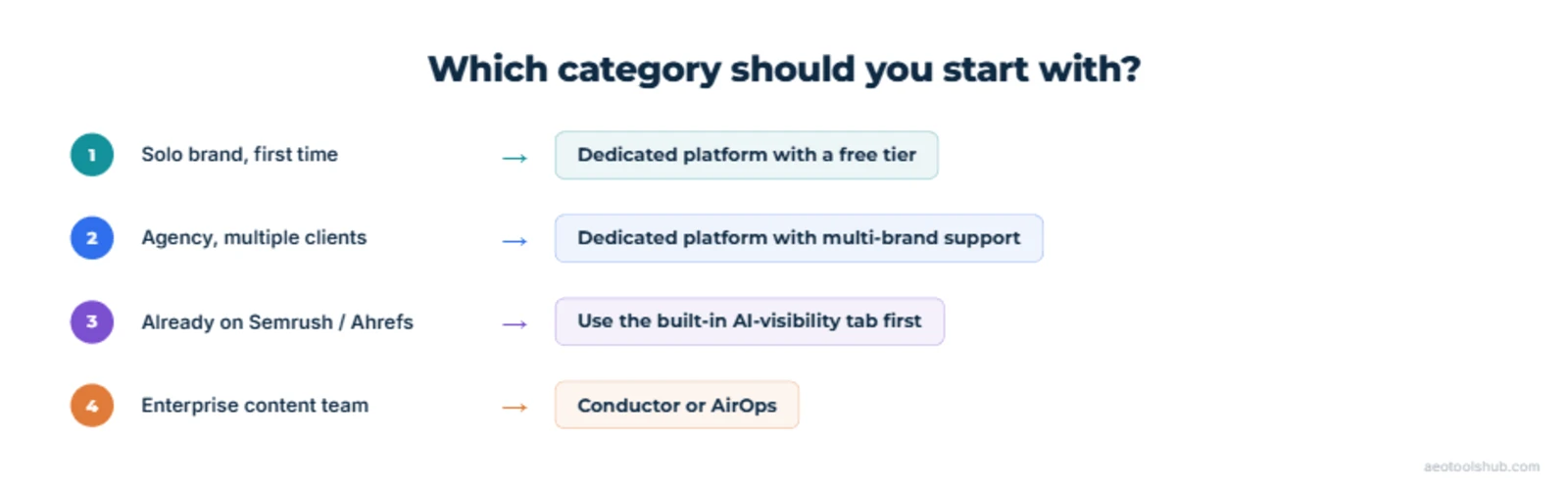
I’ll give you a straight answer instead of “it depends,” because in practice it doesn’t depend on much:
- Solo brand or first-time buyer → a dedicated platform with a usable free tier. Peec or Otterly, not an SEO suite add-on. You need to see what “AI visibility” even looks like for your brand before you decide how deep to go.
- Agency managing several client brands → a dedicated platform with genuine multi-brand or agency pricing (Peec and Otterly both have agency tiers; Scrunch does too). This is the single biggest differentiator if that’s your situation, and it’s worth checking explicitly rather than assuming any “AI visibility tool” scales to ten client accounts cleanly.
- Already paying for Semrush or Ahrefs → try the built-in AI-visibility module first. Don’t buy a second tool until you’ve confirmed the one you already own isn’t enough.
- Running content production at real scale → Conductor or AirOps, where visibility tracking plugs into a workflow you’re already running rather than sitting in a separate tab you have to remember to check.
How we’re reviewing these tools
Worth being upfront about this: we’re not testing all 12 tools simultaneously and publishing a synchronized shootout. That’s a less honest approach than it sounds, since AI-visibility data shifts day to day and no credible review site freezes an entire category on one day anyway. Instead, each tool gets tested on a fixed protocol (same benchmark brand, same core prompt set, same scoring criteria) and reviewed on its own, dated, on a rolling drip of roughly one new review every 4-6 weeks rather than a synchronized one-time snapshot, with each review carrying its own re-verification date. Tools with no accessible self-serve trial get reviewed from documentation and verified third-party sources, and we say so explicitly rather than pretending otherwise.
Peec.ai is first, since it’s the tool I use daily on real client work rather than a rushed trial account.
Frequently asked questions
Do I need more than one AI visibility tool?
Usually not to start. One dedicated platform, chosen for the right category, covers most brands’ needs. Multiple tools make sense once you’re validating data across engines the way we do for reviews, or once you’ve outgrown one tool’s coverage limits.
What’s the difference between an AI visibility tool and a rank tracker?
A rank tracker measures where you sit in traditional search results. An AI visibility tool measures whether and how you’re mentioned inside an AI-generated answer, which is a different retrieval and citation mechanism entirely — Google Search Console and standard rank trackers won’t show you any of this.
Are free tiers enough to get started, or do I need to pay immediately?
Free tiers and trials are enough to answer the first question that matters: does this category of tool even show you anything useful for your brand? Treat the trial period as a test drive, not a long-term measurement plan — most free tiers cap prompt volume too low for ongoing tracking.
How often should I re-check which tool is right for me?
This market moves fast enough that a yearly check is reasonable, and sooner if your situation changes (you start managing more brands, a competitor’s tool ships a feature you actually need, or your current tool’s pricing tier no longer fits your prompt volume).
Do these tools track Amazon’s own AI features, like Rufus, or just ChatGPT, Perplexity and Gemini?
Coverage varies and is worth checking directly against each vendor’s current engine list before assuming — this is a fast-moving area and we’ll cover it in more depth once our Amazon/e-commerce AEO guides are live.
Next steps
- 1Pick your category first, using the four profiles above, before you look at a single tool’s feature list.
- 2Trial one tool in that category, using its free tier or trial, on your own brand’s real prompts, not a generic demo query.
- 3Check the buyer’s guide for the specific criteria to run through during that trial — how to choose an AI visibility tracking tool.
- 4Come back to the full directory at /ai-tools-overview/ as reviews publish — it’s the source of truth for what’s actually been tested versus what’s still desk research.
- 5Once a tool is running, measure properly — see how to measure your brand’s AI visibility and what each metric actually tells you before drawing conclusions from the first week of data.